

Society
Human Rights

Policy
Policy (our fundamental view)
Based on our Corporate Philosophy of “Contributing to humanity and society as a corporate group that creates new value through the power of chemistry, from the biosphere to outer space,” we have clearly stated “respect for human rights” in our Basic CSR Policy and NOF Group Corporate Code of Ethics, and are promoting initiatives to respect human rights. As the NOF Group expands its business globally, we support and respect international norms such as the ILO Declaration on Fundamental Principles and Rights at Work, OECD Guidelines for Multinational Enterprises on Responsible Business Conduct, the UN International Bill of Human Rights, the UN Guiding Principles on Business and Human Rights, the Ten Principles of the UN Global Compact, and the Government of Japan’s National Action Plan on Business and Human Rights. To fulfill our responsibility to respect human rights throughout all corporate activities, including the prohibition of child labor, forced labor, and human trafficking, as well as the exercise of freedom of association and the right to collective bargaining, we established the NOF Group Human Rights Policy in fiscal 2021, which applies to all executives and employees of the Group. For this, we respect not only the international norms listed above, but also the culture, customs, history, and labor-related laws and regulations of the countries and regions in which we do business. This also includes addressing harassment based on race or nationality (racial harassment).
We also consider and implement initiatives to address human rights risks that could arise in our business activities. Specific examples of activities include conducting NOF Group employee engagement surveys to check the status of human rights compliance within the company, taking corrective actions on identified issues, and carrying out CSR questionnaires to suppliers across the supply chain to assess the status of respect for internationally recognized human rights.
Furthermore, we worked on spreading awareness of the values in the revised Corporate Philosophy and Guiding Framework, revised in April 2023. In April 2025, we revised the former Corporate Code of Ethics to become the NOF Group Corporate Code of Ethics and communicated this to Group companies in Japan and overseas by distributing a booklet. We are also asking employees for a deeper understanding by deploying an educational video across the entire Group in April 2026. We will continue to work to reduce human rights risks by further deepening our human rights due diligence efforts through enhanced employee education, dialogue with stakeholders, and other means.
Human Rights Policy
NOF Group Human Rights Policy
Basic approach to human rights
As a corporate group that creates new value in wide- ranging fields from the biosphere to outer space, the NOF Group has clearly codified respect for human rights in its Basic CSR Policy and Corporate Code of Ethics and promotes its initiatives for respecting human rights under its corporate philosophy of contributing to mankind and society. In the course of developing its business on a global basis, the NOF Group shall support and respect international standards on human rights, including the International Bill of Human Rights, the Ten Principles of the United Nations (UN) Global Compact, the UN Guiding Principles on Business and Human Rights, the International Labour Organization (ILO) Declaration on Fundamental Principles and Rights at Work, and the Organisation for Economic Co-operation and Development (OECD) Guidelines for Multinational Enterprises, and fulfill its responsibility for respecting human rights across all of its corporate activities.
1. Principles and Purpose
With the profound awareness that human rights are essential to the pursuit of happiness and affluent life for all people, and guided by international standards on human rights and our corporate philosophy and guiding framework, the NOF Group will fulfill its responsibility for respecting human rights through its initiatives for respecting human rights, going beyond compliance with the laws and regulations of countries and regions where it operates. In the event that there are inconsistencies between internationally recognized human rights and national and regional laws and ordinances, the NOF Group will do its best to pursue methods to respect internationally recognized principles on human rights.
2. Scope of Policy
This policy shall apply to all officers and employees of the NOF Group. The NOF Group will also continue to encourage its business partners and suppliers with the expectation that they will support this policy and participate in similar initiatives, and work together to promote initiatives for respecting human rights.
3. Responsibility for Respecting Human Rights
The NOF Group will fulfill its responsibility for respecting human rights by ensuring that it does not violate the human rights of people who are affected by the Group’s own business activities and also by taking appropriate actions to remedy issues in the event of adverse impacts on human rights being inflicted by the Group’s own business activities. In the event where adverse impacts on human rights are being inflicted by business partners or suppliers, or in the process of supplying products, the NOF Group will require that they take appropriate actions. Specifically, this includes the following:
- Abolishing discrimination and prohibiting harassment
- Respecting privacy
- Appropriate working hours
- Fair and impartial compensation
- Freedom of association and right to collective bargaining
- Prohibition of human trafficking, forced labor, and child labor
- Occupational safety and health
- Impact on local communities and residents
4. Human Rights Due Diligence
The NOF Group will build mechanisms for human rights due diligence, investigate and identify issues in a preventive manner and remedy them through appropriate means, and strive continuously to prevent or mitigate adverse impacts on human rights. Specifically, this includes the following:
- Continuous monitoring to ensure no adverse impacts occur
- Identifying adverse impacts in the supply chain
- Initiatives to prevent and mitigate adverse impacts and risks
- Demonstrating the effectiveness of internal and external whistleblowing systems
- Facilitating dialogue with stakeholders
5. Remedy
In the event where it is revealed that the NOF Group has caused or furthered adverse impacts on human rights, it will remedy the situation through appropriate procedures. The NOF Group has established whistleblowing contact points (compliance hotline) to quickly detect conduct that violates or is suspected of violating human rights or corporate ethics. This system ensures the protection of the whistleblower, which includes prohibiting searching for, unfavorably treating, and retaliating against the whistleblower. It can also be used by external parties such as business partners and suppliers.
6. Dialogue and Consultation
The NOF Group will conduct dialogue and consultation with relevant stakeholders in the event where adverse impacts on human rights are being inflicted or if there is a risk of such impacts.
7. Education
The NOF Group will continue to provide appropriate education to ensure that correct understanding of this policy is instilled both within and outside the Group and that the policy is put into practice effectively.
8. Promotion System
The Chairman of Compliance Committee will be appointed as the person responsible for this policy to promote initiatives on respecting human rights in line with the policy. Measures necessary for promoting initiatives and other matters are discussed by the Compliance Committee and reported to the Board of Directors, the details of which are disseminated internally.
9. Information Disclosure
The NOF Group will disclose the status of its initiatives on respecting human rights on its website and by other means.
Note: This policy was formulated with the advice of external experts who have knowledge and practical experience in human rights and was approved by the Board of Directors.
Established on November 1, 2021
Revised on July 30, 2025
Koji Sawamura Representative Director, President and CEO of NOF CORPORATION
Risks and Opportunities
Strengthening human rights due diligence may increase costs and on-site workloads and cause conflicts with suppliers or procurement delays due to investigations, responses, and supplier audits. On the other hand, it enables early detection and correction of serious risks such as child labor, forced labor, and harassment; prevents legal sanctions, lawsuits, and reputational damage; and helps enhance brand trust and investor assessments, stabilize the supply chain over the long term, and secure new market opportunities. Although these measures entail short-term burdens, they can help preserve value over the long term.
Strengthening harassment measures may increase costs through supervision, training, and reporting systems, inhibit communication, and increase recruitment burdens. Conversely, enhancing employees’ sense of security in the workplace reduces turnover, raises productivity, and maintains reputation, leading to long-term employee retention and greater corporate value.
Risks and opportunities for human rights
| Major risk | Overview | Opportunities | Countermeasures | |||
|---|---|---|---|---|---|---|
| Initiative | FY2025 (actual) | FY2026 (plan) | ||||
| Harassment |
|
|
Common |
Revision of the Corporate Code of Ethics |
Preparing a revised, multilingual NOF Group Corporate Code of Ethics and creating employee education videos |
Ensuring awareness throughout the Group in Japan and overseas |
|
Development of |
Selecting new video training materials and rolling them out to |
Posting new educational videos and |
||||
|
Rolling out of an education program for Corporate Philosophy, values, |
Rolling out measures across the Group and improving communication through visits to |
Continuing training by organizational level |
||||
| Human rights abuses |
|
|
Continuous awareness-raising |
Publishing articles addressing legal revisions and social conditions |
Selecting themes that address internal conditions and social trends |
|
|
Harassment |
Creation of a guide for responding to reports |
Holding briefing sessions for managers |
Rolling out initiatives to Group companies and holding briefings |
|||
|
Human Right |
Implementation of human rights due diligence |
Conducting human rights risk assessments reflecting actual Group conditions |
Planning and implementing human rights risk response measures based on human rights risk assessments |
|||
|
Implementation of human rights education |
Providing human rights education to management |
Planning and implementing training by |
||||
|
Continued implementation |
Implementing human rights measures based on employee engagement survey results |
Understanding evaluations of improvement measures |
||||
Human Rights Due Diligence
The NOF Group has established a human rights due diligence framework in line with the procedures outlined in the UN Guiding Principles on Business and Human Rights. We continuously work to prevent or mitigate adverse impacts on human rights by proactively identifying and investigating issues based on the opinions of external experts, and taking corrective action through appropriate means. First, to identify the human rights risks that the NOF Group should prioritize, we conducted the Group’s first company-wide human rights risk assessment in FY2025.
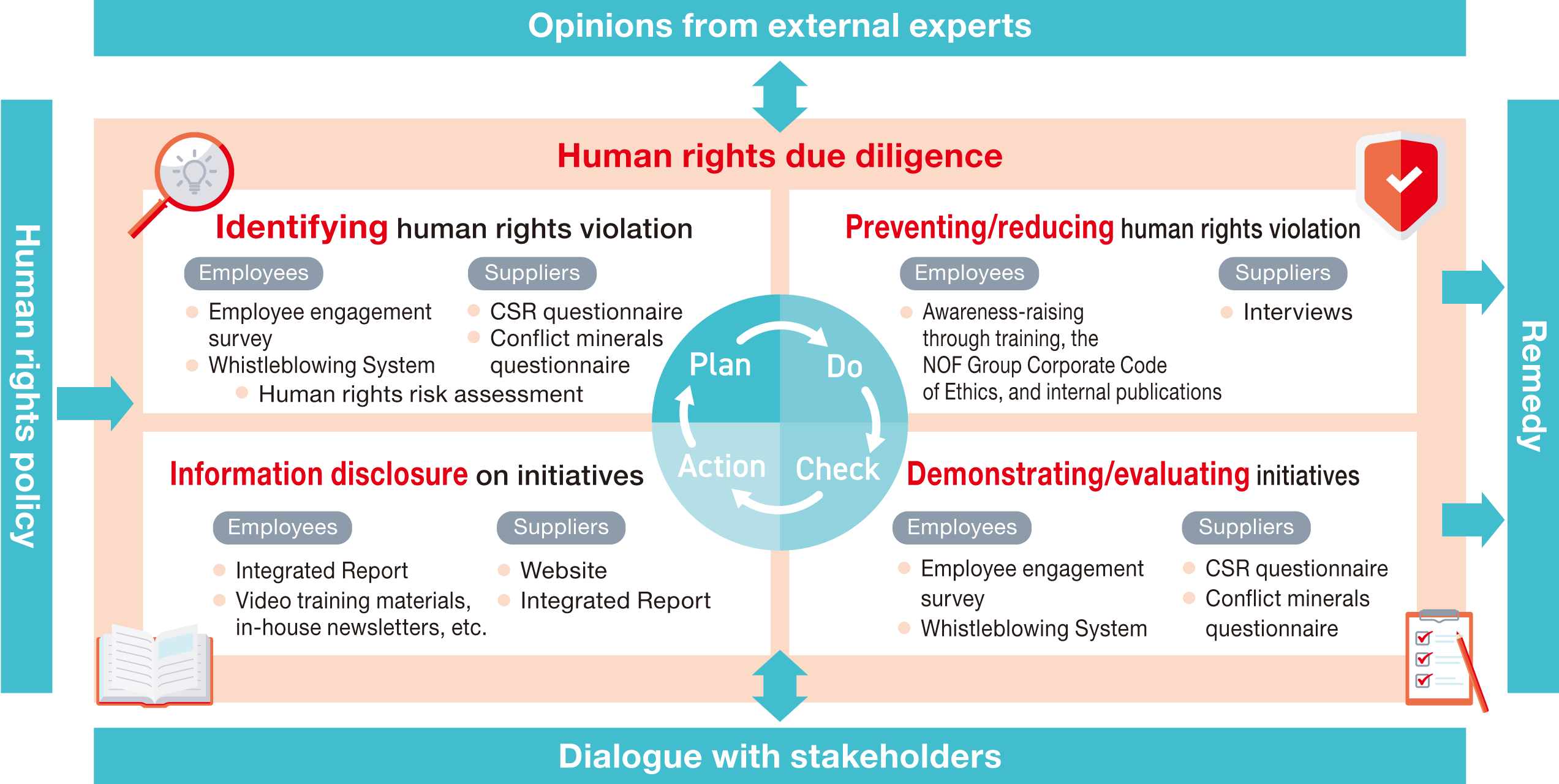
Conducting a human rights risk assessment
We assessed human rights risks using the following process.
1.Organize Human Rights Issues (Prepare a Human Rights Issues List)
Prepare a human rights issues list taking into account the NOF Group’s business characteristics and various guidelines
2.Organize the Value Chain (Prepare Value Chain Flows)
Organize the value chain for each NOF Group business division and determine the scope of risk assessment
3.Identify Human Rights Risks (Establish Worst-Case Scenarios)
Identify human rights risks based on the human rights issues list and value chain flows and establish worst-case scenarios
4.Assess Human Rights Risks
Conduct a human rights risk assessment questionnaire for NOF division heads, location heads, and presidents of affiliated companies. Assess severity, including scale, scope, and difficulty of remediation, and likelihood of occurrence
5.Aggregate Human Rights Risks
Aggregate questionnaire results and determine the Group-wide assessment
6.Prepare a Human Rights Risk Map
Map each risk by severity and likelihood based on the assessment results
7.Determine Priority Risks
Identify human rights risks requiring priority monitoring with reference to the human rights risk map and the NOF Group’s business characteristics
8.Report to the Board of Directors
Report priority human rights monitoring risks and the risk map to the Board of Directors for approval
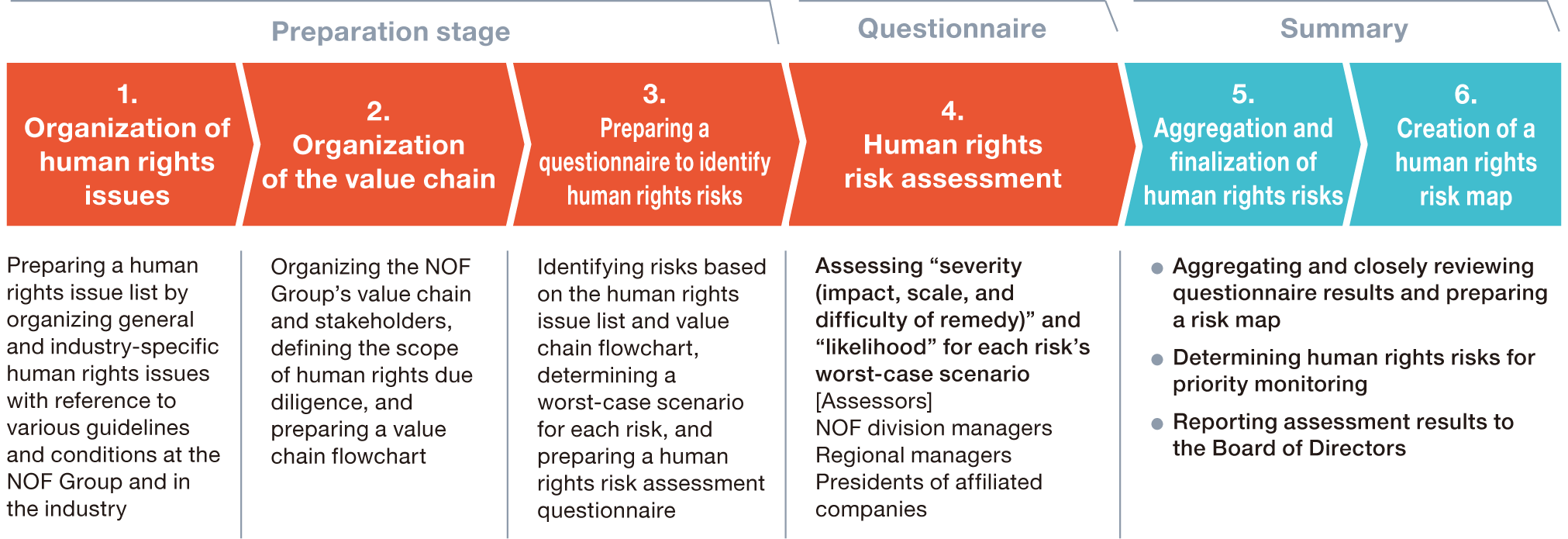
Human rights risk assessment process
Preparation of the human rights issues list
We prepared a list of potential human rights issues related to the NOF Group’s businesses with reference to international human rights norms such as the UN International Bill of Human Rights, the Ten Principles of the United Nations Global Compact, the UN Guiding Principles on Business and Human Rights, the ILO Declaration on Fundamental Principles and Rights at Work, and the OECD guidelines for multinational enterprises on Responsible Business Conduct, as well as materials from human rights experts, human rights defenders, academics, governments, NGOs, and other specialists.
The human rights issues covered are broadly classified into the following four categories.
- A:Risks related to labor within our operations and supply chain
- B:Risks to consumers and customers related to products and services
- C:Risks to local communities arising from business activities
- D:Grievance channels for each risk in A through C
We identified potential human rights risks for these four categories, established worst-case scenarios taking into account the Group’s business characteristics, and conducted the assessment.
Human rights issue list
| A | Labor-related human rights risks Human rights risks concerning workers in the value chain |
|
|---|---|---|
| B | Human rights risks related to our products and services Human rights risks concerning consumers and users of products and services |
|
| C | Human rights risks arising from other business activities Human rights risks involving local communities |
|
| D | Common issues |
|
Preparation of value chain flow diagrams
The NOF Group comprises five distinct businesses: Functional Materials, Metal Coatings, Functional Foods, Life Science, and Explosives & Propulsion. For this human rights risk assessment, we comprehensively identified human rights risks by clarifying the stakeholders involved in the five NOF Group businesses, from raw material procurement and manufacturing through the supply chain to disposal.
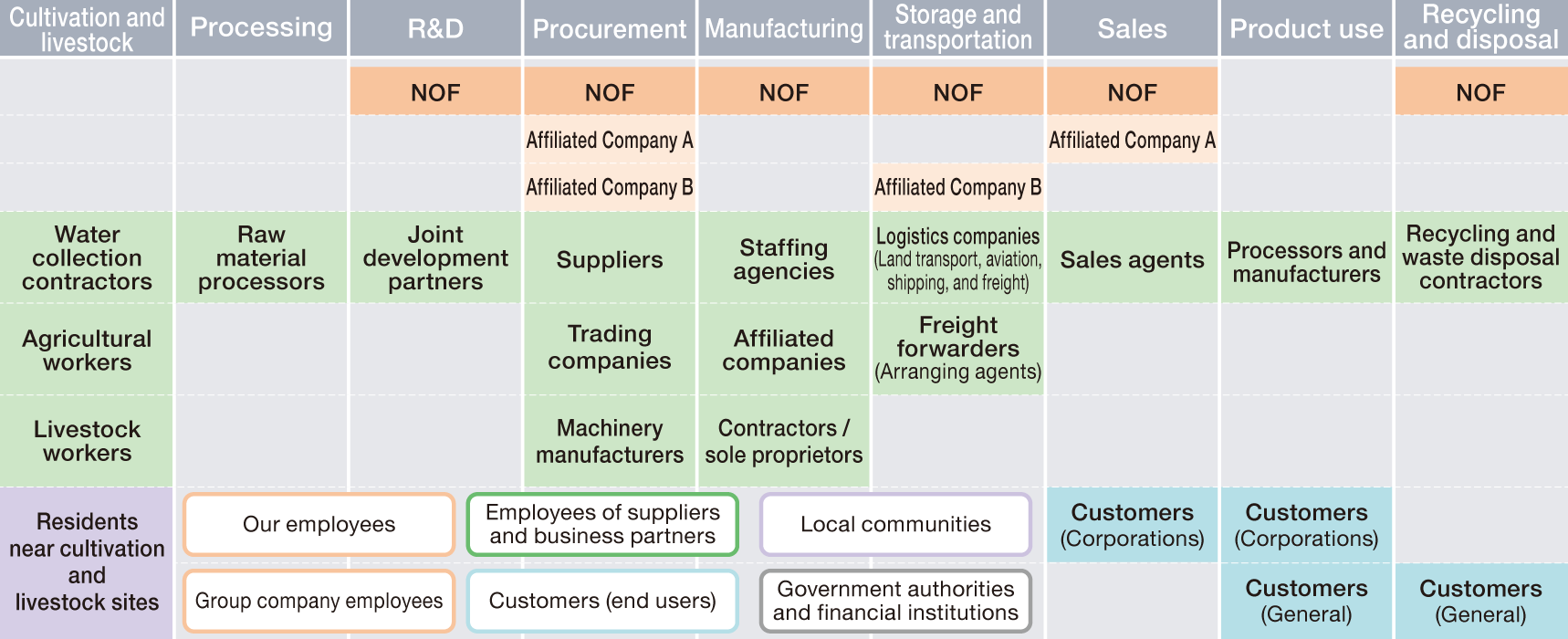
Value chain flowchart (example: Functional Foods Business)
Creation of a human rights risk map
We mapped each human rights issue for our company and the supply chain, with severity on the vertical axis and likelihood of occurrence on the horizontal axis. For identified high-risk human rights issues, we will first monitor the risks. If the results of monitoring indicate a need for risk reduction, we will consider and implement specific countermeasures.
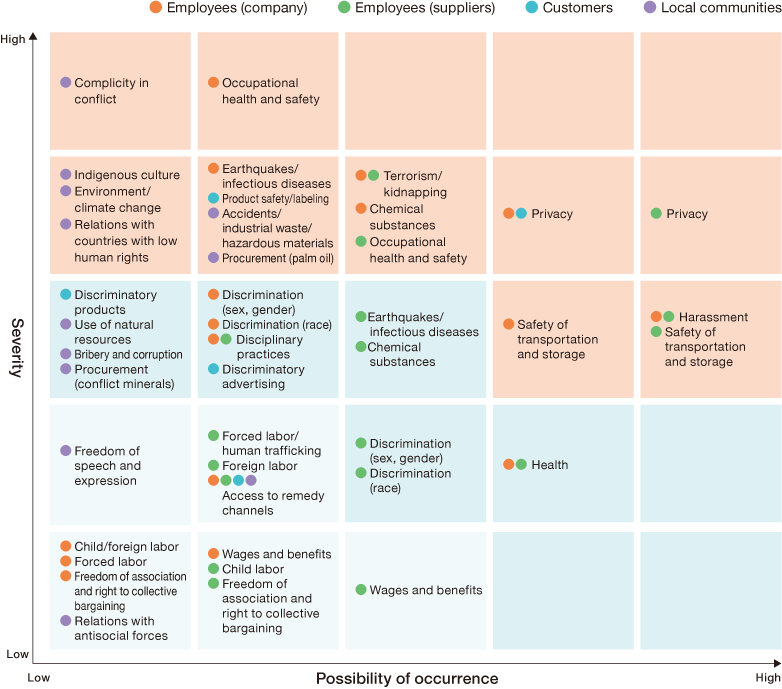
Risk map
Key human rights risks for monitoring
Based on the human rights risk assessment results and the NOF Group’s business characteristics, we defined the following human rights risks as requiring priority monitoring. No serious human rights violations were identified as a result of the human rights due diligence conducted in FY2025. Going forward, we will periodically monitor cases falling under these risks and promptly develop and implement measures where action is required.
Overview of major risks
| Major risk | Worst-case scenario | Affected rights holders | |
|---|---|---|---|
|
Health and safety |
Occupational health |
Insufficient workplace safety considerations cause a large-scale fire or explosion at a NOF Group plant or site, harming employees |
● Employees |
|
Disasters and pandemics |
Employees are harmed because specific responses and measures, such as appropriate safety confirmation and workplace safety assurance, are not implemented during a major earthquake or pandemic, such as an emerging infectious disease |
||
|
Terrorism / kidnapping |
Employees stationed in or traveling to countries or regions with geopolitical risks, such as political conflict, are detained or taken away without cause by extremist forces and suffer harm |
||
|
Chemical substances |
Employees develop illnesses caused by chemical substances because necessary ventilation equipment and personal protective equipment were not provided during chemical-handling work |
||
|
Occupational health |
Insufficient safety considerations at suppliers’ and business partners’ workplaces cause a large-scale fire or explosion at a NOF Group site, harming employees and others |
● Workers |
|
|
Occurrence of accidents |
Accidents such as explosions and fires at logistics sites and plants damage local residents’ property and homes |
● Local communities |
|
|
Occurrence of accidents and release of |
Accidents such as explosions and fires at logistics sites and plants, or releases of chemicals into the atmosphere or rivers, cause injuries or health damage to local residents |
||
|
Health and safety of local residents in connection with operations |
Illegal dumping or improper treatment of industrial waste containing chemicals causes fires or chemical leaks, resulting in injuries or health damage to |
||
|
Harassment |
Harassment |
Various forms of harassment, including workplace bullying, sexual harassment, and maternity harassment, occur at the Company or suppliers’ and business partners’ workplaces, causing employees to develop mental illness |
● Employees ● Workers |
|
Privacy violations |
Personal information leaks and privacy violations |
Inadequate information security management at the NOF Group or suppliers’ and business partners’ workplaces causes leaks of employees’ or job applicants’ personal information and privacy violations |
● Employees ● Workers ● Customers |
|
Transportation and |
Transportation and |
A chemical leak occurs during transportation, causing drivers or recovery workers to experience physical illness. Alternatively, inadequate safety measures during loading, unloading, or warehouse work cause accidents that injure employees |
● Employees ● Workers |
|
Product safety |
Product safety |
Insufficient consideration of safety standards and user diversity, such as physical characteristics and gender, in product design and functionality allows defective products to reach the market, harming customers’ health or safety |
● Customers |
|
Appropriate labeling |
Appropriate labeling |
Customers experience physical illness because insufficient information was provided about risks to the human body and appropriate handling methods when products were supplied |
|
|
Responsible |
Conflict minerals |
Procurement of conflict minerals provides funding to antigovernment forces and others, threatening the safety and livelihoods of local residents |
● Local communities |
|
Palm oil |
Plantations with which we do business clear natural forests without adequate planning to expand palm oil cultivation, causing frequent landslides and threatening the safety and livelihoods of local residents |
||
Human Rights Initiatives for NOF Group Employees
Initiatives to safeguard occupational safety and health in the workplace
The whole NOF Group, including the staff of cooperating companies assigned to NOF’s works and plants, is making all-out efforts to eradicate occupational accidents. The NOF Group has clearly expressed its determination to make its workplaces secure and safe for all the workers involved in Group activities, and to realize this ideal, set forth its Occupational Safety and Health Policy in April 2006. The major initiatives are as follows.Please refer to page 209 for information on the occurrence of occupational accidents.
1.Development of OSHMS (Occupational Safety and Health Management System)*
The NOF Group, under its Occupational Safety and Health Policy, is undertaking buildup of the Occupational Safety and Health Management System (OSHMS). Referencing the guidelines of the International Labor Organization and the Ministry of Health, Labour and Welfare, we are building up our own system and promoting activities. The Risk Assessment program, which started in fiscal 2008 at all works and plants of the NOF Group, has now been adopted by Domestic Group companies as well.
2.Implementation of various training and drills
The NOF Group conducts a variety of training programs, including safe forklift operation, handling of hazardous and chemical substances, prevention of slips, falls, chemical burns, and heatstroke in the workplace, as well as disaster preparedness and BCP drills.
A management system that defines the organization, responsibilities, procedures, processes, and management resources required for an operator to continuously mitigate potential occupational safety and health risks.
Management of work hours
In order to reduce prolonged working hours and enrich employees’ lives outside of work through improved operational efficiency and productivity, the NOF Group is thoroughly enforcing proper labor management and promoting initiatives to reduce working times. These include restricting work after the regular working hours and introducing a work interval system.
Establishment of internal whistleblowing contact points
The NOF Group has set up consultation desks in Japanese, English, Chinese (Simplified Chinese), Korean, Indonesian, and Portuguese at external third-party institutions as contact points for whistleblowing and consultation in overseas countries where the NOF Group’s business bases are located. Employees can contact the desks if they become aware of a violation or potential violation of compliance rules.
In fiscal 2025, we received a total of 29 reports, mainly concerning harassment and workplace management. We carefully investigated the facts of each report promptly and without searching for the whistleblower, and took necessary corrective actions and measures to prevent recurrence. For example, in harassment-related reports, we issued guidance to the reported individuals or imposed disciplinary actions.
[Exchange of views with stakeholders]
Opinions from the NOF Labor Union
Employees’ “health and safety,” including both physical and mental health, are recognized as the highest-priority initiative. We request the allocation of management resources with outcomes in mind, planned implementation of measures, and continuous improvement based on evaluation and monitoring.
Aggregate overtime hours are trending downward due to more diverse work styles and improved operational efficiency, which is commendable, but differences among workplaces and individuals remain. We hope that further improvements will be achieved through the appropriate allocation of human resources, planned human resources development, reviews of work content, and improving productivity.
Human rights initiatives, including harassment prevention, depend greatly on embedding the revised 2025 NOF Group Corporate Code of Ethics. Fortunately, through values training for all employees, many now recognize that the NOF Group is at a turning point where its corporate culture is being reborn in a new form. As all employees deepen their understanding of harassment, compliance, and ethics, the preventive effect should increase while positively affecting individual job satisfaction, workplace vitality, and ultimately business performance. We look forward to continued proactive initiatives.
Implementation of the employee engagement survey
Since fiscal year 2022, NOF Group has conducted an employee engagement survey for Company employees to investigate the occurrence of harassment within the Company, respect for privacy, treatment and evaluation of women and non-Japanese employees, occupational safety and health in the workplace, and awareness of whistleblowing contact points and disadvantageous treatment. Responses were received from 1,972 respondents in fiscal 2025.
Some of the results of the survey are as follows. Employees who responded that they knew of the reporting channels accounted for 95.8% of the total, an improvement of 1.5 percentage points from FY2024. Conversely, 30.0% responded that they did not know the contact details, up 0.9 percentage points, indicating a need for more targeted efforts to raise employee awareness.
Meanwhile, in response to the question, “Has awareness that discrimination and harassment are unacceptable been firmly established in the workplace?,” 80.7% of employees responded that “Awareness has been fully established” or “Awareness has been somewhat established,” an increase of only 0.4 percentage points from FY2024. Of these, 30.1% responded that it was “fully established,” a decrease of 5.2 percentage points from FY2024.
To address these issues, we will use the Corporate Code of Ethics revised in April 2025 to raise awareness among all employees and plan company-wide training beginning in FY2026 to develop on-site leaders as “Compliance Leaders.”
Results of survey on awareness of whistleblowing contact points
| Options | Did you know that there are contact points for reporting and consulting about illegal or improper behavior in the workplace? |
||||
|---|---|---|---|---|---|
| FY2024 | FY2025 | ||||
| I know about the contact points |
I know about the contact points, including how to reach them |
94.3% | 65.2% | 95.8% | 65.8% |
| I know about the contact points, but don’t know how to reach them | 29.1% | 30.0% | |||
| I don’t know about the contact points | 5.7% | 4.2% | |||
Results of survey on establishment of awareness of preventing harassment
|
Options |
Has awareness that discrimination and harassment are unacceptable been firmly established in the workplace? |
||||
|---|---|---|---|---|---|
| FY2024 | FY2025 | ||||
| Established | Awareness has been fully established |
80.3% | 35.3% | 80.7% | 30.1% |
| Awareness has been somewhat established | 45.0% | 50.6% | |||
| Not established | Awareness has not really been established | 19.7% | 15.8% | 19.3% | 14.7% |
| Awareness has not been established almost at all | 3.9% | 4.6% | |||
Examples of comments from the employee engagement survey
Establishing awareness of harassment
- Training for new graduates and younger employees has also been enhanced, and awareness-raising has become thorough. (30s, male)
- I feel that the claims of those alleging harassment have become too strong. (20s, male)
Establishing awareness of respect for privacy
- There are more privacy-conscious conversations, making the workplace feel safer. (30s, male)
- People sometimes discuss my private life or family circumstances without permission. (20s, male)
Diversity, treatment, and evaluation
- I feel that employees are evaluated fairly regardless of gender, age, or other attributes. (Age 50 or older, male)
- There are large wage differences among regular employees, commissioned clerical employees, and region-specific employees. (Age 50 or older, male)
Use of leave systems
- Many operations depend on specific individuals, making it difficult to take refreshment leave. (30s, male)
- During busy periods, there is still an atmosphere that makes it difficult to request leave. (40s, female)
Ensuring safety and health
- I appreciate the initiatives to improve the work environment. (40s, female)
Awareness of whistleblowing contact points
- All new employees are informed about whistleblowing contact points and consultation systems. (30s, female)
- Some employees say they would hesitate to use them in practice. (Age 50 or older, male)
Prohibition of disadvantageous treatment
- The prohibition of disadvantageous treatment has been institutionalized and is becoming widely understood. (40s, female)
- I worry that expressing my opinion could affect my treatment or career. (Age 50 or older, male)
Human Rights Initiatives for Stakeholders Involved Through Business Transactions
Formulation of the CSR Procurement Policy and CSR Procurement Guidelines,
and incorporating CSR-related clauses in basic purchasing contracts
The NOF Group established the CSR Procurement Policy for stable, sustainable procurement. In addition, we created the CSR Procurement Guidelines that compile measures the NOF Group implements and requests its suppliers to implement.
Furthermore, when signing a new basic purchasing contract with a business partner, we decided to add a clause stating efforts to comply with the NOF Group’s CSR Procurement Policy and CSR Procurement Guidelines.
Implementation of the CSR questionnaire
In the procurement unit, we provide our main suppliers with necessary explanations on the NOF Group’s CSR Procurement Policy and conduct questionnaires on the status of CSR activities at our main suppliers, using the CSR/Sustainable Procurement Self-assessment Questionnaire created by the Global Compact Network Japan (GCNJ) to improve the objectivity of the questionnaire.
Most recently, we surveyed our major suppliers from fiscal 2023 to 2024 and achieved a coverage rate of 92% based on purchase amount.
The average scores of questions related to human rights are shown in the table below. Suppliers with scores below 50 points are considered to have potential human rights risks. Interviews were conducted in fiscal 2025 to confirm whether there were any human rights risks at suppliers, but no suppliers have been found to have human rights risks as of now.
As a target under the 2028 Mid-term Management Plan, we set a KPI of an improvement rate*2 of at least 75% among the 24 suppliers*1 interviewed under the 2025 Mid-term Management Plan.
Survey score
| 90 points or above | 70 to 89 points | 50 to 69 points | Below 50 points | |
|---|---|---|---|---|
| Human rights score distribution | 56% | 16% | 18% | 10% |
CSR questionnaire results
| Category | Question | Average score (Out of 5 points) |
|---|---|---|
| Ⅰ. Corporate governance concerning CSR | Establishment of an internal whistleblowing system | 4.39 |
| Ⅱ. Human Rights | 1. Respect for human rights and prohibition of discrimination | 4.25 |
| 2. Avoiding complicity in or contribution to human rights violations | 4.10 | |
| 3. Respect for indigenous peoples’ lives and local communities | 3.75 | |
| Ⅲ. Labor | 1. Prohibition of discrimination in employment | 4.50 |
| 2. Providing employees with equal opportunities for human resources development and career advancement |
4.52 | |
| 3. Prohibition of inhumane treatment | 4.64 | |
| 4. Payment of appropriate wages | 4.78 | |
| 5. Fair application of working hours, leave, paid leave, and other arrangements | 4.86 | |
| 6. Prohibition of forced labor | 4.70 | |
| 7. Prohibition of child labor | 4.68 | |
| 8. Respect for the religious traditions and customs of the countries and regions in which business operations are conducted |
4.17 | |
| 9. Recognition of and respect for freedom of association and the right to collective bargaining |
4.39 | |
| 10. Proper management of employee occupational safety and health | 4.82 |
- Selected with a focus on (1) overall score rate and (2) human rights item score rate
- Percentage of companies showing improvement in either applicable item under (1) or (2)
Procurement of sustainable palm oil
The existence of human rights and labor problems has long been noted in the oil palm plantations where palm oil is produced. The NOF Group joined the Round-table on Sustainable Palm Oil (RSPO) in FY2012 and obtained supply chain certification from the organization in FY2014. NOF, a founding member of the Japan Sustainable Palm Oil Network (JaSPON) which was launched in Japan in 2019, conducts activities to procure sustainable palm oil.
Response to responsible mineral procurement
With regard to conflict minerals (3TG*1) that may have an impact on human rights and other issues, we use the Responsible Minerals Initiative (RMI*2)-prescribed Conflict Minerals Reporting Template (CMRT*3) and conduct questionnaire surveys of all key business partners. Furthermore, starting from fiscal 2023, we have initiated a survey using the Extended Minerals Reporting Template (EMRT*4), a unified format for target minerals cobalt and natural mica, with our key business partners.
- Refers to the four minerals of tin, tantalum, tungsten, and gold extracted in the Democratic Republic of Congo and neighboring countries
- Abbreviation for Responsible Minerals Initiative
- Abbreviation for Conflict Minerals Reporting Template
- Abbreviation for Extended Minerals Reporting Template
Establishment of external whistleblowing contact points
The NOF Group recognizes compliance as a foundation that supports the company and believes it is crucial to prevent or promptly correct incidents that violate laws, regulations, and the NOF Group Corporate Code of Ethics, or involve human rights abuses, to avoid them becoming severe or prolonged. To this end, we have established contact points for whistleblowing outside the Company, including our business partners.
Respect for customers’ human rights
The aforementioned contact point for whistleblowing from outside the Company accepts reports not only from suppliers but also from NOF Group customers. To date, we have not received any reports on human rights (violations) through the contact point.