

Society
Three Pillars of Human Resources Performance (2) Diversity & Inclusion

Metrics and Targets
Promoting diversity and innovation
We advocate “respect for diversity” in our code of conduct and, based on the belief that diverse perspectives are the very source for the creation of new innovation and value, we are striving to foster an organizational culture where everyone is able to participate in an active manner regardless of their attributes, and where the sharing and combination of knowledge occurs.
We believe that by fostering an environment and culture where opinions and ideas can be freely expressed and individuality is respected, diverse human resources can fully demonstrate their abilities. We are working to secure diverse human resources regardless of gender, age, nationality, or disability status. In addition to this, we are also promoting the hiring of human resources (experienced personnel) with extensive experience in the three prioritized business fields, with the aim to promote innovation through mutual understanding and mutual respect among human resources with different perspectives. In addition, the active participation of female employees is a major issue in promoting the activities of diverse human resources. In order to increase the ratio of female career-track employees, NOF has been continuing its efforts to make sure that the percentage of women new graduates recruited for career-track positions is 30% or more for the past 11 years. The percentage of female career-track employees, which was less than 10% of all career-track employees as of the end of FY2015, increased to 30% by the end of FY2025. The ranks of female career-track employees, who are expected to be promoted to management-level positions as future management candidates and play an even more active role, are growing larger. We will continue to strive to enhance systems that make it easy to work, making efforts to create an environment in which diverse human resources can actively participate and increase the ratio of female management-level employees from a medium-term perspective.
Rate of hiring of female new graduates recruited for career-track positions [Covered organizations:NOF]
| Actual | Targets | Measure | ||
|---|---|---|---|---|
| FY2023 | FY2024 | FY2025 | ||
| 32.7% | 38.0% | 39.1% | 30% or more (Every fiscal year) |
|
Ratio of female management-level employees [Covered organizations:NOF]
| Actual | Targets | Measure | ||
|---|---|---|---|---|
| FY2023 | FY2024 | FY2025 | ||
| 5.2% | 6.2% | 6.4% (1.3-fold) |
3-fold or more (compared with FY2021) FY2030 (numerical targets) |
|
Percentage of employees with disabilities [Covered organizations:NOF]
| Actual | Targets | Measure | ||
|---|---|---|---|---|
| FY2023 | FY2024 | FY2025 | ||
| 2.54% | 2.65% | 2.82% | 3.0% or more FY2030 (numerical targets) |
|
Pay gap ratio between male and female full-time employees*1 [Covered organizations:NOF] [Covered organizations:NOF / 5 domestic consolidated companies]
| Actual | Targets | Measure | ||
|---|---|---|---|---|
| FY2024 | FY2025 | |||
| Full-time employees (NOF) |
72.6% | 73.6% |
Full-time employees: |
|
| Full-time employees (NOF / 5 domestic consolidated companies) |
71.1% |
72.4% |
||
Rate of male employees utilizing childcare leave*2(Average number of childcare leave days taken by male employees*3) [Covered organizations:NOF]
| Actual | Targets | Measure | ||
|---|---|---|---|---|
| FY2023*4 | FY2024*4 | FY2025*4 | ||
| 97.4% (33.1 days) |
95.7% (30.9 days) |
94.1% (37.1 days) |
85% or more (acquisition of 2 weeks or more) FY2030 (Numerical targets) |
|
- Pay gap ratio between male and female employees (%) = Average annual income of women / Average annual income of men x 100
- The rate of childcare leave utilization is calculated according to the following criteria.
・In cases of split leave for the same child, only the initial leave is counted.
・ If the child is born in the previous fiscal year and childcare leave is taken in the current fiscal year, it is counted as leave taken in the current fiscal year. - The average number of days utilizing childcare leave is calculated based on the total number of childcare leave days taken by employees who returned to work in the current fiscal year.
- The target for FY2025 is set at 100% (acquisition of 1 day or more).
Hiring and Turnover
Hiring and appointment of human resources
Under the values of “challenge,” “fairness,” and “harmony,” NOF strives to invigorate the foundation that enables diverse personnel to thrive by creating an environment where opinions and ideas can be freely exchanged and individuality is respected. In recruiting personnel, our policy is to respect diversity regardless of gender, age, nationality, disability status, or other characteristics.
In addition to regular recruitment of new graduates, we focus on recruiting experienced personnel who will drive sustainable business growth and lead innovation, securing personnel for a wide range of domestic and overseas roles in R&D, production, quality control, technology, sales, planning, administration, and other fields.
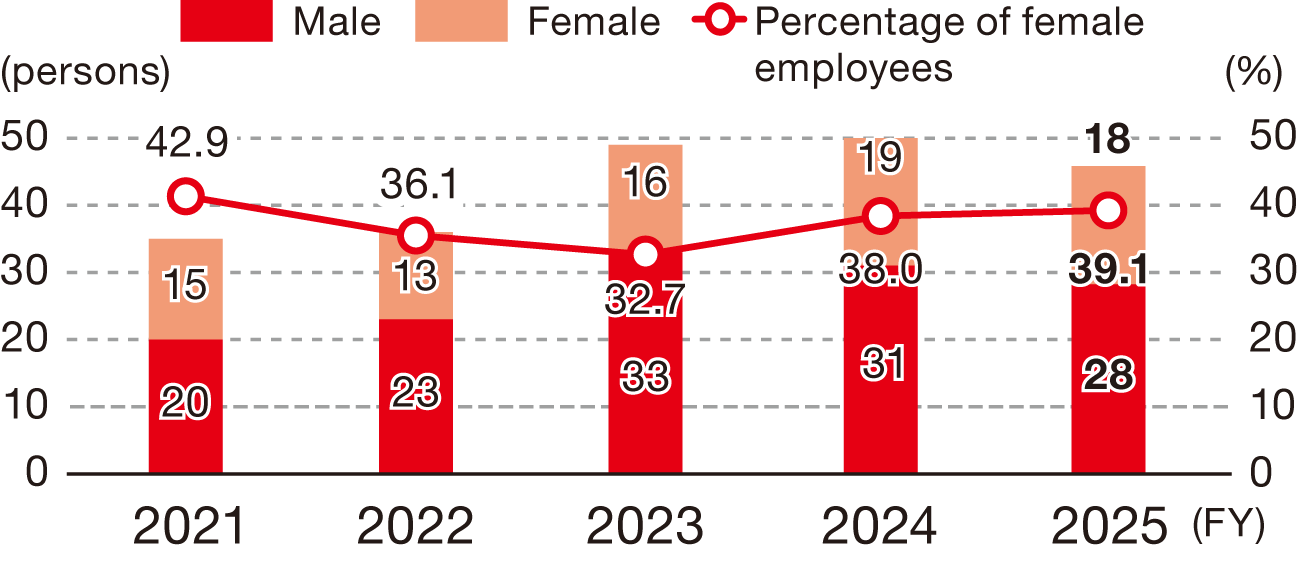
Number of new graduates hired for career-track positions/
Percentage of female employees hired for career-track positions*
[Covered organizations:NOF]
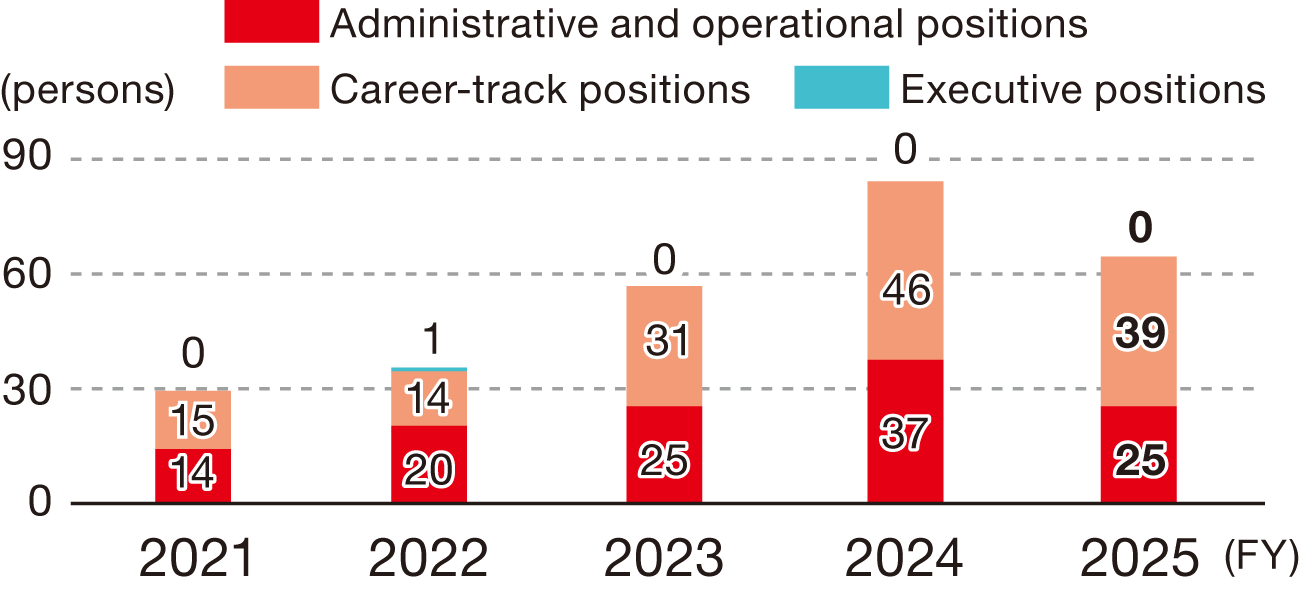
Number of mid-career workers hired
[Covered organizations:NOF]
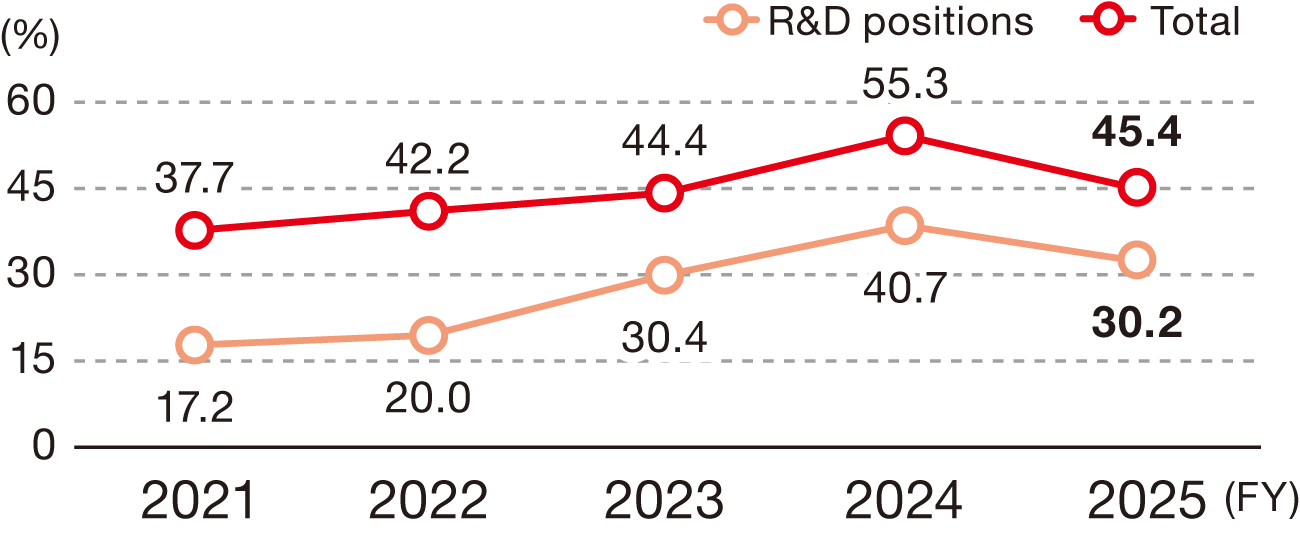
Rate of hiring career-track positions
[Covered organizations:NOF]
Average age of mid-career workers hired (at the time of joining) [Covered organizations:NOF]
- FY2024:32.4
- FY2025:31.3
Ratio of male to female mid-career workers hired by course [Covered organizations:NOF]
Hiring for executive and career-track positions
- FY2025:Male 74.4%
Female 25.6%
Hiring for administrative and operational positions
- FY2025:Male 68.0%
Female 32.0%
Turnover
NOF has established an opportunity (self-report system) for supervisors and subordinates to hold a dialogue about their careers once a year. Through this, we are working to understand individual wishes, etc. to support career development and promote the creation of comfortable workplaces, as well as enhancing systems that help employees balance work with family care, childcare, and other obligations. In addition, by establishing a career consulting service, we provide employees with opportunities to obtain expert advice and support proactive career building. We are utilizing this as a mechanism that enables employees to receive career advice, thereby broadening their perspectives and outlook on their jobs and working with high motivation. In the event of unavoidable staff turnover, in addition to hiring replacements (mid-career workers or new graduates) or temporary workers, we ensure that business operations are not negatively impacted through such steps as review of work allocation and responsibilities, continuous improvement of operational efficiency, and assessment of personnel allocation. As for turnover due to mandatory retirement, we strive to maintain and improve the quality of operations by reviewing personnel allocation and improving operational efficiency, with hiring new personnel through the systematic hiring of new graduates as the main approach.
Turnover due to personal reasons[Covered organizations:NOF]
- FY2024:2.8%
- FY2025:2.4%
Turnover due to personal reasons[Covered organizations:NOF / 5 domestic consolidated companies]
- FY2024:2.6%
- FY2025:2.2%
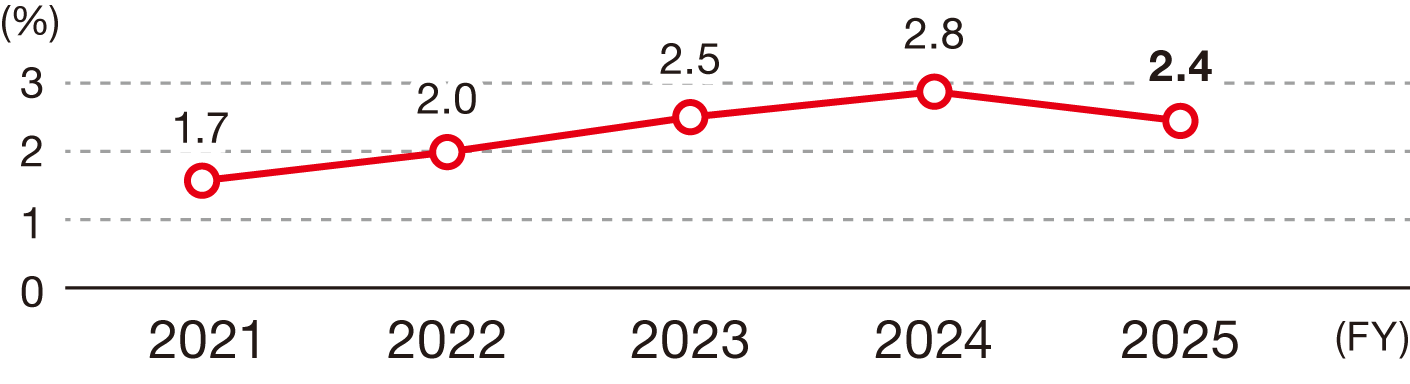
Turnover due to personal reasons
[Covered organizations:NOF]
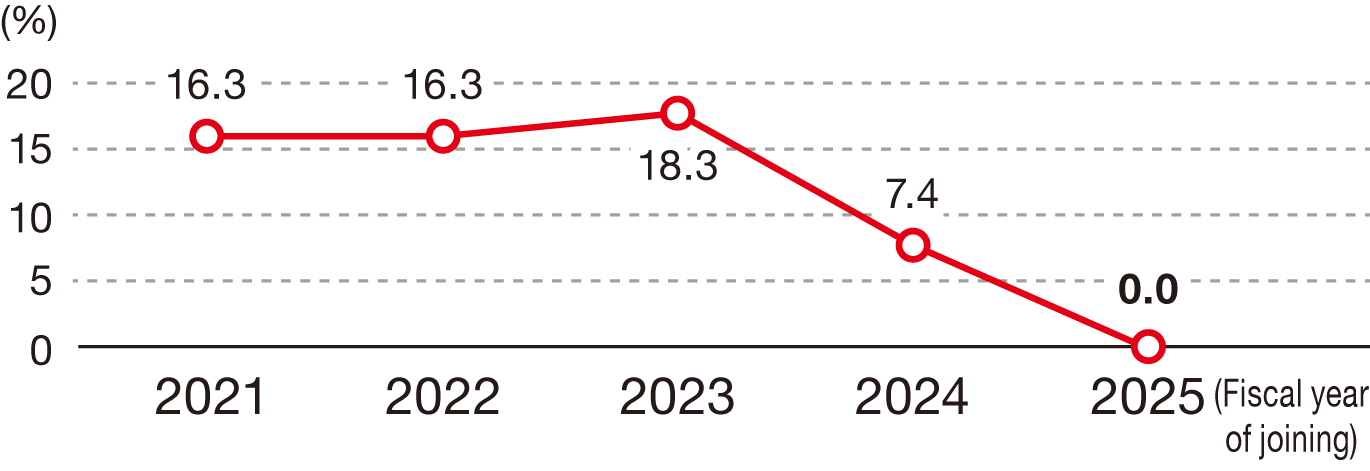
Turnover rate of new graduate employees
within three years of joining*
[Covered organizations:NOF]
Diversity in Employment
Internal recruiting system
NOF had set up an internal recruiting system for project work conducted across the Company, and in FY2024, we revised the system to accept applications for certain internal personnel changes. We will strive to operate the system in a way that promotes organizational vitality, among others, by improving career ownership and assigning motivated personnel.
Raising of the retirement age
NOF has raised its retirement age to 65 in April 2023. By raising the retirement age, we have created a place where employees can continue to utilize their high levels of expertise, skills, and experience within the Company and play an even more active role.
Diversity & inclusion policy (approach)
The NOF Group believes that creating an environment and culture that maximizes the vitality of employees with diverse values is important for achieving sustainable business growth, and that by embracing and respecting diversity, we can continue to generate innovation.
In April 2023, we implemented a revised corporate philosophy and guiding framework and established a new code of conduct which states, “Respect diversity and act fairly with high ethical standards and good sense.” With this, we expect our employees to act in a manner that embraces and respects diversity. We work to build an organization in which willing and capable employees are properly evaluated in every aspect including recruitment, treatment, and promotion, and can easily demonstrate their capabilities.
Hiring of employees with disabilities
NOF promotes the hiring of people with disabilities and improves barrier-free accessibility at each site, so that such personnel can demonstrate their respective capabilities as an active member of their workplace. As of March 2026, the employment rate of persons with disabilities was 2.82%, which surpasses the legally prescribed percentage. NOF will continue its efforts to expand the hiring of people with disabilities and establish workplace environments where such personnel can work comfortably.
Percentage of employees with disabilities [Covered organizations:NOF]
- FY2024:2.65%
- FY2025:2.82% *
- FY2030 (numerical targets):3.0% or more
Percentage of employees with disabilities [Covered organizations:NOF / 5 domestic consolidated companies]
- As of March 2026:2.39%
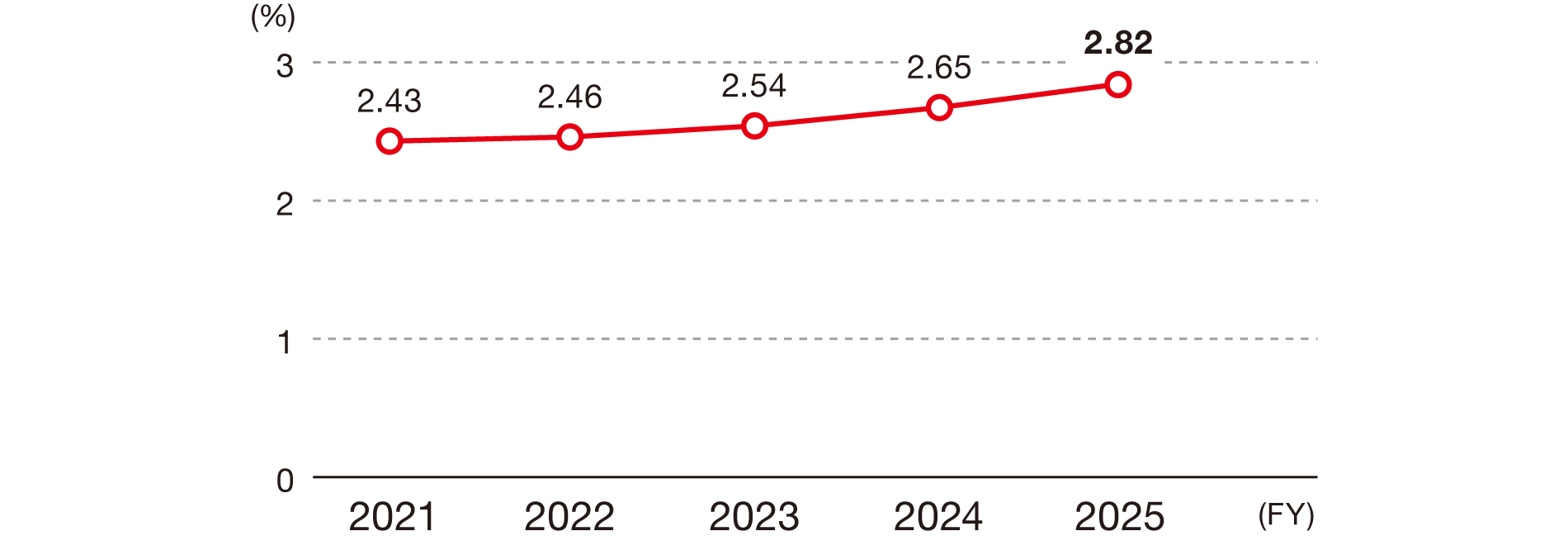
Percentage of employees with disabilities
[Covered organizations:NOF]
Active Participation of Women
Promoting the active participation of women
NOF promotes the active participation of women, and of new graduate career-track hired in fiscal 2025, 39.1% were women (see the graph on p. 199: Number of new graduates hired for career-track positions/Percentage of female employees hired for career-track positions). NOF actively recruits women and works to create a workplace environment where employees can demonstrate their abilities regardless of gender. We are expanding support programs for childcare and nursing care and leave programs addressing women-specific health issues. We also provide training for all employees based on NOF’s values and foster a corporate culture that respects diversity.
Rate of hiring of female new graduates recruited for career-track positions [Covered organizations:NOF]
- FY2024:38.0%
- FY2025:39.1%
- Target for each fiscal year:30% or more (Target achieved every fiscal year since FY2016)
Ratio of female management-level employees [Covered organizations:NOF]
- FY2024:6.2%
- FY2025:6.4% (1.3 times the FY2021 level)
- Target by FY2030:3-fold or more (compared with FY2021)
Ratio of female management-level employees [Covered organizations:NOF / 5 domestic consolidated companies]
- FY2024:5.9%
- FY2025:5.5%
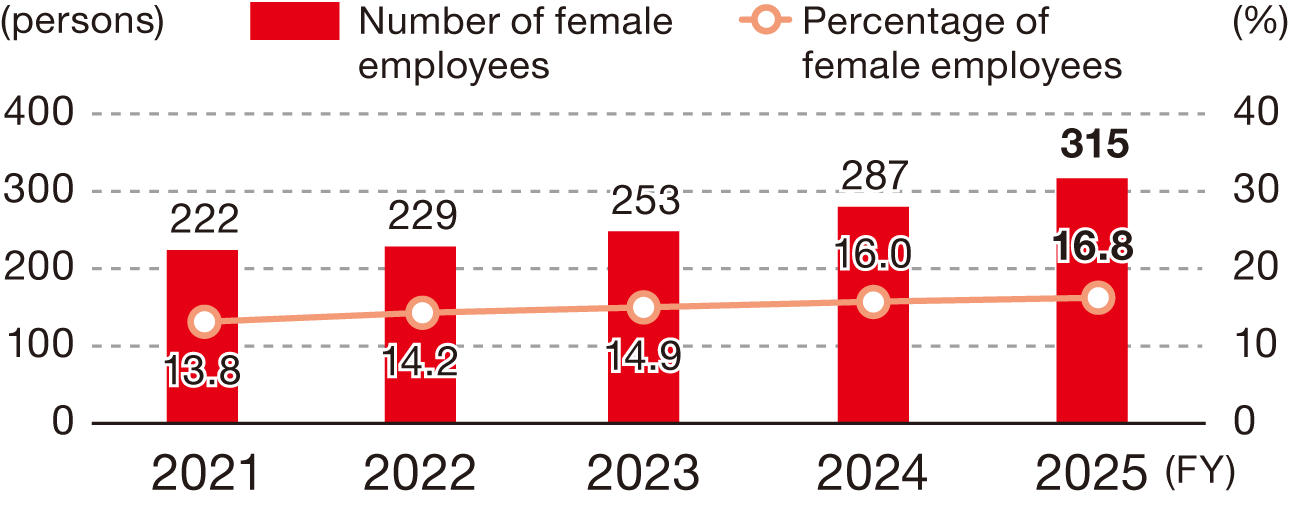
Number and percentage of female employees*
[Covered organizations:NOF]
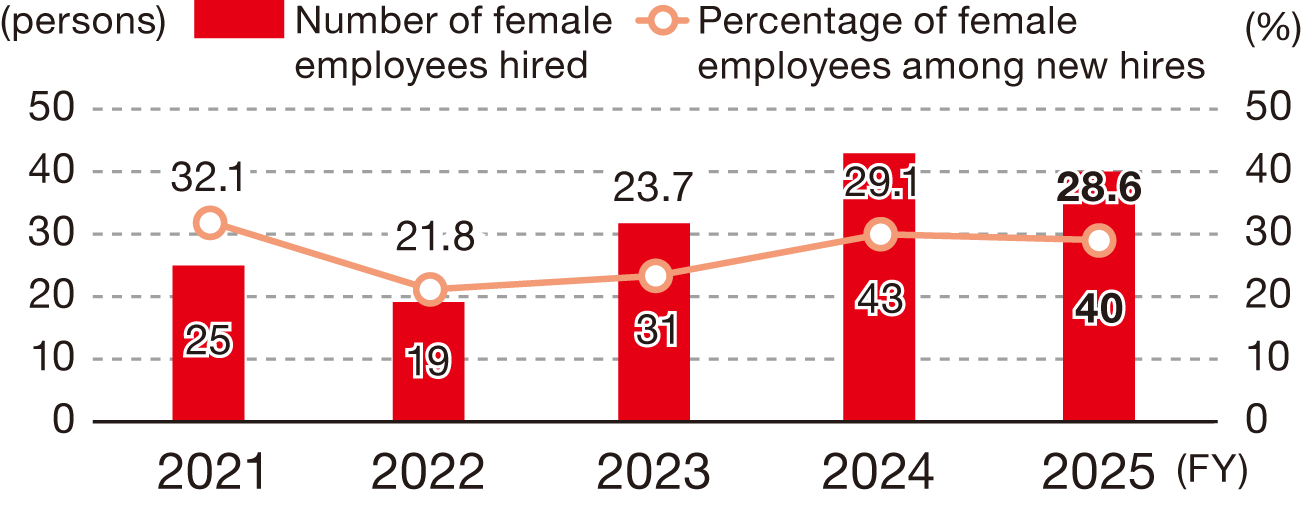
Number and percentage of female employees hired
[Covered organizations:NOF]
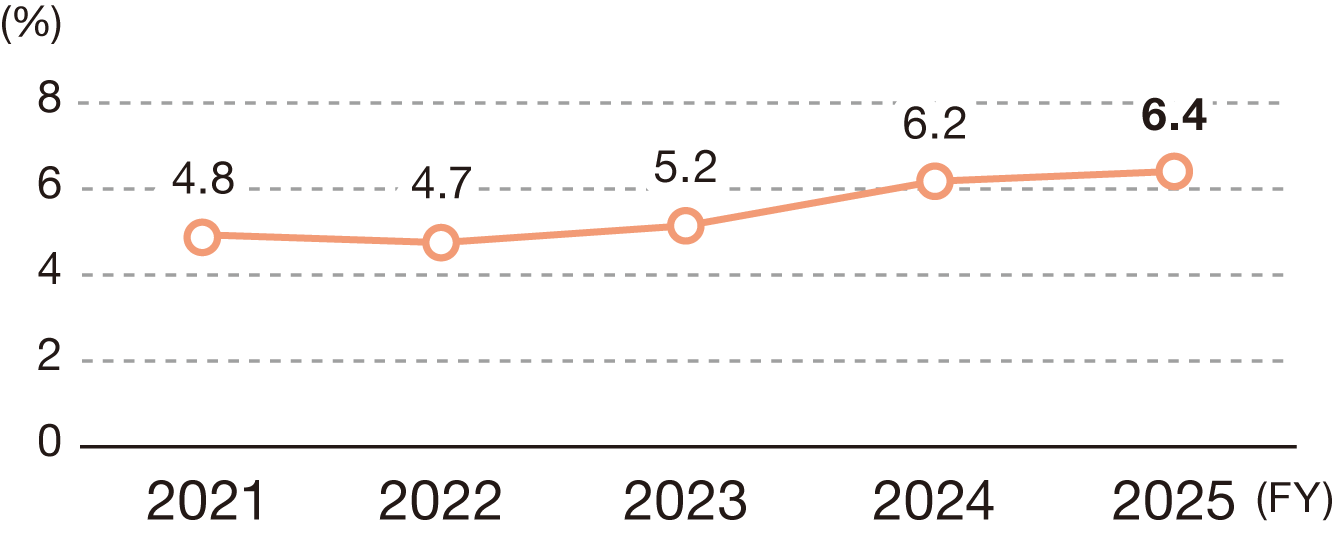
Ratio of female management-level employees
[Covered organizations:NOF]
Action plan for general business operators based on the Act on Advancement of Measures to Support Raising Next-Generation Children and Act on the Promotion of Women’s Active Engagement in Professional Life
The following action plan has been formulated for the purpose of enhancing work-life balance and creating an environment in which each employee ambitiously takes on challenges and plays an active role.
1. Plan period:April 1, 2023 to March 31, 2028 (5 years)
2. Targets and initiatives (from April 2023)
Target 1:Create an environment that facilitates the balance between work and family life
<Initiative>
To enable employees to continue working with peace of mind while balancing work with childcare, family care, medical treatment, etc., the Company promotes the creation of workplace environments that facilitate the use of the work-life balance support systems and the expansion of such systems. It has also revised its accumulated paid leave system.
Target 2:Establish an environment to achieve a utilization rate of annual paid leave of 75% or more
<Initiative>
To encourage employees to take annual paid leave, we monitor and promote the use of such holidays at each workplace.
Target 3:Promote efficient work styles
<Initiative>
We have implemented a work-from-home system to reduce working hours.
Target 4:Maintain the percentage of female employees hired for career-track positions at 30% or more and create an environment enabling women to remain in the workplace
<Initiative>
We have set the ratio of female employees hired for career-track positions as a KPI and recruit human resources accordingly. As a measure to realize diverse work styles according to life stages, we have also established an environment enabling women to remain in the workplace, by allowing female employees who are pregnant to take accumulated paid leave for
health issues.
Remuneration
Fairness of remuneration
NOF’s employee salary regulations stipulate the principle of “equal pay for work of equal value.”
At NOF, the gender pay gap ratio among full-time employees in FY2025 was 73.6%. This is mainly attributable to the different average length of service between men and women, the allowance gap resulting from men being the majority of employees engaged in shift work in the manufacturing divisions, and the gender ratio gap in managerial positions. When employees are classified according to their responsibilities and roles as management-equivalent employees or general employees (hired for career-track and administrative and operational positions), the regular employee wage ratio remained above the target level, as in the previous year. We will continue aiming to reduce the gender pay gap ratio over the medium to long-term by helping employees balance work and childbirth, childcare, etc., promoting the creation of workplace environments where women can work comfortably, and appointing women to managerial positions.
Gender pay gap ratio [Covered organizations:NOF]
- FY2024 :Full-time employees 72.6%、Temporary/ part-time employees 96.8%、Total 71.9%
- FY2025 :Full-time employees 73.6%、Temporary/ part-time employees 87.8%、Total 72.5%
- FY2030 target:Full-time employees 75% or more
Pay gap ratio between male and female full-time employees in FY2025 (by hiring category)
- Management-level equivalent employees:89.6%
- General employees (hired for career-track and administrative and operational positions):83.0%
Gender pay gap ratio [Covered organizations:NOF / 5 domestic consolidated companies]
- FY2024 :Full-time employees 71.1%
- FY20245 :Full-time employees 72.4%
- FY2030 target:Full-time employees 75% or more
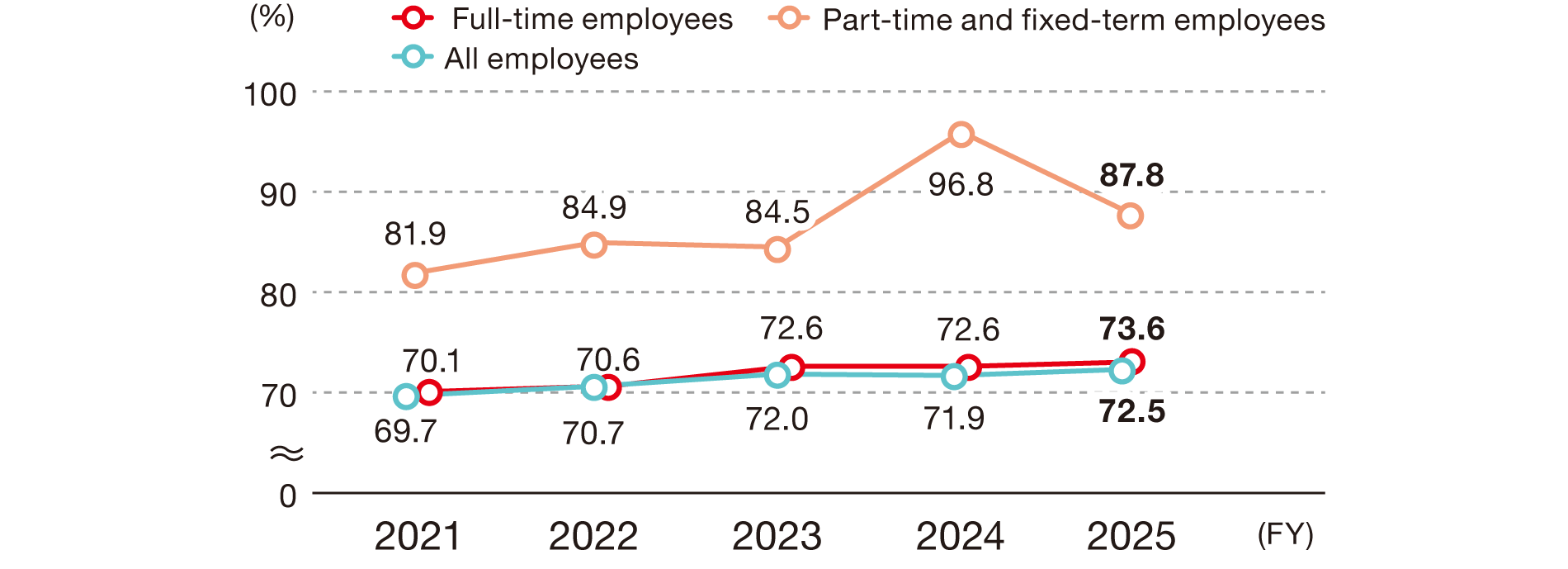
Gender pay gap ratio *
[Covered organizations:NOF]
Causes and measures for the gender pay gap among full-time employees
| Cause | Measure | |
|---|---|---|
| Gender difference in average length of service | → | Enhance support for balancing work with childbirth, childcare, etc. |
| Because only men are engaged in shift work in the manufacturing divisions, the associated allowances have resulted in a wage gap. | → | Promotion of work environment improvements, such as mechanization of heavy work and enhancement of break rooms, to create an environment where female employees can work more easily in manufacturing sites operating 24 hours a day |
| Gender gap ratio in managerial positions | → | Active recruitment of women for career-track positions and advancement of an internal environment that promotes the active participation of women |
Appropriate payment of premium wages for overtime work
Under appropriate working-hour management, NOF properly pays premium wages in accordance with work rules and laws and regulations for unavoidable overtime work. We will continue regarding accurate monitoring of working hours as the first step in managing employee health and maintain highly transparent attendance management.
Living wage
Based on the belief that it must achieve its management plan and establish a stable corporate foundation for the future, NOF makes every effort to pay employees fair and appropriate wages. As part of its initiatives to assess and ensure a living wage, NOF has concluded with the NOF Labor Union an in-house minimum wage agreement exceeding the statutory minimum wage and an agreement on special in-house compensation based on the National Personnel Authority’s standard cost of living, thereby striving to provide employees with a living wage that supports a secure standard
of living.
Work-Life Balance
Promotion of work-life balance
NOF develops a work environment in which employees can work with motivation, while also balancing work and personal activities such as childcare, family care, hobbies, learning, rest, and community activities. Placing importance on the work-life balance of its employees, NOF has adopted various systems to provide specific support, as shown in the table below. The items in the colored sections in the table indicate NOF’s original systems or those exceeding legal requirements.
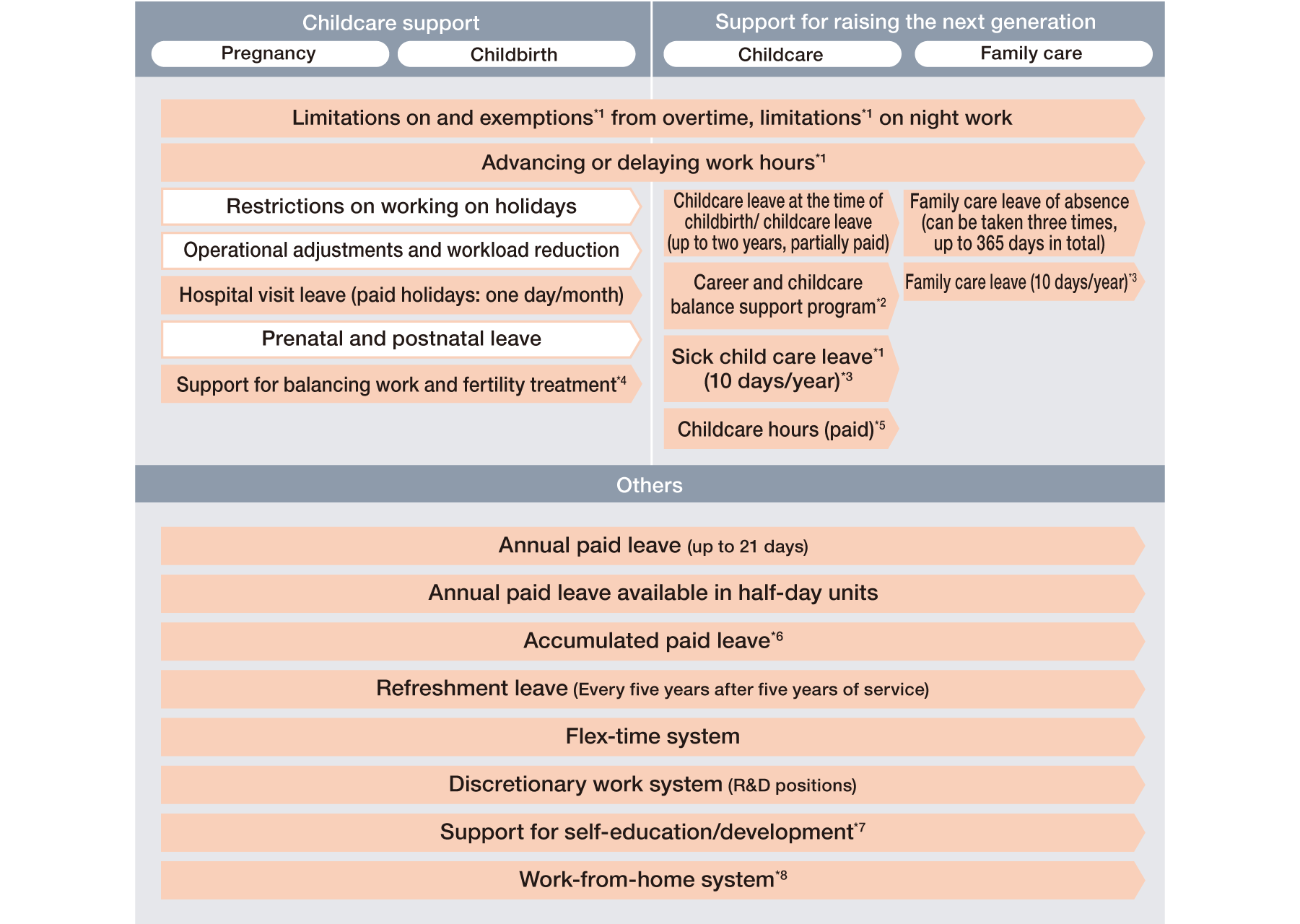
Systems that support diverse work styles [Covered organizations:NOF]
- The childcare support systems are available to employees raising children up to the third grade of elementary school.
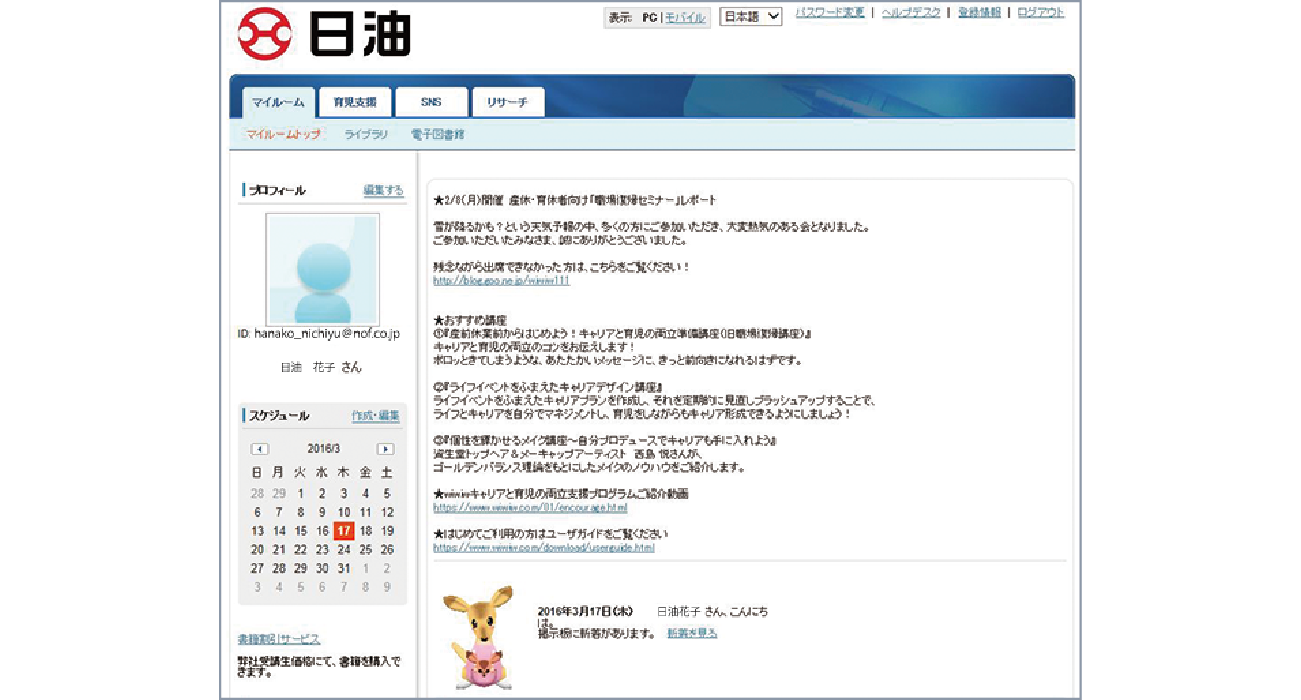
- We have introduced the online service wiwiw (provided by wiwiw.inc) to help employees on childcare leave balance their careers with childcare.
By providing this service to those on maternity or childcare leave, we support them in balancing their careers with childcare. - Can be taken in hourly increments.
- Systems such as short-hour work, flex-time work, and fertility treatment leave are available.
- Female employees raising infants under one year old are granted two paid childcare breaks a day (30 minutes per break).
- Accumulated paid leave is a system in which unused paid holidays can be accumulated and carried over every year.
This system can be used for personal illness/injury, childcare, care of sick family members, family caregiving, self-education/development, volunteer activities, refresh leave (long-service leave), etc. - We support self-education/development by providing support for correspondence learning allowing employees to select training courses.
We have also established a system enabling employees who have worked at the Company for 10 years or longer to take accumulated paid leave if they take part in training programs outside the Company for 10 days or longer. - Up to two remote work days can be taken per week with prior approval. In addition, with prior approval, employees are allowed to shift their working hours up to two hours earlier or later.
Prevention of long working hours
Under appropriate labor management, NOF takes measures to curb long working hours while improving operational efficiency and productivity. In addition to checking working hours through computer log management, we are introducing restrictions on working after scheduled hours, overtime restrictions for employees working long hours, minimum rest intervals between shifts, and designated days encouraging employees to leave on time.
We have concluded a “36 Agreement” with the labor union or employee representatives. Following labor-management consultation, overtime is limited to 45 hours per month, with a special provision allowing a maximum of 75 hours per month up to six times per year. Annual overtime is capped at 720 hours. In fiscal 2025, the average monthly overtime hours worked at NOF reached 15.0 hours (average monthly overtime hours at NOF and its five domestic consolidated companies: 13.4 hours).
Average monthly overtime work hours [Covered organizations:NOF]
- FY2025:15.0 hours
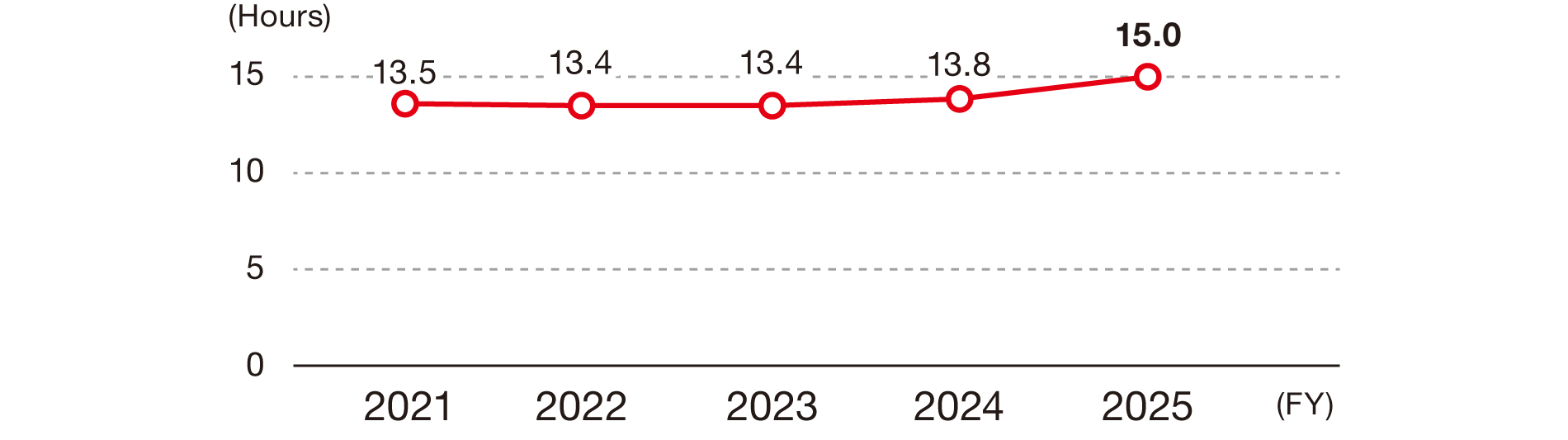
Average monthly overtime work hours
[Covered organizations:NOF]
Encouraging employees to take annual paid leave
NOF develops an environment in which employees can work with motivation as it places importance on work-life balance. To promote the use of annual paid leave, we encourage all employees to take holidays during their birth months, monitor each employee’s leave status, remind employees and their supervisors to take leave, and have the two sides review the leave status during
their meetings.
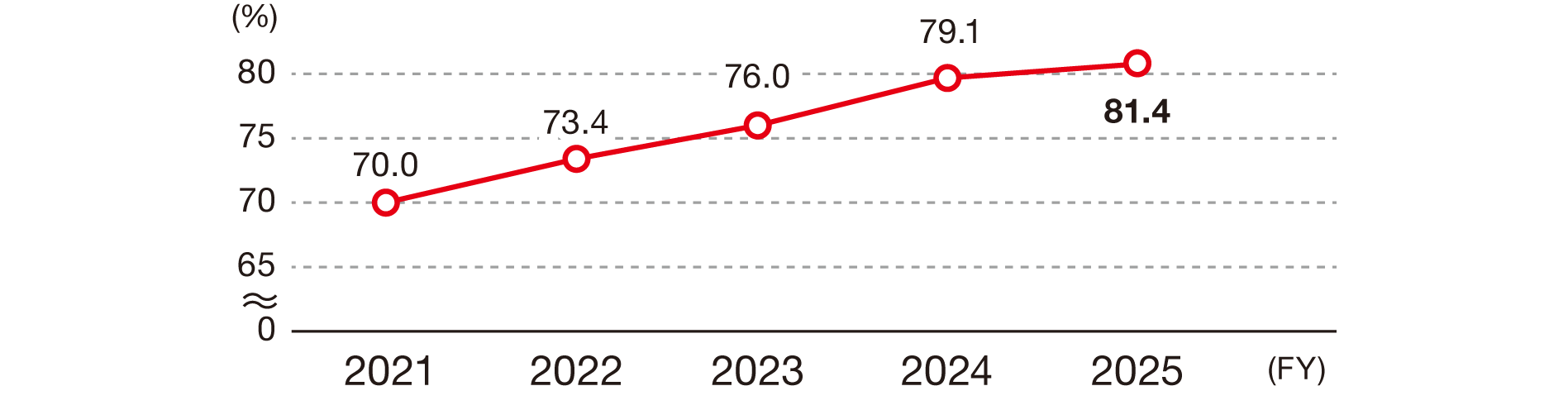
Utilization rate of annual paid leave [Covered organizations:NOF]
- FY2024:79.1%
- FY2025:81.4%
- FY2030 Target*1:75% or more
Utilization rate of annual paid leave [Covered organizations:NOF / 5 domestic consolidated companies]
- FY2024:77.6%
- FY2025:80.1%
- FY2030 Target:75% or more
Utilization rate of annual paid leave *2*3
[Covered organizations:NOF]
- The FY2025 target is 75% or higher for both NOF and 5 domestic consolidated companies
- Data are as of March 31 each year.
- Calculated for the period from September 21 of the previous year to September 20 of the current year (leave-taking period at NOF).
Personal illness or injury leave (accumulated paid leave system)
NOF has established a system under which employees can use accumulated paid leave when they need to take two or more consecutive days off due to personal injury or illness.
Refresh leave system
NOF provides a system enabling employees who have worked with the Company for 5, 10, 15, 20, 25, 30, 35, and 40 years to take five consecutive paid holidays, in order to help refresh themselves both mentally and physically, away from everyday duties, and obtain the opportunity to expand their perspectives and foster flexible thinking.
On-time leave campaign day
NOF designates Wednesdays, the second Friday and the third Friday of each month as days on which employees are encouraged to finish work on time at their respective works, as an initiative to promote efficient work styles (excluding employees on shift schedules at manufacturing sites, among others).
Volunteer leave system
NOF has established a system enabling employees to take accumulated paid leave if they take part in volunteer activities at the request of the national and local governments, etc.
Supporting Childcare/Family care
NOF promotes an environment where all employees can balance work and childcare and has achieved a high utilization rate of childcare leave among men. However, society now expects male employees to participate meaningfully in childcare rather than taking leave for only one or a few days. Accordingly, beginning in FY2026, NOF will move to the next-stage target of “at least 85% of male employees taking two or more weeks of childcare leave by FY2030,” aiming to improve the quality of childcare leave. To achieve this target while supporting employees’ career development, NOF offers the following unique support measures.
In FY2025, the percentage of NOF’s male employees taking “two weeks or more” of childcare leave was 62.7% (59.7% for NOF and five domestic consolidated companies).
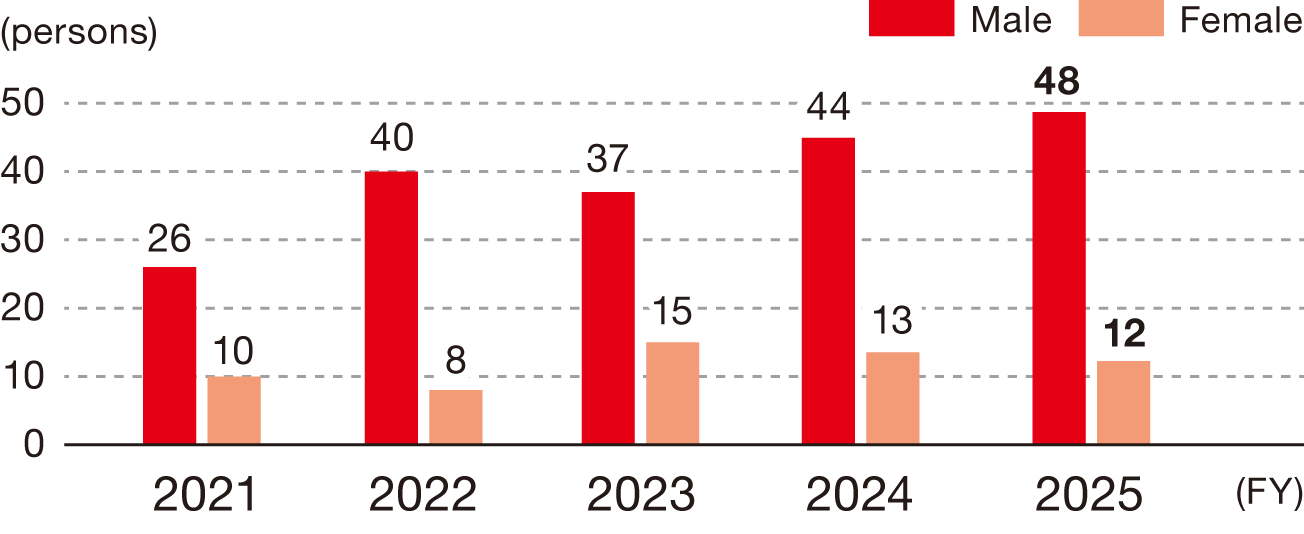
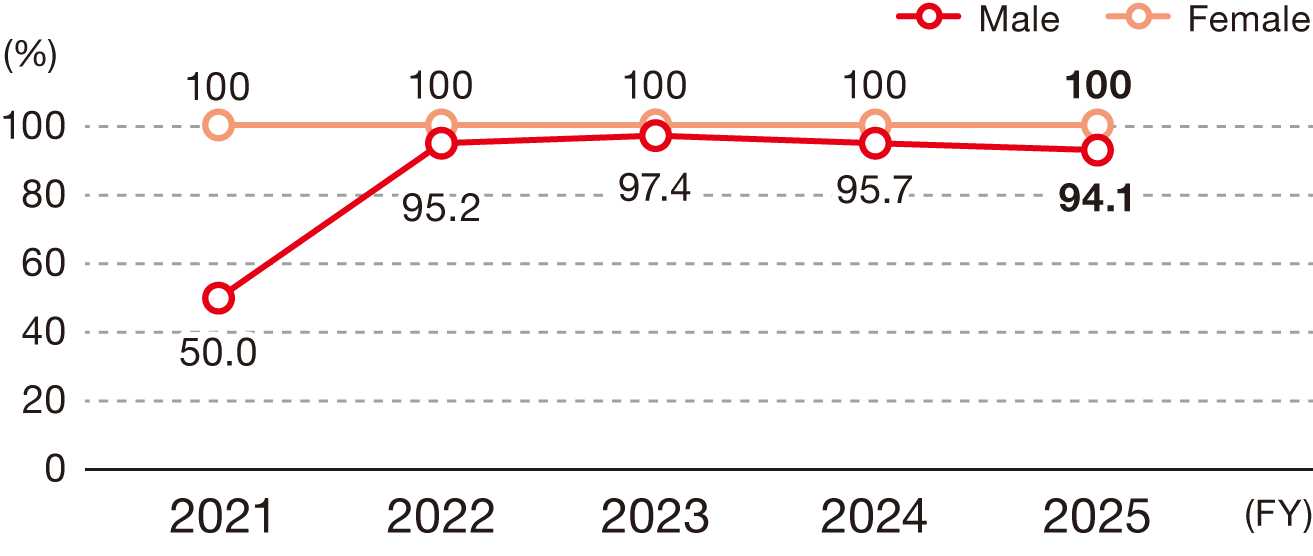
Utilization rate of childcare leave*1/ number of employees utilizing childcare leave [Covered organizations:NOF]
- FY2024:Male 95.7% (44 persons)
Female 100% (13 persons) - FY2025:Male 94.1% (48 persons)
Female 100% (12 persons)
Average number of days of childcare leave taken by men*2 [Covered organizations:NOF]
- FY2025:37.1 days
Utilization rate of childcare leave [Covered organizations:NOF / 5 domestic consolidated companies]
- FY2025:Male 81.9% (59persons)
Average number of days of childcare leave taken by men 48.3 days
Female 100% (17persons)
Employees utilizing childcare leave*3
[Covered organizations:NOF]
Utilization rate of childcare leave*3
[Covered organizations:NOF]
- Utilization rate of childcare leave is calculated according to the following criteria:
[In cases of split leave for the same child, only the initial leave is counted /
If the child is born in the previous fiscal year and childcare leave is taken in the current fiscal year, it is counted as leave taken in the current fiscal year] - The average number of childcare leave days taken is calculated according to the following criteria.
[Calculated based on the total number of childcare leave days taken by employees who returned to work in the current fiscal year] - Data are as of March 31 each year.
Childcare support program
NOF adopted “Career and Childcare Balance Support Program” in April 2016. Under this program, we introduce online lectures and Q&A sessions on work-life balance to employees who are about to go on maternity leave and those who have returned from childcare leave. The program is aimed at supporting their career development. We also provide lectures to help brush up management, language, and other business skills. In addition, we also help employees improve skills during their childcare leave and return to work smoothly by providing them with the latest company newsletters, information on personnel reshuffle, etc. The program has been used by many employees, including male employees, and is rated favorably.
NOF’s proprietary balance support handbooks
In April 2017, NOF prepared handbooks to support employees and managers in balancing work and childcare or family care. The childcare handbook summarizes information on flexible systems such as postnatal paternity leave (childcare leave at the time of childbirth) and split taking of childcare leave, as well as ways to communicate with supervisors and workplaces. The family care handbook summarizes basic knowledge on the Long-Term Care Insurance System, NOF’s balance support system regarding family care, among others. The handbooks are regularly updated in line with legal revisions and posted on the Work-Life Balance section of NOF’s intranet service (NICE). We also provide information on the handbooks to employees who need childcare or family care.
- Handbook Supporting Work and Childcare Balance (for male employees)
- Handbook Supporting Career and Childcare Balance (for managers)
- Handbook Supporting Work and Family Care Balance
- Handbook Supporting Work and Family Care Balance (basic edition introducing senior family facilities and family care expenses)
Individual provision of information to employees and establishment of consultation desks on childcare and family care
Since October 2022, NOF informs eligible employees individually on childcare leave and related systems and benefits, and confirms whether they intend on utilizing these systems. In addition, for employees who have not taken childcare leave, we reconfirm their intentions through their supervisors. Furthermore, since April 2025, we also inform employees individually on systems related to family care leave of absence, etc., and confirm their intentions. Consultation desks on childcare and family care have been established at each site, and employees can consult on the work systems they can utilize for realize work-life balance.
Operational guidelines for securing personnel to cover those on childcare leave
NOF prepared operational guidelines for securing personnel to cover those on childcare leave in July 2024. To promote the utilization of childcare leave, it is necessary to deal with challenges such as the difficulty of securing personnel to cover those on childcare leave. We prepared a handbook and deliver it throughout the Company. The handbook is aimed at eliminating, as much as possible, differences among workplaces in accessibility to childcare leave and helping each workplace run itself appropriately.
Personnel system for supporting childcare and family care
NOF works to expand various easy-to-use systems for supporting employees in balancing work and childcare or family care. We encourage employees to take childcare leave by offering pays for the first five days of postnatal paternity leave (childbirth leave at the time of childbirth) and childcare leave. In addition, employees can take paid leave for the reasons of childcare and family care by utilizing NOF’s accumulated paid leave system (a system in which unused annual paid leave can be accumulated and carried over every year). We set the total number of days of family care leave of absence above legal requirements. Among others, we support employees in balancing work and childcare or family care through flexible work systems such as the short-hour work system, flex-time system, and work-from-home system.
Employees utilizing family care leave of absence [Covered organizations:NOF]
- FY2025:0
Employees utilizing family care leave of absence [Covered organizations:NOF / 5 domestic consolidated companies]
- FY2025:1
Pensions and retirement plans
NOF has a funded defined benefit corporate pension plan to provide for the payment of retirement benefits to employees. Points are accumulated on the basis of qualifications and years of service under the human resources system, and an annuity or lump-sum payment is provided.
The funding ratio of pension assets relative to the policy reserves of the defined benefit corporate pension plan as of March 31, 2026, is as follows. Note that it exceeds the criteria on an ongoing*1 and non-ongoing*2 basis.
| Pension assets | ¥26,324 million |
| Policy reserves | ¥19,864 million |
| Funding ratio | 132.5% |
- Continuation criteria:The funded level required for pension benefits assuming that the plan will continue in the future
- Discontinuation criteria:The funded level corresponding to pension benefits if the plan were to be terminated as of the end of the fiscal year
Rewards and Incentives
Reward for employee achievements
NOF has a reward system to recognize employees whose performance the Company determines will contribute to its long-standing development every July 1.
Reward for employee invention
In April each year, NOF screens employee inventions and grants rewards to inventors.