

NOF Group Sustainability
Business Model
our customers’ product development,
we help maximize the value of their final products.
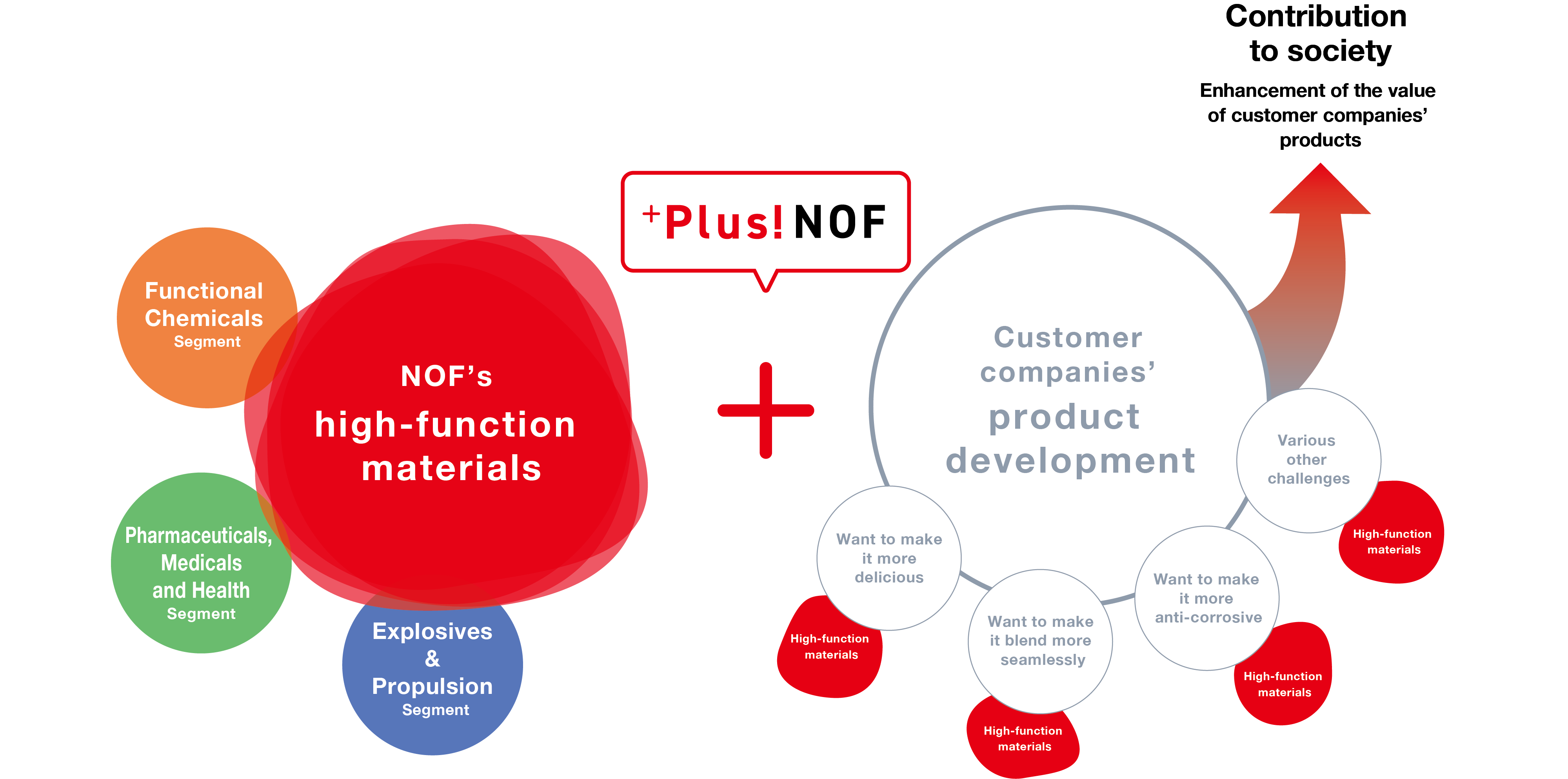
NOF offers high-function materials to help companies achieve “more” for their products, such as making medicines more effective, making parts more compact, making foods more delicious, and becoming more environmentally friendly. High-function materials are those that enhance properties such as stability, easy sliding, seamless blending, stretchiness, and high repellency. Amid the increasing commoditization of products and services and continued commitment to decarbonization, a challenge for customer companies is not only creating new products but also improving the quality of existing ones. NOF supports these efforts. Beyond simply supplying our products, we also work closely with our customers as partners in product development. By flexibly customizing materials to meet specific needs, we help turn our customers’ desire for “more” into reality.
Since our founding in 1937 as a chemical manufacturer using fats and oils as raw materials for soap, the NOF Group has continuously evolved in step with societal changes. Today, we focus our R&D efforts on three prioritized business fields: Life/Healthcare, Environment/Energy, and Electronics/IT. Our greatest strengths lie not only in the design and synthesis of materials, but also in our analytical and evaluation technologies and know-how. Furthermore, we expand our R&D areas and deepen our expertise through industry-academia-government collaboration, in addition to in-house efforts.
Examples of NOF Group products that solve customer challenges
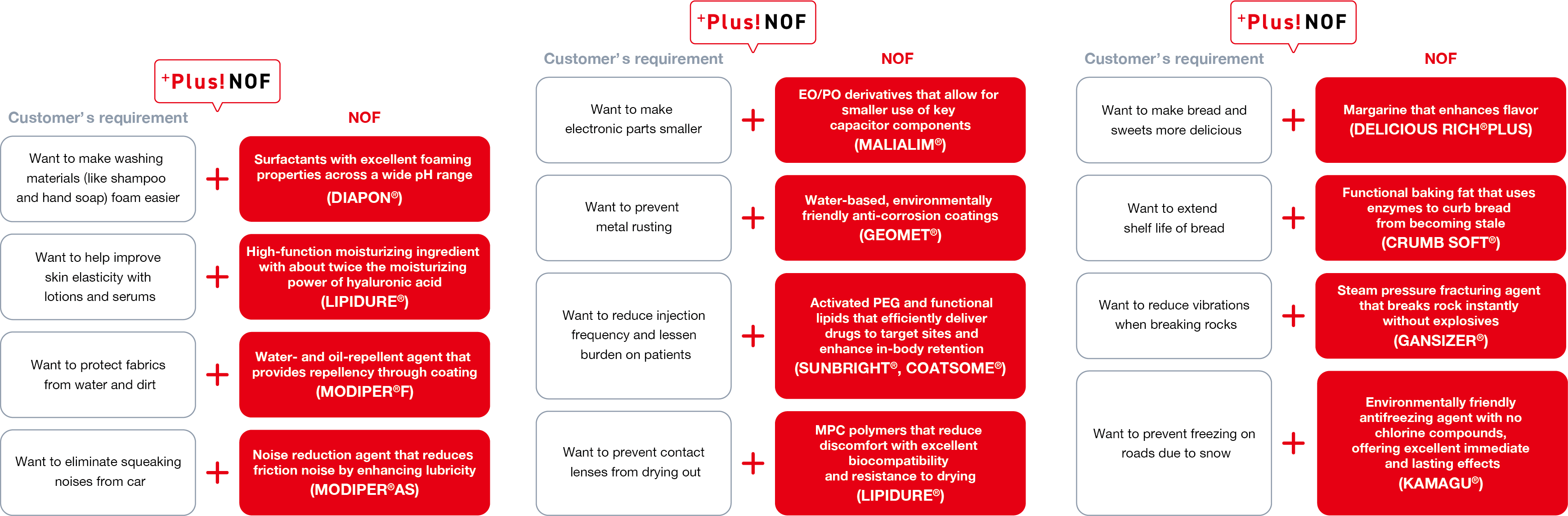
Examples of NOF Group Products That Solve Customer Challenges
Can serums or creams really improve skin wrinkles?
The four main causes of wrinkle formation
Skin wrinkles tend to become a concern with age. As they become more noticeable, you may start to worry that you look older than your age. But why do wrinkles form in the first place? Let’s take a look at the four causes.
Cause 1: Reduction of moisture in the skin (dryness wrinkles)
When moisturizing ingredients like hyaluronic acid and ceramide in the skin decrease, moisture in the skin is lost due to dryness. This causes the skin to become thin and hard, leading to the formation of fine wrinkles.
Cause 2: Repeated facial expressions (expression lines)
Repeating the same facial expressions over many years makes the skin develop matching creases, resulting in deep lines.
Cause 3: Decrease of elastic components due to aging
The loss of elastic components such as collagen and elastin, as well as moisturizing ingredients like ceramide, causes the skin to lose its resilience and firmness.
Cause 4: Damage from UV rays
UV rays cause collagen and elastin to degrade, impairing skin elasticity.
As this shows, there are various causes behind wrinkle formation. Many people may want to address these with over-the-counter serums and creams.
How can you restore your skin’s elasticity?
Wrinkle-improving cosmetics on the market include those that make wrinkles less noticeable by providing moisture to the skin, and those that fundamentally address the causes with active ingredients.
One active ingredient that directly addresses causes 1 to 3 is ceramide.
Ceramide is the main component of intercellular lipids naturally found on the skin’s surface.
It has high moisturizing and skin barrier functions, protecting the skin from dryness and irritation. However, it is known that ceramide levels decrease with age. As a result, the moisturizing and barrier functions weaken and the skin becomes hard or loses its resilience due to various causes.
Replenishing ceramide functions lost with age or dryness can be expected to improve the elasticity of hardened skin, softening and rejuvenating it.
Based on this idea, ceramide polymers—beauty ingredients with structures similar to ceramide—have been developed.
When ceramide polymers are applied to the skin, they cluster together on the surface, forming a network.
When the moisture in cosmetics evaporates, these ingredients remain on the skin, and the associating power of the polymers stretches the wrinkles and tightens the skin.

However, the ingredient itself can be removed by water or irritation, so it is important to use it continuously. Repeated daily use create a habit of smoothing out wrinkles and can be expected to promote the regeneration of soft skin.
Ceracute® — A soft texture that easily blends with skin
Natural ceramide is difficult to dissolve in water or oil. When added to serums or creams, the texture during application becomes a challenge.
Ceracute®, developed by NOF, improves the smooth texture of serums and creams. It offers a pleasant feel, blending naturally into skin without irritation. In addition to skincare, it is also used in haircare products as an ingredient that adds volume to hair.
Ceracute® is listed in cosmetic ingredient lists under the name "(Glyceryl Amide Ethyl Methacrylate/Stearyl Methacrylate) Copolymer". If you’re interested, be sure to check it out!
How can you prevent mirrors and glass from fogging up?
The mechanism of fogging on mirrors and glass
Air contains tiny, invisible amounts of moisture (water vapor).
Warm air can hold a lot of moisture, but when it cools, its capacity to hold moisture decreases. Therefore, when warm air cools suddenly, the moisture in the air turns into water droplets.
When these tiny droplets adhere to a surface such as glass or a mirror, it appears foggy.
In winter, windows fog up or become wet with condensation for the same reason. When the warm air in a room comes into contact with a cold window, the moisture in the air turns into droplets and adheres to the glass.
How can you prevent fogging?
Did you know that applying soap to your bathroom mirror prevents it from fogging up with steam? This is easy to try, so there may be many people who have already given it a go.
The basic principle of anti-fog agents used in industrial products is the same.
Soap and anti-fog agents contain surfactants.
Surfactants serve various functions. Most important for anti-fogging is the ability to prevent water from forming into round droplets.
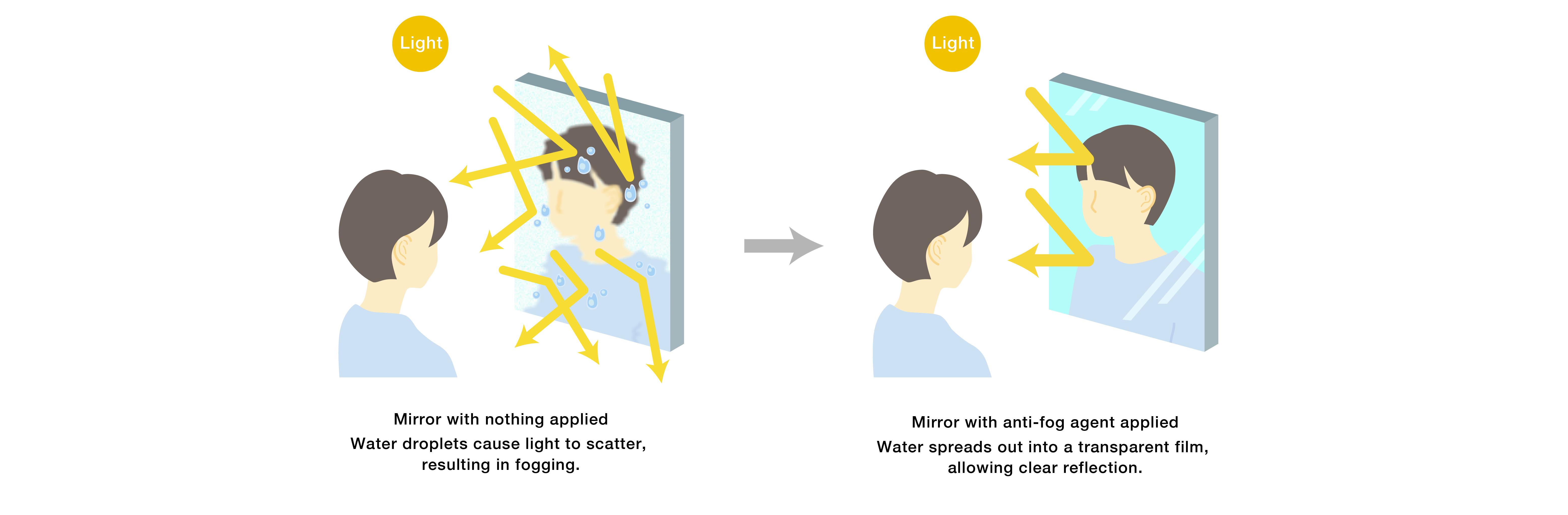
By applying surfactants to mirrors or glass, the surface tension of moisture adhering to the surface decreases. As a result, water does not form into droplets but instead spreads out as a clear film, covering the entire surface.
This mechanism makes the surface of mirrors and glass look clean and clear.
Some industrial anti-fog agents also use coatings that absorb water vapor.
So, how are industrial anti-fog agents different from soap?
The highly durable MODIPER® H Series
It would be problematic if anti-fog agents for extended-use products washed away easily with water, like soap. It is important that a product maintains its strong anti-fog effect for many years after reaching the customer, without the need for reapplication.
NOF’s MODIPER® H Series is a highly durable anti-fog agent developed for exactly that purpose.
After an object is coated and cured with heat or UV light, anti-fogging properties are imparted. Even when exposed to external stress, its self-recovery function ensures that it remains scratch-resistant and retains high anti-fog performance. The agent is suitable for use in various environments.
What technologies prevent rust on metal products?
Why metals rust
You may often see signposts, playground equipment, and fences or railings made of iron, all showing brown rust due to aging.
This sort of rust forms because of oxygen. When the surface of metal comes into contact with air or water, the oxygen in these triggers the formation of rust. This phenomenon is the reason for rust.
As rust progresses, appearance worsens and the metal becomes brittle and prone to breakage, creating hazards. Therefore, most metal products undergo anti-corrosion treatment to prevent rust.
Using more rust-prone materials as a sacrifice?
Anti-corrosion treatments include the formation of a zinc coating through electrolysis (electrogalvanizing) or the application of a zinc flake coating.
Those who notice this use of zinc might wonder whether zinc is highly resistant to rust. Actually, the opposite is true—zinc is a metal that rusts (oxidizes) more readily than iron.
The anti-corrosion treatments mentioned above protect the base material from rust by coating the material with zinc, so that the zinc oxidizes before the material does.
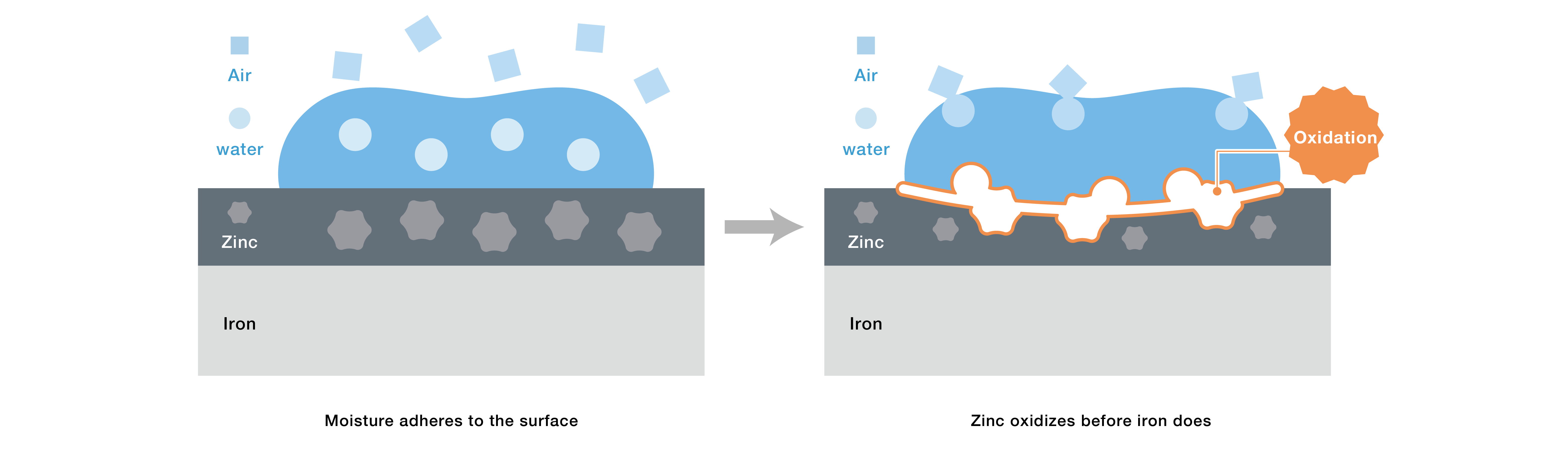
When zinc rusts (oxidizes), it turns into a white powder. As this doesn’t completely prevent rust, a critical point in anti-corrosion treatments using zinc is figuring out ways to slow oxidation even further. Service life varies with the treatment method and environment.
GEOMET®: Rust-resistant and environmentally friendly
NOF’s zinc flake-type anti-corrosion coating GEOMET® uniquely blends zinc with aluminum and other ingredients. This provides outstanding corrosion resistance compared to conventional zinc plating treatments.
It is also designed to be safer to use, with consideration for the environment and health.
- Contributes to greater lifespan and recyclability of iron, supporting resource conservation
- Completely chrome-free, with no toxic or carcinogenic chromium compounds
- Imposes less environmental burden than other anti-corrosion treatments, with no wastewater generated during treatment
As an environmentally compatible anti-corrosion coating, GEOMET is widely used in fields such as automotive parts and wind power generation components.
How can you prevent contact lenses from drying out?
Causes of lens dryness
Many consumers wear contact lenses daily for orthoptic or cosmetic use, but some wearers may feel discomfort. Of several possible causes, the most common is dryness.
Moisture may evaporate from the lenses during periods of long use. The dried lenses absorb tears, creating a feeling of eye dryness.
Infrequent blinking and air conditioning can dry lenses.
What are lens manufacturers doing?
To prevent contact lenses from drying, manufacturers coat the lens surfaces with biocompatible materials and add moisturizing agents to the lens packaging solution.
There are several types of moisturizing agents. MPC polymers in particular have been noted for their high biocompatibility and their moisturizing capability twice that of hyaluronic acid.
MPC polymers are an artificial material with a surface structure similar to the human cell membrane. This confers high moisturizing capability as well as excellent safety due to low risk of rejection.
Adding MPC polymers to the lens packaging solution maintains the lens surfaces' moisturizing capability.
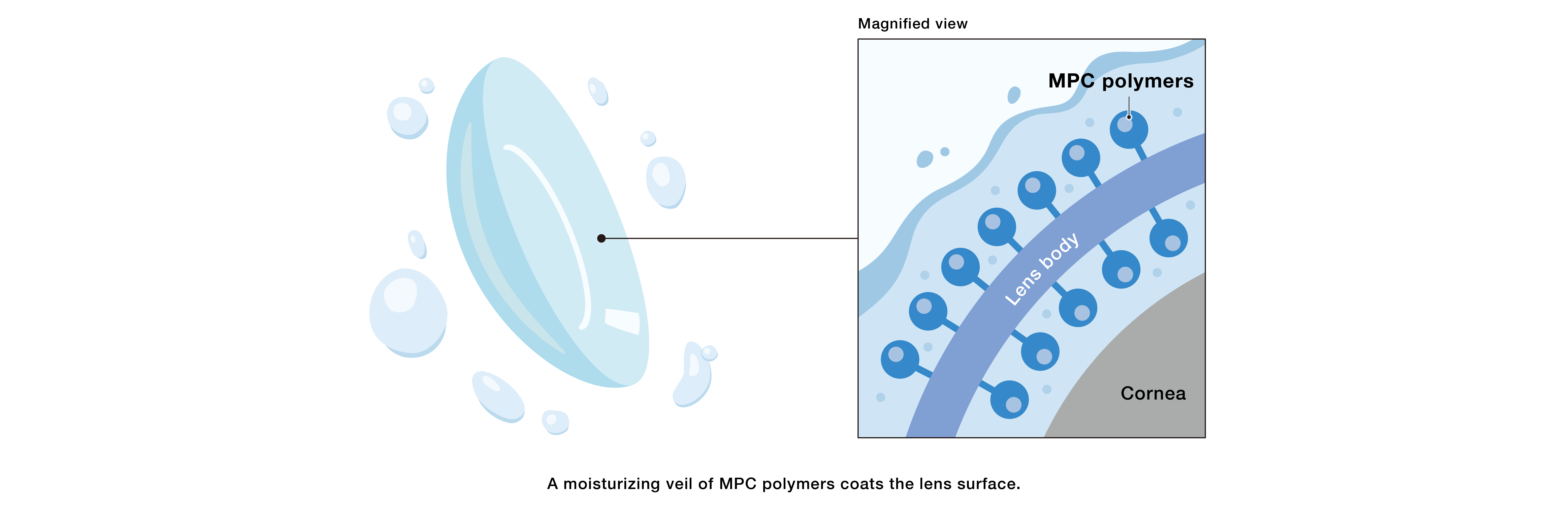
Furthermore, by incorporating MPC monomers as a material in the lens body, high moisture retention can be added to the lens itself.
MPC polymers can be added not only to contact lens packaging solutions but also to eye drops to relieve dry eye. The hydrophilic properties of MPC polymers have been found to inhibit evaporation of tears.
Lipidure® – MPC polymers with uses beyond eye care
Focusing on the biocompatibility of MPC polymers, NOF has expanded their applications to a variety of fields.
Lipidure® enables a free molecular design with physical properties that can be customized for the purpose. It is used for oral care, cosmetics, diagnostics, materials of medical devices, and more.
Why do store-bought breads stay tasty for days?
Why does the texture of homemade bread change quickly?
When you bake bread at home, you’re often impressed by its fresh-baked flavor and can't wait to have it again the next day.
However, by the next day, homemade bread dries out or hardens. You may have been surprised at how much it seems like a different bread altogether.
The reason bread becomes hard is the aging of the starch in the wheat flour.
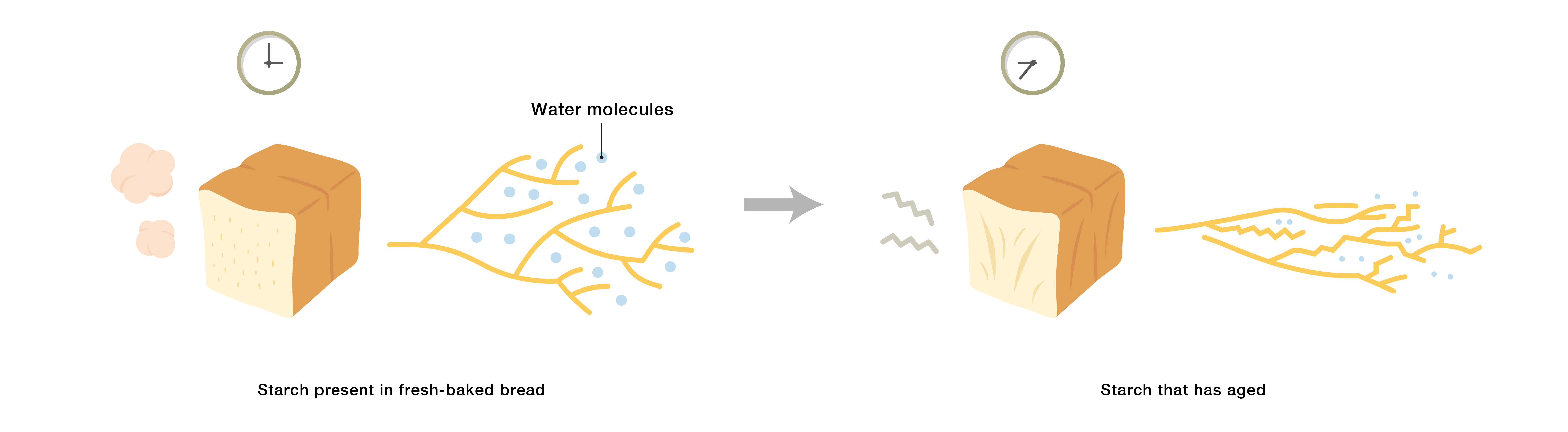
The starch in fresh-baked bread swells under heat, becomes filled with water, and forms a loosened structure.
However, as time passes and water is lost, the starch ages and changes into a hard structure. This is why the texture of bread changes over time.
The secret behind store-bought bread’s long shelf life
By contrast, bread sold at convenience stores and supermarkets often has a shelf life of several days during which it maintains quality.
This is thanks to technology that prevents the aging of starch.
How to prevent starch aging 1: Emulsifiers
The starch-modifying components in emulsifiers combine with starch to preserve the loosened starch structure.
How to prevent starch aging 2: Enzymes
Enzymes are used to break down starch and prevent the bread from solidifying.
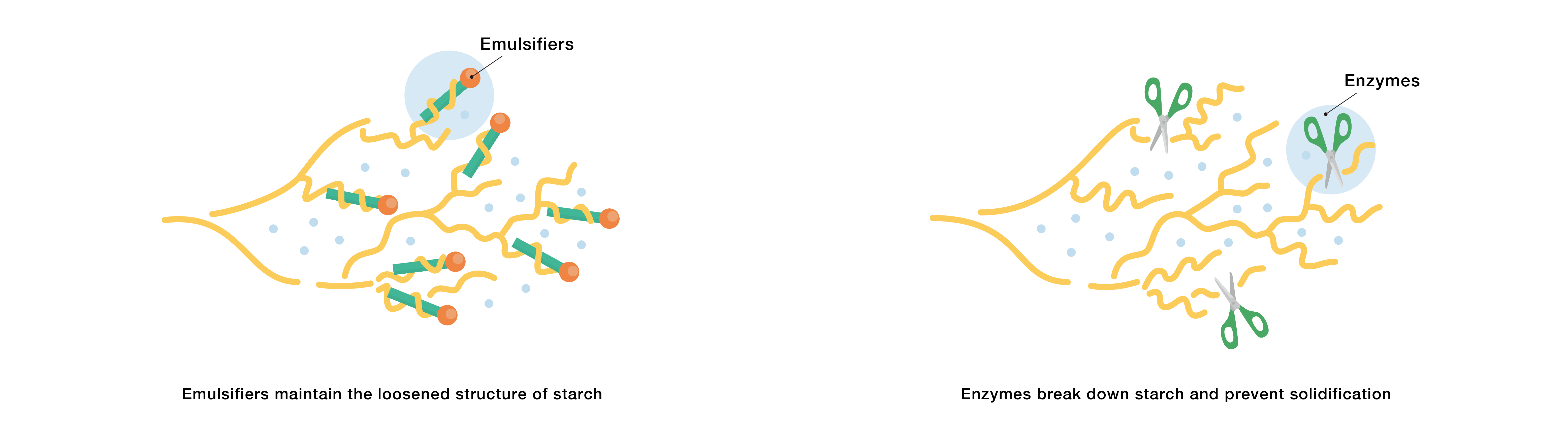
Emulsifiers and enzymes impact taste and texture differently, so their use depends on the type of bread to be made.
Controlling the deliciousness of all kinds of foods!
NOF is a leading manufacturer of functional food materials. We continually update our technology to make the bread on your table tastier and longer-lasting.
Starch can only be broken down by enzymes once it has been loosened through heating. Conversely, standard enzymes are sensitive to heat and lose effectiveness quickly during baking, which has posed a challenge.
NOF, through its proprietary research, has developed enzymes that remain effective at higher temperatures for longer periods. This has made it possible to enjoy a wider range of textures for longer.
We have also improved the quick dispersion of emulsifiers into bread dough.
NOF’s “Science of Deliciousness” isn’t limited to bread. Day by day, we explore new materials and technologies to further enhance the deliciousness of a wide range of foods, including sweets and noodles.
How do temperature-sensitive paints and labels work?
Temperature indicators found in everyday life
Materials such as paints, labels, and tapes that change color with temperature are called “temperature indicators.”
Although many people may not be familiar with the term “temperature indicators,” the mechanism is used in common household items. Examples include mugs whose designs change with temperature and pens whose ink disappears when rubbed due to frictional heat.
Temperature indicators are also used on-site in manufacturing, processing, power generation, transportation, and other industries. While mechanical thermometers are sometimes used, in industrial settings temperature indicators often offer the following advantages.
Features of Temperature Indicators
- No power supply required
- Low cost; can be applied or painted in many locations
- Color change clearly indicates temperature, reducing misreading
Mechanisms of Color Change
There are various ways to induce color change in materials through temperature.
Two representative mechanisms are as follows:
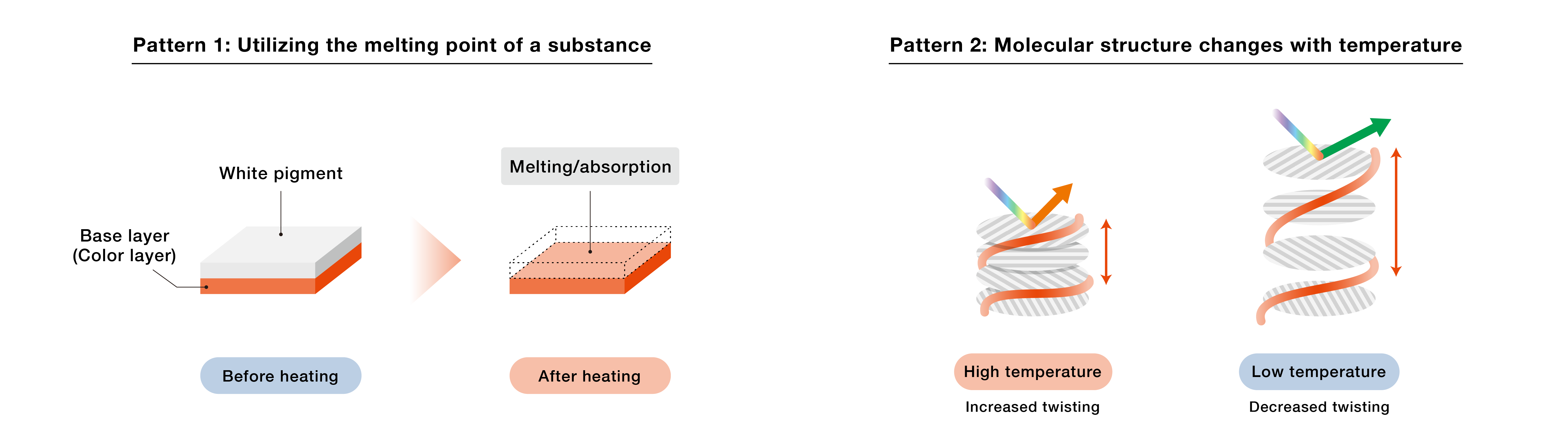
Pattern 1: Utilizing the melting point of a substance
Just as ice always melts at 0°C, every substance has a specific melting point at which it transitions from solid to liquid. This pattern utilizes the property of specific melting point to expose the underlying color layer, resulting in a visible color change.
Pattern 2: Utilizing materials whose molecular structure changes with temperature
This pattern utilizes the phenomenon by which molecular motion increases with temperature rise and decreases with temperature drop.
Twisted-structure molecules are commonly used in standard temperature indicators. The degree of molecular twist changes with temperature. In many materials, molecules become more twisted at higher temperatures and less twisted at lower temperatures. As the molecular structure alters, the wavelength of reflected light shifts, enabling observable color changes.
Flexible temperature management in a variety of environments
As explained earlier, temperature indicators are used in a wide range of settings such as manufacturing and processing sites.
For example, they are used in electrical equipment and electronics maintenance, in cold-chain logistics, and as labels to check for abnormal heating of train wheels.
In other words, the purpose of using temperature indicators varies with the site.
“I want to use irreversible indicators that retain their changed color.”
“I want to use indicators that are durable and reusable.”
“I want to use indicators accurately in high-temperature environments.”
“I want to use indicators outdoors.”
NiGK Corporation offers a wide lineup to meet such a wide range of needs.
By supporting essential on-site temperature management, we ensure safety and quality.