Value Creation

Materiality and KPIs

This is a image related to Value Creation

Materiality matrix

The 24 materiality factors were mapped according to the two axes of “degree of impact on society” and “degree of impact on our company” to create a materiality matrix. We identified 11 items shown in the top right of the matrix as material issues.

FY2025 review

Directors, including Outside Directors, and titled Operating Officers participated in the Sustainability Committee chaired by the President, reviewed materiality issues, and established FY2026 indicators (KPIs) and targets based on the FY2025 results for each issue.
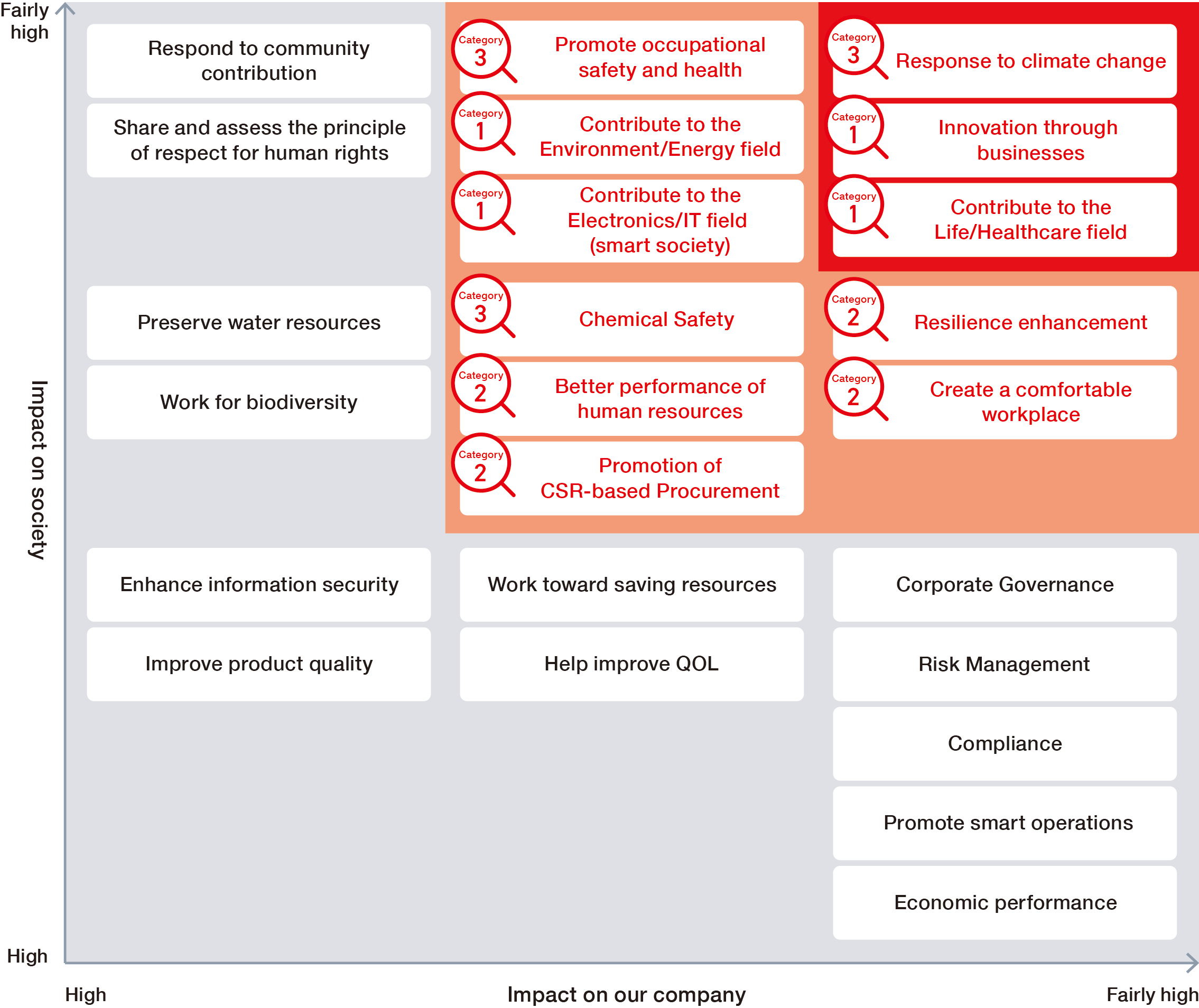
This is a materiality matrix mapping 24 materiality elements along two axes: impact on society and impact on the company. Eleven items have been identified as key issues in the upper-right quadrant, where the impact on both axes is

Materiality matrix

3 Categories

Concrete deployment of material issues

The NOF Group has classified 11 identified materiality items into three categories and is taking action by linking them to concrete business activities. For each materiality item, a lead division and responsible division are assigned, and indicators (KPIs) and targets are set as we undertake initiatives.
We will enhance the sustainability of the NOF Group and society as a whole with the aim of realizing the “NOF VISION 2030” .

Category1 Provide new values to realize a prosperous and sustainable society

Targeting the three prioritized business fields, we will aim to offer new value by combining the core technologies we have cultivated through our diverse business development.
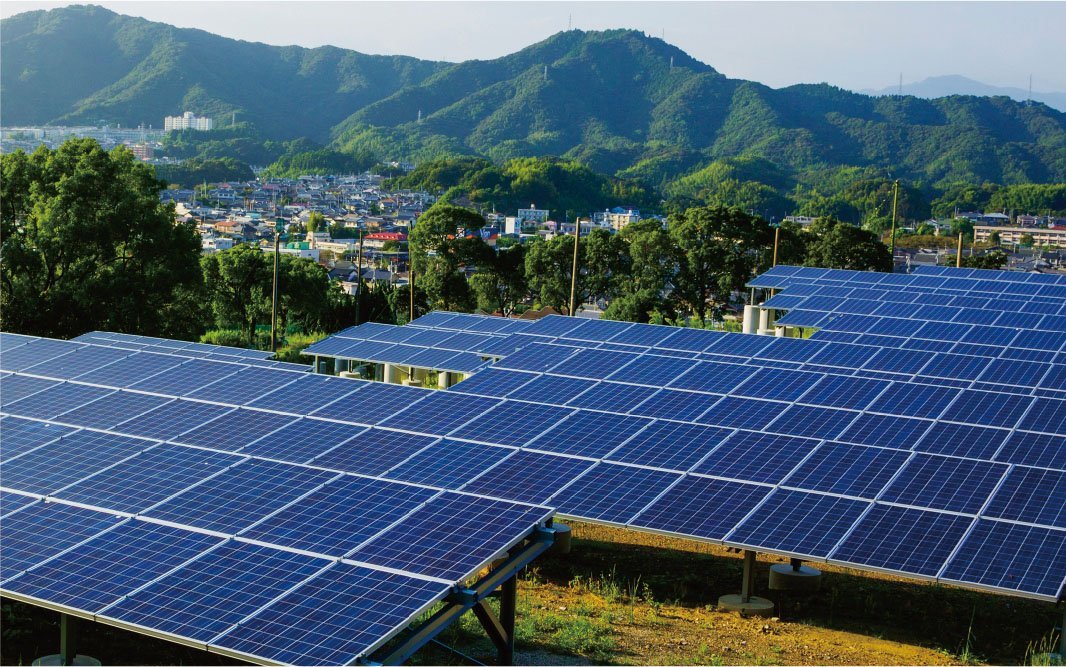
This is a photograph of solar panels installed outdoors near a mountainous area.
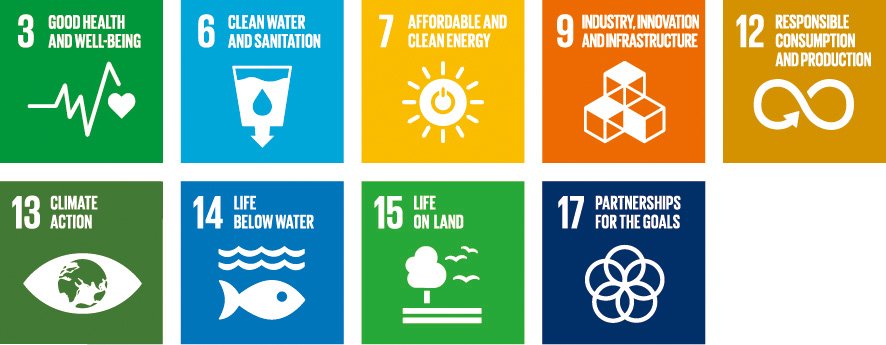
These are the logos for SDGs Goals 3, 6, 7, 9, 12, 13, 14, 15, and 17.
Category2 Strengthen the business foundation

As well as building a corporate culture that accepts diversity of values, we will appropriately identify changes in the environment and technological progress and enhance our resilience.

This is a stock photo taken from behind, showing five people lined up by a window, gazing at the incoming light.
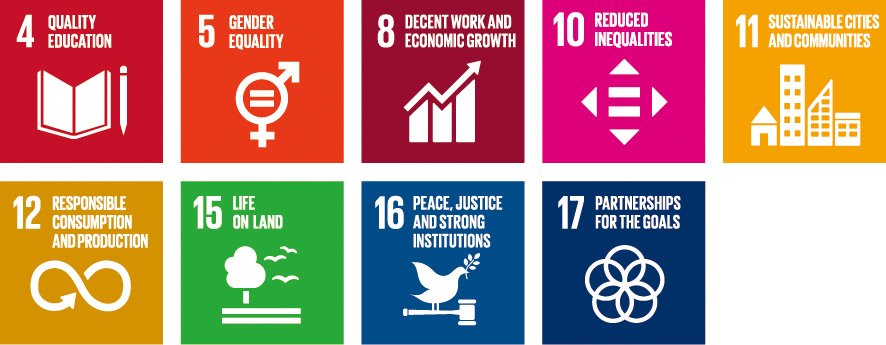
These are the logos for SDGs Goals 4, 5, 8, 10, 11, 12, 15, 16, and 17.
Category3 Promote Responsible Care activities

By ensuring environmental, safety, and health throughout all processes from product development and manufacturing to disposal, we aim to be a corporate group trusted by society as a whole.
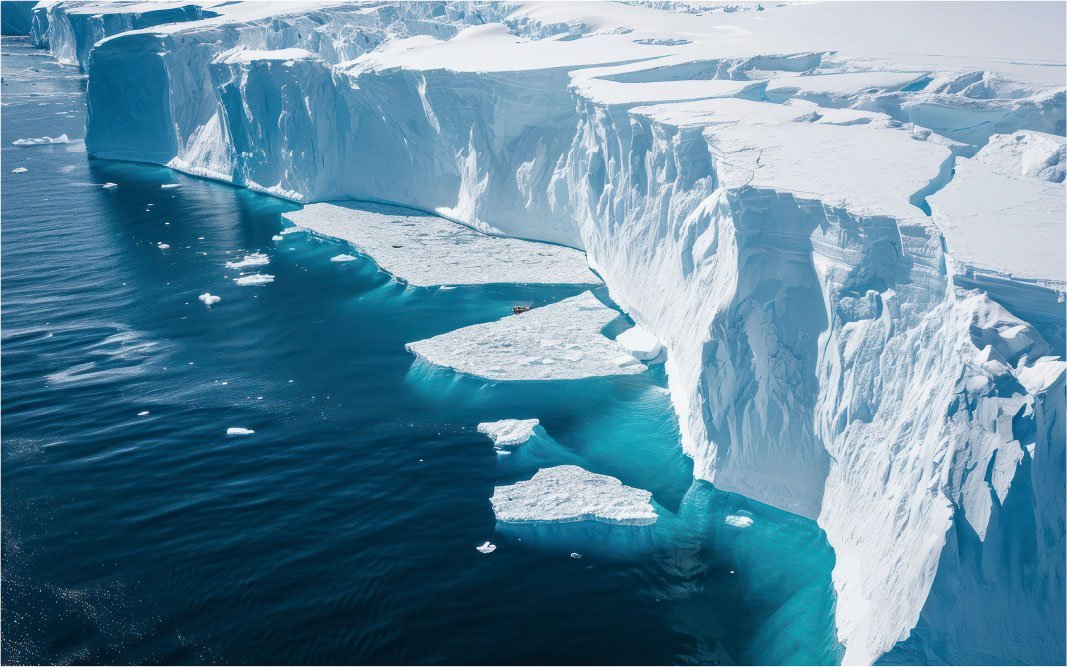
This is a stock photo showing the edge of a glacier facing the sea as it collapses.
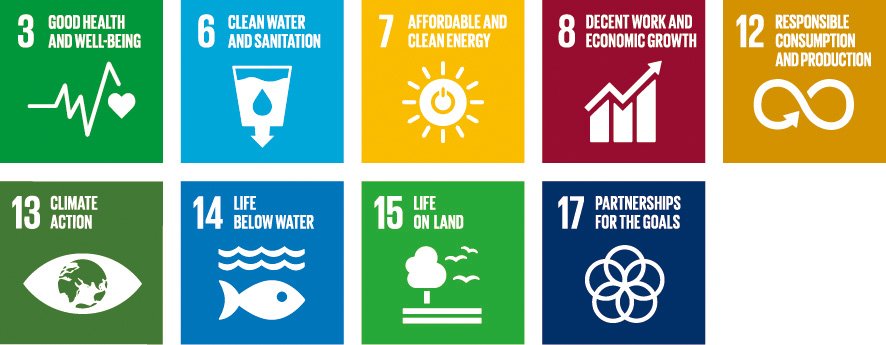
These are the logos for SDGs Goals 3, 6, 7, 8, 12, 13, 14, 15, and 17.

KPIs

Category1 Provide new values to realize a prosperous and sustainable society
Materiality Indicators (KPIs) FY2025 FY2026
Numerical targets Target fiscal year Results Details of major initiatives Numerical targets Target fiscal year Details of major initiatives
Innovation
through
businesses
R&D investment amount
(NOF Group)
¥25.6 billion
(3-year
cumulative total)
2025

¥8.1 billion
3-year cumulative total ¥23.3 billion
(achievement rate of 91%)

Enhancement of
R&D capabilities

  • Call for commissioned industry-academia research
  • Promotion of
    joint research
  • Enhancement of support for R&D
  • Intellectual property strategy formulation and strategic applications
¥28.4 billion
(3-year
cumulative total)
2028

Enhancement of
R&D capabilities

  • Creation of promising topics in growth fields
  • Early commercialization of business development topics
  • Strengthening support for R&D efficiency
  • Strengthening IP strategy
Number of patent
applications
(NOF)
500 cases
(3-year
cumulative total)
2025

215 cases
3-year cumulative total 597 cases
(achievement rate of 119%)

630 cases
(3-year
cumulative total)
2028
Contribute to the
Life/Healthcare
field
Net sales of strategic
products* in the Life/Healthcare field
(NOF Group)
15% increase (compared to
FY2022 results)
2025 12% increase (compared to FY2022)
  • Supply of strategic products to the Life/Healthcare field
20% increase (compared to
FY2025 results)
2028
  • Supply of strategic products to the Life/Healthcare field
Contribute to the
Environment / Energy field
Net sales of strategic
products* in the Environment/
Energy field
(NOF Group)
15% increase (compared to
FY2022 results)
2025 66% increase (compared to FY2022)
  • Supply of strategic products to the Environment/Energy field
100% increase (compared to
FY2025 results)
2028
  • Supply of strategic products to the Environment/Energy field
Contribute to the
Electronics/IT field (smart society)
Net sales of strategic products* in the Electronics/IT
field
(NOF Group)
15% increase (compared to
FY2022 results)
2025 24% increase (compared to FY2022)
  • Supply of strategic products to the Electronics/IT field
30% increase (compared to
FY2025 results)
2028
  • Supply of strategic products to the Electronics/IT field
Among the products in the three prioritized business fields outlined in our vision (Life/Healthcare, Environment/Energy, Electronics/IT), strategic products refer to products for which we pursue customer satisfaction and incorporate new functions and technologies to deliver superiority over competitors, or products we aim to develop into core offerings of our future business divisions
Category2 Strengthen the business foundation
Materiality Indicators (KPIs) FY2025 FY2026
Numerical targets Target fiscal year Results Details of major initiatives Numerical targets Target fiscal year Details of major initiatives
Human Capital Enhancement
・Talent
 Development

・Diversity


Talent Development Investment
(NOF)
Over 2.5-fold (compared to
FY2022 results)
2025 2.6-fold (compared with FY2022)
  • Strengthening
    growth support
Over 3.5-fold (compared with FY2022) 2030
  • Strengthening growth support
Rate of hiring of female new
graduates recruited for career-track positions
(NOF)
30% or more Every fiscal year 39.1%
  • Implementation of systematic
    recruitment
30% or more Every fiscal year
  • Implementation of systematic recruitment
Ratio of female
management-level
employees
(NOF)
Over 3-fold (compared to
FY2021 results)
2030 1.3-fold (compared with FY2021)
  • Implementation of systematic recruitment
  • Development and promotion of female management-level employees
Over 3-fold (compared with FY2021) 2030
  • Implementation of systematic recruitment
  • Development and promotion of female management-level employees
Percentage of
employees with
disabilities
(NOF)
3.0% or more 2030 2.82%
  • Promotion of employment of people with disabilities
3.0% or more 2030
  • Promotion of employment of people with disabilities
Pay gap ratio between male and female full-time employees
(NOF)
(5 domestic consolidated companies)
75% or more 2030 73.6%
(NOF)
72.4%
(5 domestic consolidated companies)
  • Improvement of working environments, such as production sites
  • Development and promotion of female management-level employees
75% or more 2030
  • Improvement of working environments, such as production sites
  • Development and promotion of female management-level employees
FY2025:
Rate of male employees utilizing childcare leave
(NOF)

FY2026:
Rate of male employees utilizing childcare leave for
2 weeks or longer*1
(NOF)
100% 2030 94.1%
(taking at least 1 day of annual leave)
  • Development of environments where leave can be utilized easily

85% or more

2030
  • Development of environments where leave can be utilized easily
Risks
  • Sustainable business growth stalls due to delays in talent development
  • Inability to secure necessary employees leading to delays in business plans
Opportunities
  • Evolution of organizational capabilities through a combination of internal talent development and external recruitment
  • Investment in labor saving and automation (accelerating smart factory implementation)
  • Improvement of manufacturing workplaces where the elderly and women are able to participate in an active manner, achieving a diverse organization
Strategies
  • Deliberation on company-wide talent development policies and plans, and evaluation of implementation content at the Talent Review Meeting
  • Discussion of talent development, recruitment status, and response policies at the Sustainability Committee
  • Promotion of business understanding by holding factory tours, etc., for new graduate hires, and expansion of dissemination channels for recruitment information for mid-career workers
  • Development of a re-employment system for retirees to rejoin the company
  • Accumulation of smart factory implementation know-how at a model factory and deployment to other factories
  • Implementation of planned capital expenditures (improvement of the workplace environment)
Create a comfortable
workplace

・Employee
 engagement


Utilization rate of annual paid leave
(NOF)
(5 domestic consolidated companies)
75% or more 2025 81.4%
(NOF)
80.1%
(5 domestic consolidated companies)
  • Raising awareness by disseminating the Health-Conscious Management Declaration
75% or more 2030
  • Raising awareness by disseminating the Health-Conscious Management Declaration
Overall employee
engagement score
(NOF)
50.0 or more 2025 51.0
  • Execution of measures using employee engagement surveys as a starting point
53.0 or more 2030
  • Execution of measures using employee engagement surveys as a starting point
Risks
  • Rise in turnover rate due to family care, etc., impeding business promotion and operation execution
Opportunities
  • Improvement of organizational resilience through standardization of operations
  • Improvement of employee engagement with greater support measures for balancing work with childcare and family care
Strategies
  • Provision of opportunities to engage in career dialogue with supervisors, support for career development, and promotion of a comfortable workplace
  • Career consultation services and support for self-directed career development and growth
  • Improvement of productivity through operational efficiency and process reviews via DX promotion and introduction of generative AI
  • Enhancement of support systems for balancing work with childcare and family care
Promotion of
CSR-based
Procurement


Coverage rate of CSR questionnaire survey  (based on value of purchases)
(NOF)
85% or more 2025 92%
(cumulative total over
2025 plan)
(NOF)
  • CSR questionnaires for suppliers completed in FY2023 and FY2024
85% or more 2028
  • Implementation of the CSR questionnaire*2
FY2025:Improvement requests via
interviews to target suppliers in order to firmly establish CSR-based procurement
(based on number
of companies)
(NOF)

FY2026:
25 Mid-term Management Plan Interview Supplier improvement rate
(Number of companies improved /24 companies)(NOF)
85% or more 2025 96%
(Interviews conducted with 24 of the
25 targeted companies)
  • Implementation of improvement requests via interviews to
    target suppliers
75% or more 2028
  • Follow-up with
    target suppliers
Risks
  • Drop in credibility due to perceived insufficiency of efforts for sustainable and responsible procurement
Opportunities
  • Fulfillment of social responsibility, risk reduction, enhancement of brand value, strengthening of competitiveness
Strategies
  • Implementation of interviews with suppliers and requests for improvement
Resilience
enhancement
BCP education and training hours
(NOF Group)
Total of 4,000 hours Every fiscal year Total of 8,000 hours or more
  • Enhancement of each BCP manual
  • Improvement of response capabilities through expanded training scenarios
  • Inspection and confirmation of location activities through audits
Total of 4,000 hours or more Every fiscal year
  • Enhancement of each BCP manual
  • Improvement of response capabilities through expanded training scenarios
  • Inspection and confirmation of location activities through audits
    1. Changed from taking at least 1 day (FY2030: 100%) to taking at least 2 weeks from FY2026. This improves the quality of childcare leave by enabling actual participation in childcare.
    2. Also deployed to YUKA SANGYO CO., LTD., Nippon Koki Co., Ltd., NiGK Corporation, Showa Kinzoku Kogyo Co., Ltd., and NOF METAL COATINGS ASIA PACIFIC CO., LTD.
    Category3 Promote responsible care activities
    Materiality Indicators (KPIs) FY2025 FY2026
    Numerical targets Target fiscal year Results Details of major initiatives Numerical targets Target fiscal year Details of major initiatives
    Response to  climate change


    CO₂ emissions
    (Domestic Group)
    40% reduction (compared with FY2013) 2030 123,000 tons/year
    31%
    reduction (compared with
    FY2013)
    • Promotion of a shift to energy sources with low environmental impact
    • Promotion of introduction of energy-saving facilities
    • Promotion of efficient energy use and visualization
    107,000 tons/year
    40% reduction
    (FY2013:179,000 tons/year)
    2030
    • Promotion of a shift to energy sources
      with low
      environmental impact
    • Promotion of introduction of energy-saving facilities
    • Promotion of efficient energy use and visualization of consumption
    Carbon neutrality
    (NOF Group)
    Aim for
    achievement
    2050 Aim for
    achievement
    2050
    Risks
    • Increase in manufacturing cost due to compliance with environmental regulations, decrease in product sales
    • Increased procurement costs due to soaring raw material prices
    • Reputational damage and falling stock prices due to the use of certain raw materials
    • Increase in cultivation/production and procurement costs due to degradation of ecosystem services
    • Decrease in sales caused by flood and wind damage to production bases and value chain
    Opportunities
    • Decrease in manufacturing cost through improved resource efficiency
    • Increase in sales due to growing demand for products that contribute to environmental conservation
    Strategies
    • Promotion of initiatives to reduce GHG emissions
    • Reduction of plastic usage
    • Securing stable raw materials through multiple purchases and long-term contracts
    • Procurement of sustainable palm oil
    • Selection of suppliers and business partners taking into account risks at the production area (ensuring traceability)
    • Rain water countermeasures and disaster prevention measures for buildings and facilities
    • Development and provision of products that contribute to environmental conservation
    Chemical Safety


    Emissions of
    substances subject to PRTR Act after revision in FY2021
    (Domestic Group)
    under 170 tons/year Every fiscal year 139 tons/year
    • Creation and execution of emission
      reduction measures
    • Reevaluation of production processes
    170 tons/year
    or less
    Every fiscal year
    • Creation and
      execution of emission
      reduction measures
    • Reevaluation of production processes
    Risks
    • Tighter domestic and international regulations
    • Increases in cost associated with expansion of facilities and strengthening of management systems to comply with regulations
    • Inability to manufacture existing products leading to a decline in sales
    Opportunities
    • Proactive emission control measures and the development and provision of products that contribute to sustainability improve the Company’s ratings
      and reputation
    Strategies
    • Creation and execution of emission reduction measures
    • Reevaluation of production processes
    • Expansion of information provision to stakeholders
    • Ensuring compliance with domestic and international regulations
    Promote
    occupational
    safety and health
    Number of lost workday-involving accidents
    (Domestic Group)
    0 Every fiscal year 4 cases

    Through the participation of all personnel and risk anticipation

    • Enhancement of sensitivity toward danger
    • Thorough enforcement of basic safety actions
    • Reduction
      of disaster risks
    • Strengthening of responses based on Sangen Shugi
      (the “three actuals” principle)
    0

    Every fiscal year

    Through the participation of all personnel and risk anticipation

    • Further fostering of a safety culture
    • Adoption of basic safety actions
    • Reduction of
      disaster risks
    • Strengthening
      of responses based on Sangen Shugi
      (the “three actuals” principle)

    The NOF Group’s Vision

    Toward our corporate vision in NOF Vision 2030

    A corporate group that continuously creates new value with the power of chemistry in the three fields of Life/Healthcare, Environment/Energy, and Electronics/IT in order to realize a prosperous and sustainable society
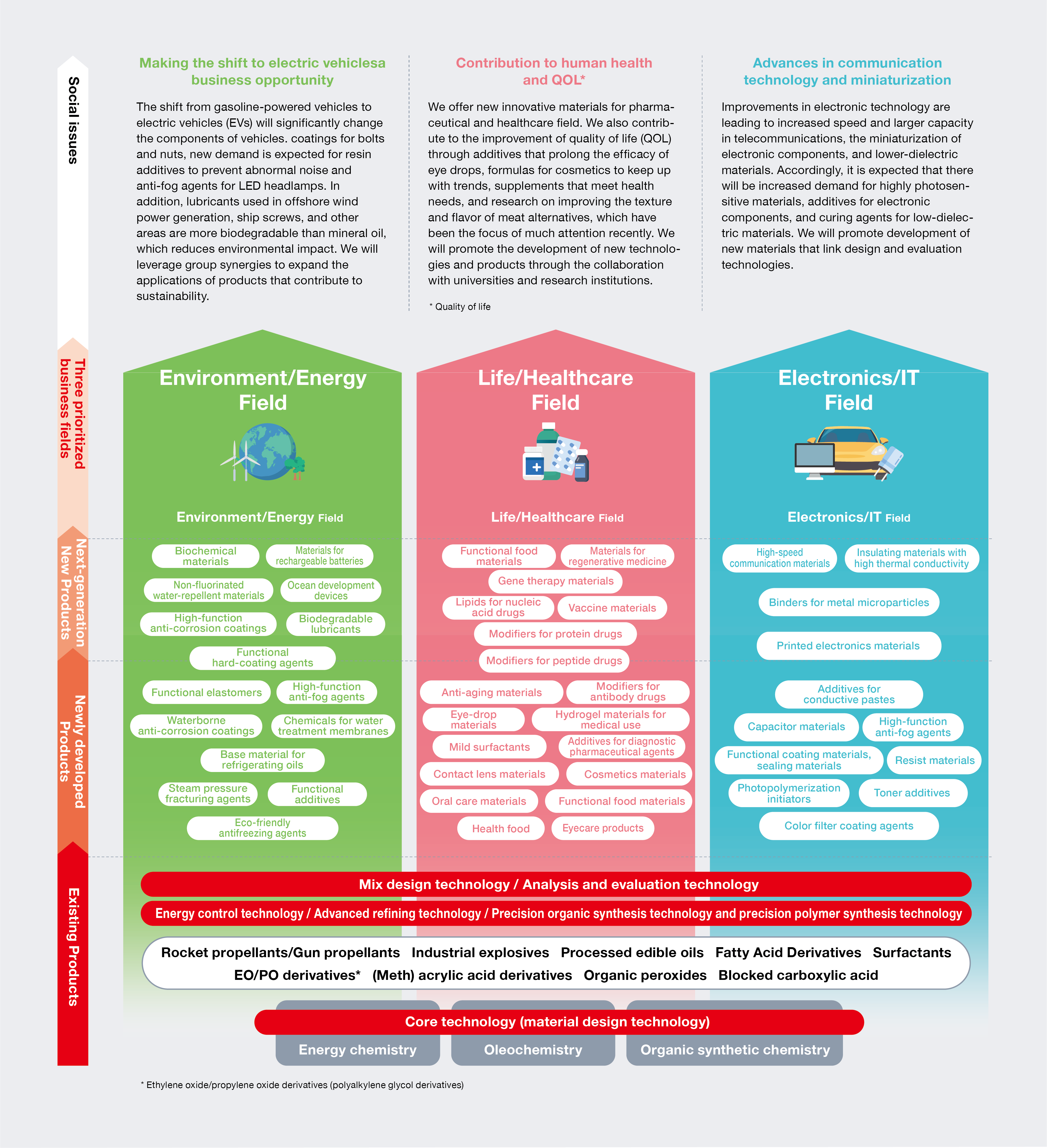
    This diagram illustrates a focus on three key areas—environment and energy, life and healthcare, and electronics and information—aimed at addressing societal challenges. Leveraging expertise and know-how in energy chemistry, oleochemistry, and organic synthetic chemistry, the company creates products based on core technologies (specifically, material design technology). In addition to selling existing products, the company works on newly developed items and next-generation products to help resolve societal issues.