

Value Creation
DX Strategy

Policy
Through DX, NOF aims to continue to be a company where all employees are highly motivated to engage creatively in their work and promptly provide high-quality products and services that anticipate the needs of customers and society. To this end, we will utilize digital data and technology to strengthen our ability to develop new products and technologies and improve productivity. As a DX strategy for realizing this vision, we have adopted “Promotion of business improvement and efficiency through digitalization” and established the following three priority implementation items: (1) Development of DX human resources, (2) promotion of DX, and (3) development of a data utilization environment. By implementing these items, we will provide value to our customers and to society in the form of more sophisticated marketing, strengthened R&D capabilities, and improved productivity and quality, and to our employees in the form of automation and streamlining of operations, and reform of work styles.
DX Strategy
Promoting operational improvement and efficiency through digitalization
Priority items
1. Development of DX human resources
(1)Accelerate the development of human resources responsible for promoting DX
(2)Improve DX literacy
2. Promotion of DX
(1)Promote Company-wide DX activities
(2)Support DX promotion activities in each division and site
3. Development of a Data Utilization Environment
(1)Build a data utilization platform
(2)Promote the utilization of internal data
(3)Introduce an information search system
(4)Establish policies and an environment for using generative AI
Development of DX human resources
DX Human Resources Development Program
Based on its DX strategies and challenges, NOF focuses on developing DX human resources to establish a framework in which each division and location autonomously promotes DX. Development program participants are selected from each division and location and classified into three personnel types: “DX Promoters,” “Data Utilization Promoters,” and “System Personnel.” To help them acquire the necessary expertise and skills, we provide, in addition to the standard program, individualized training based on participant survey results, thereby offering learning opportunities tailored to each person’s challenges and needs. In the third phase of the development program, 64 employees are participating in the DX Human Resources Development Program. Those who complete the program are certified as “DX Human Resources” and issued a “Digital Certificate.” Furthermore, 53 “DX Experts” selected from among the DX human resources play a central role in our DX promotion activities.
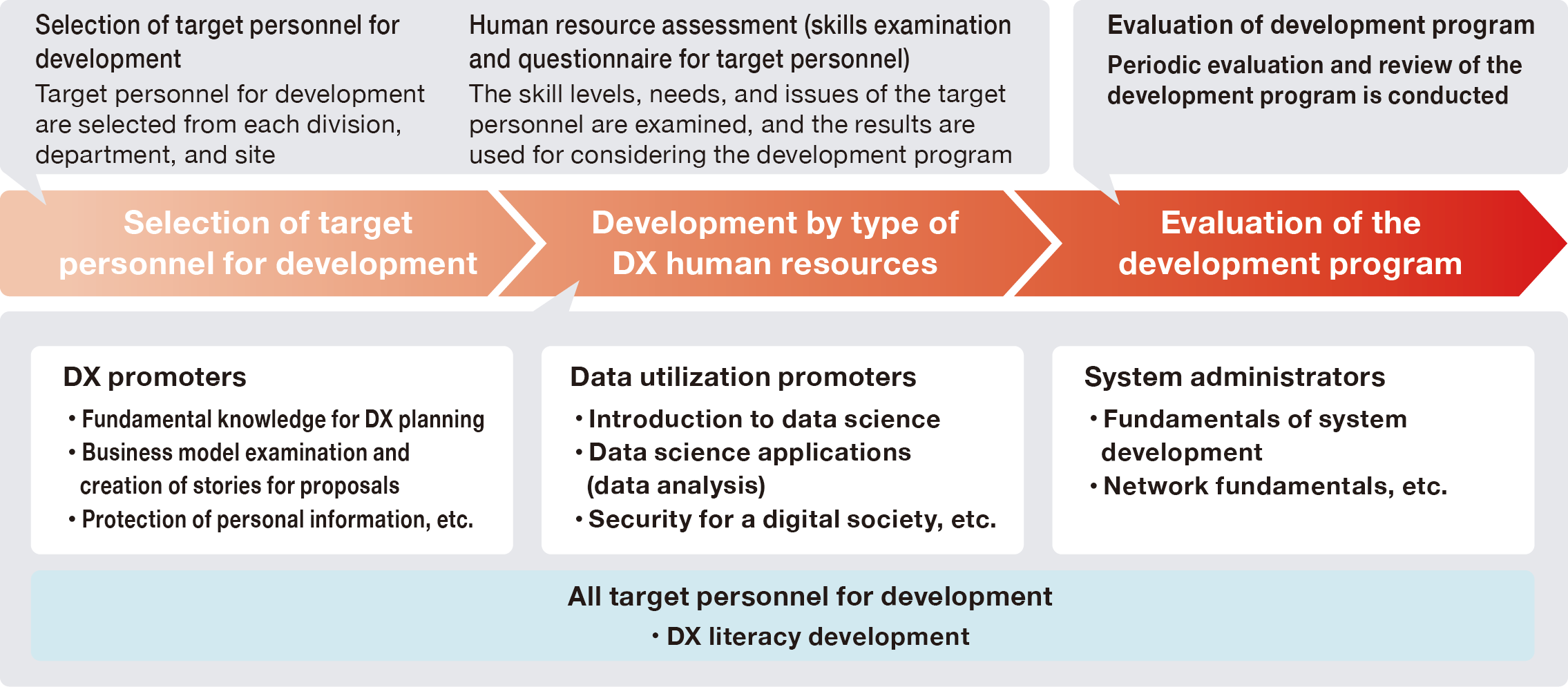
Overview of the DX Human Resources Development Program
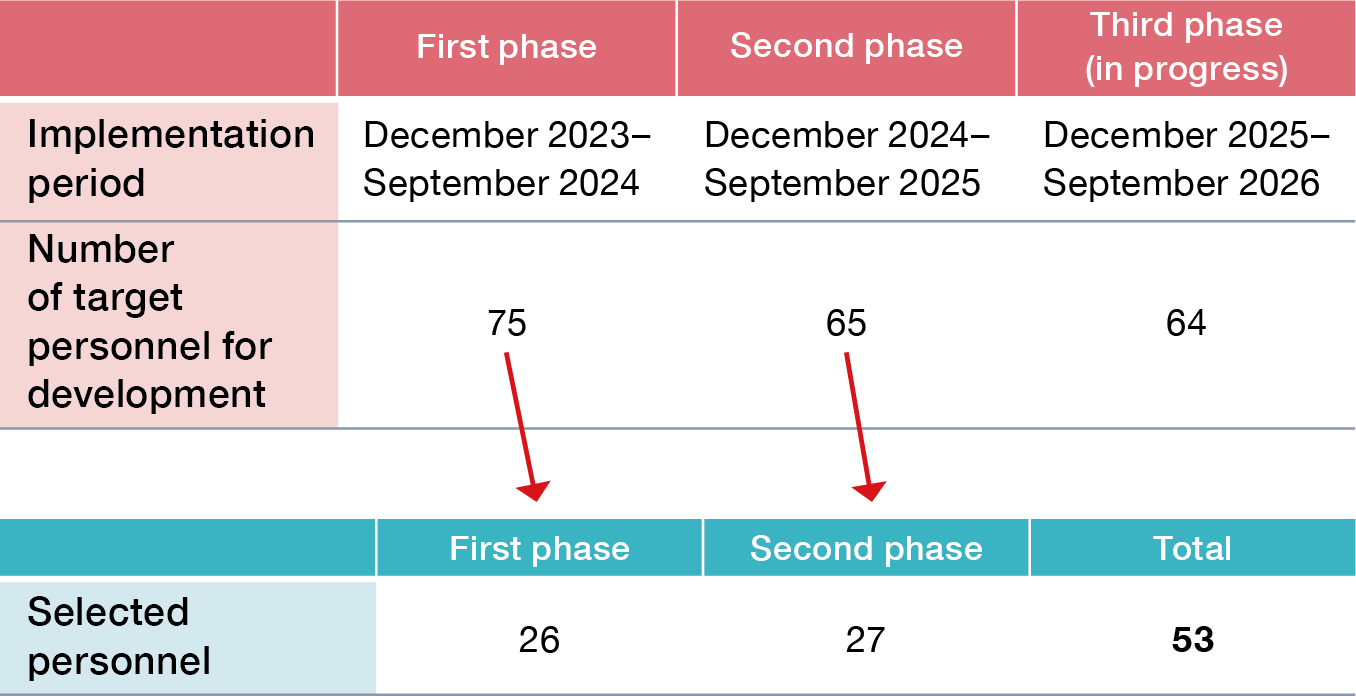
Status of initiatives for the development of
DX human resources/Number of DX Experts
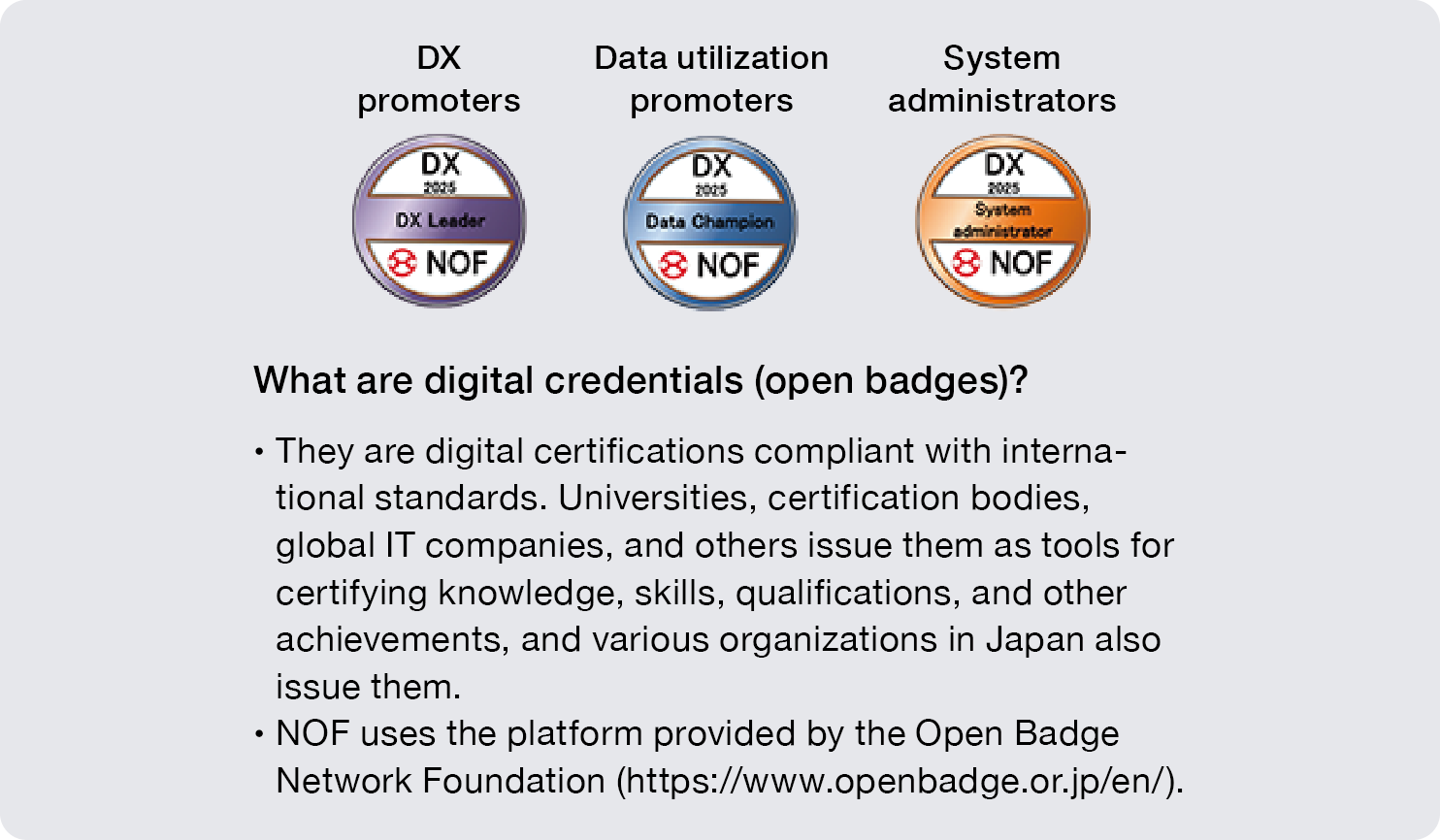
Awarding “digital credentials” to DX human resources
Overall Schedule for the DX Human Resources Development Program (Third Phase)
The DX Human Resources Development Program operates on a one-year cycle. In the third phase of the development program, participants were selected in December 2025, and basic and advanced training was conducted through August 2026. After confirming participants’ proficiency through comprehension checks and skill assessments, we will review the development program. New development program participants and DX Experts will be selected in December 2026, and the next program is scheduled to begin. The DX Experts lead DX promotion activities in their divisions and locations by participating in the “DX Liaison Meeting” and other activities.
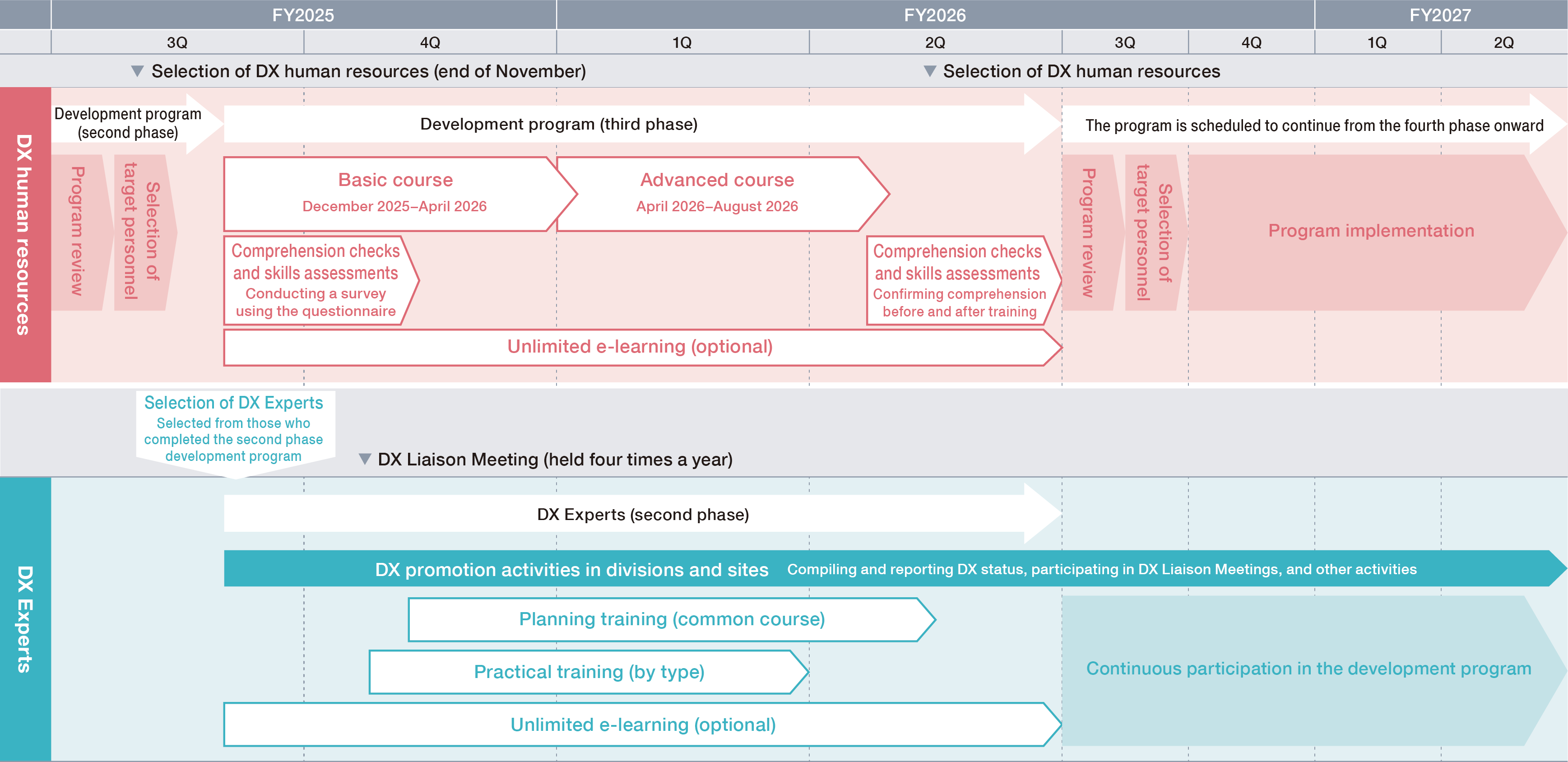
Overall Schedule for the DX Human Resources Development Program (Third Phase)
Promotion of DX
Projects requiring the introduction of technology or involving extremely high levels of difficulty are led by the Information Systems Department. For projects requiring cross-divisional or cross-system coordination, the Information Systems Department supports the relevant divisions in promoting DX.
Status of operational efficiency improvements
| Theme | Issues | DX initiatives | Progress |
|---|---|---|---|
| Improving the efficiency of quality control operations | Inspection scheduling depends on individual judgment, creating issues with person-dependent operations and efficiency | Building an inspection scheduling system using a cloud-based business platform to standardize and streamline operations | Under development for introduction in October 2026 |
| Improving the efficiency of invoice issuance operations | Extensive manual work and a heavy workload | Digitalizing invoice issuance | Migration completed by division |
| Improving the efficiency of master data applications and registration in core systems |
Extensive manual work and a heavy coordination workload | Improving the efficiency of master data application and registration operations and convenience for user divisions | Under development for introduction in November 2026 |
| Advanced use of management and operational data | Effective use of core system data | Utilizing data through a combination of ETL and BI tools | Operations have begun at a specific plant, and a data publication environment is being built for Company-wide rollout |
| Improving the efficiency of aggregation work in management accounting and creating a database |
Considering the introduction of a business management system | Considering implementation through a project team | |
| Efficient document searches | Internal documents are managed in a fragmented manner, making it time-consuming to search for and use necessary information |
Improving searchability through the introduction of a document search tool | Conducting trials of document search tools while considering a review and expand access routes to existing search methods |
| Improving productivity through Company wide business platforms | Many application and approval procedures are still paper-based | Converting application and approval procedures into workflows to reduce workloads and improve efficiency | Workflow development is progressing for Company-wide and intra-divisional operations, with a cumulative total of 150 workflows currently in operation |
| Customer information management | Fragmented customer information and sales activity data | Centralized management through the introduction of a customer relationship management platform (CRM) | Introducing and utilizing the system in stages and working to embed it in a form suited to each division’s operations |
DX Liaison Meeting
With the Information Systems Department serving as the secretariat, the “DX Liaison Meeting” is held four times a year, with the DX Experts as its primary members. In FY2025, activities included monitoring the status of company-wide DX initiatives, exchanging information among the DX Experts, and sharing expertise. We also launched “DX Portal” as a company-wide information platform and shared the results of “Project Planning Training,” in which the DX Experts participated jointly, as well as progress on activities to transform the LS Aichi Plant into a smart factory.
We also shared DX initiatives at individual divisions and locations, including a case involving the use of a video creation tool and a case involving greater efficiency in order processing at
the Daishi Plant.
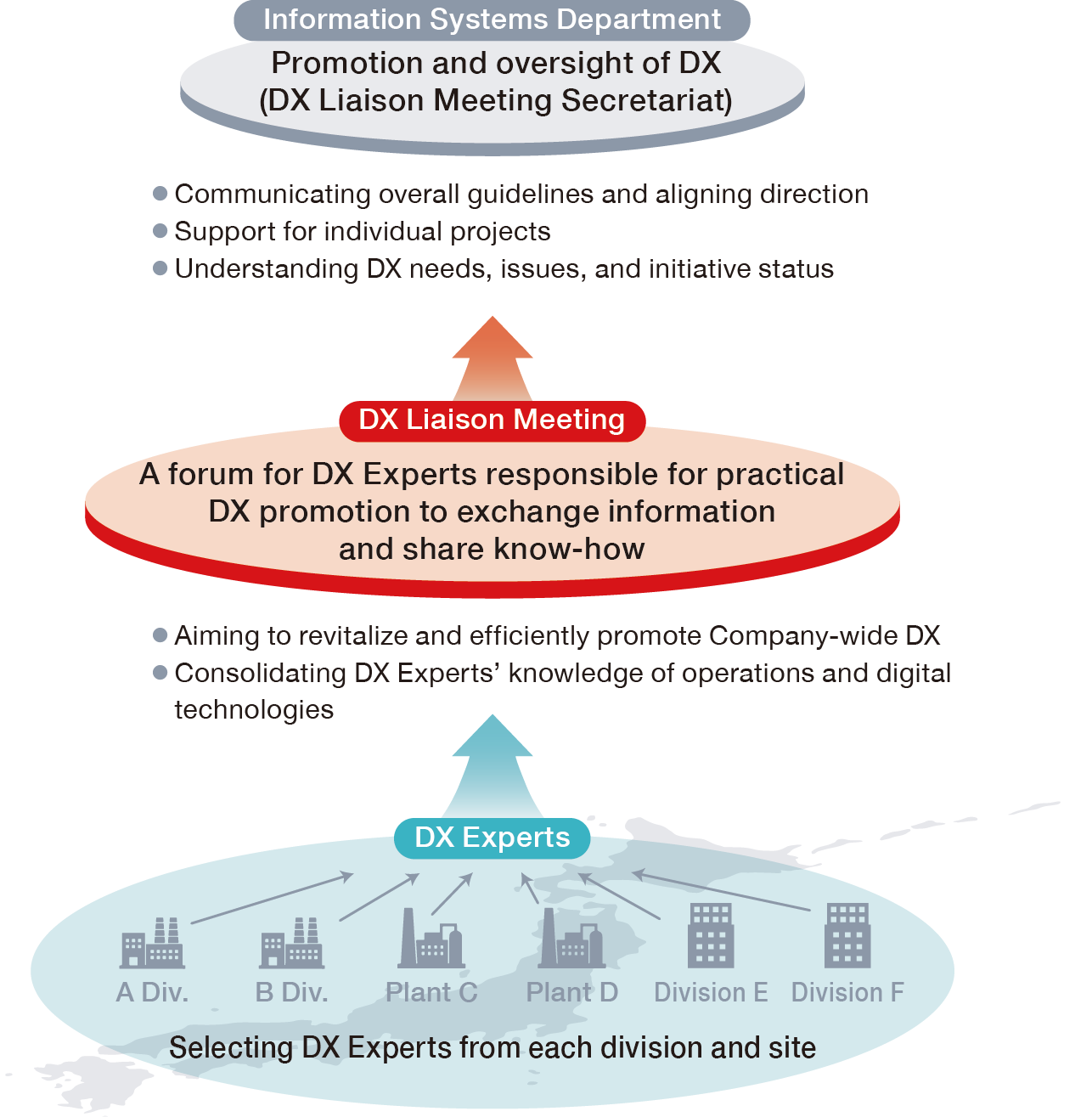
DX Liaison Meeting
Development of a data utilization environment
To realize innovation and improved productivity through data utilization, we will develop the underlying environment. In addition to infrastructure development, we are also looking into the development of a data management system, including rules and organization. By establishing these environments and systems, we will optimize manufacturing processes, improve defect rates, optimize inventories, automate production planning, conserve energy, streamline R&D operations, promote the use of intellectual property, strengthen preventive maintenance, promote occupational safety and health, visualize skills, and pass on know-how.
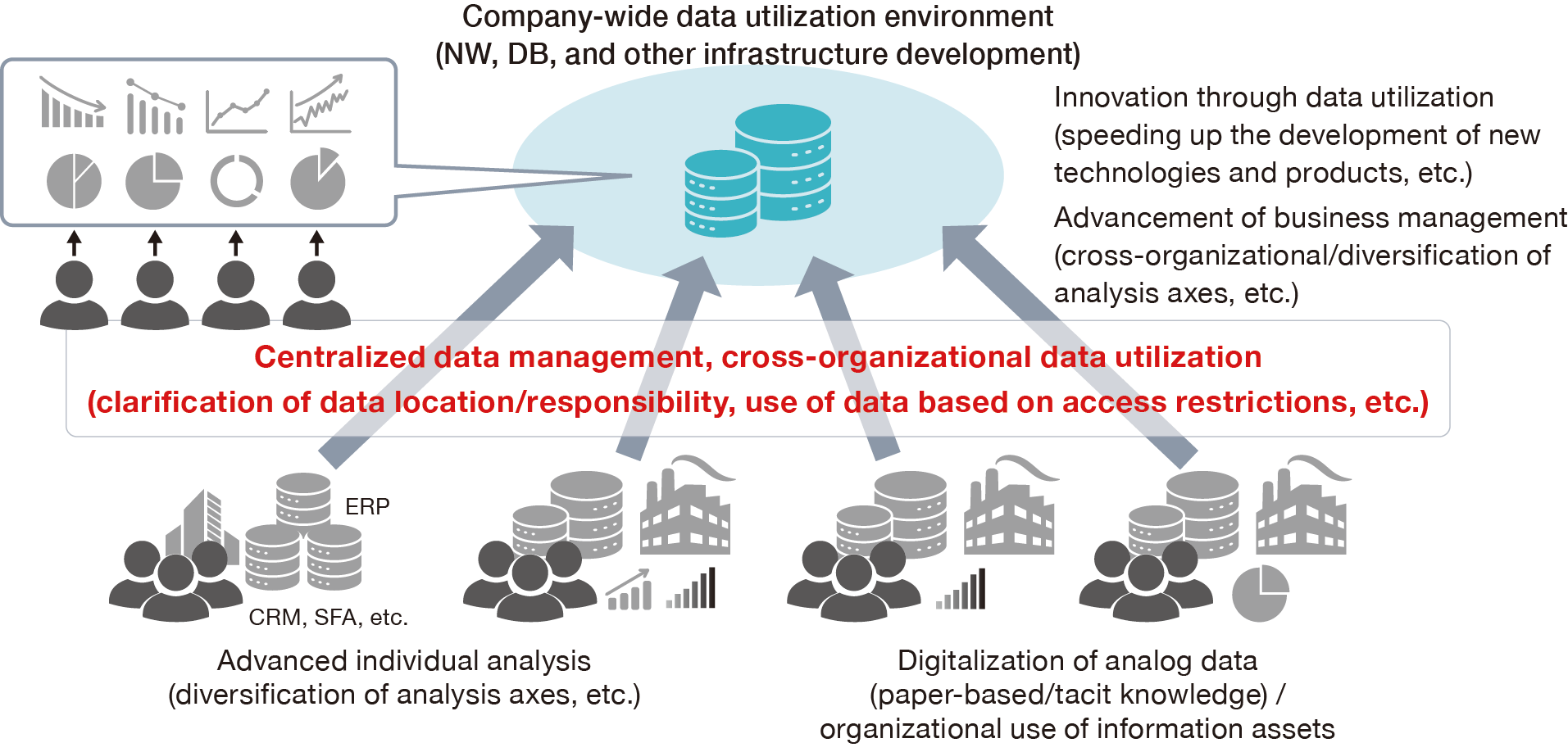
Future vision of the data utilization environment
Generative AI Utilization Strategy
In FY2025, the use of generative AI became increasingly widespread within the Company, with monthly active users reaching at least 80%. As individual employees incorporated it into their work, STEP 1, individual utilization to streamline routine work, became firmly established. The “Generative AI Utilization Promotion Liaison Meeting,” which is responsible for promoting its use, was also held four times in FY2025. This liaison meeting was established when the introduction of generative AI was being considered and, following its company-wide introduction, serves as a forum for sharing generative AI utilization status and expertise. Major activities included presenting revisions to the “Generative AI Usage Guidelines” and activities under the use case creation program. Based on these initiatives, during the period of the 2028 Mid-Term Management Plan, we will work to achieve STEP 2, business improvement through integration into workflows, and prepare for STEP 3, business transformation through the use of internal data.
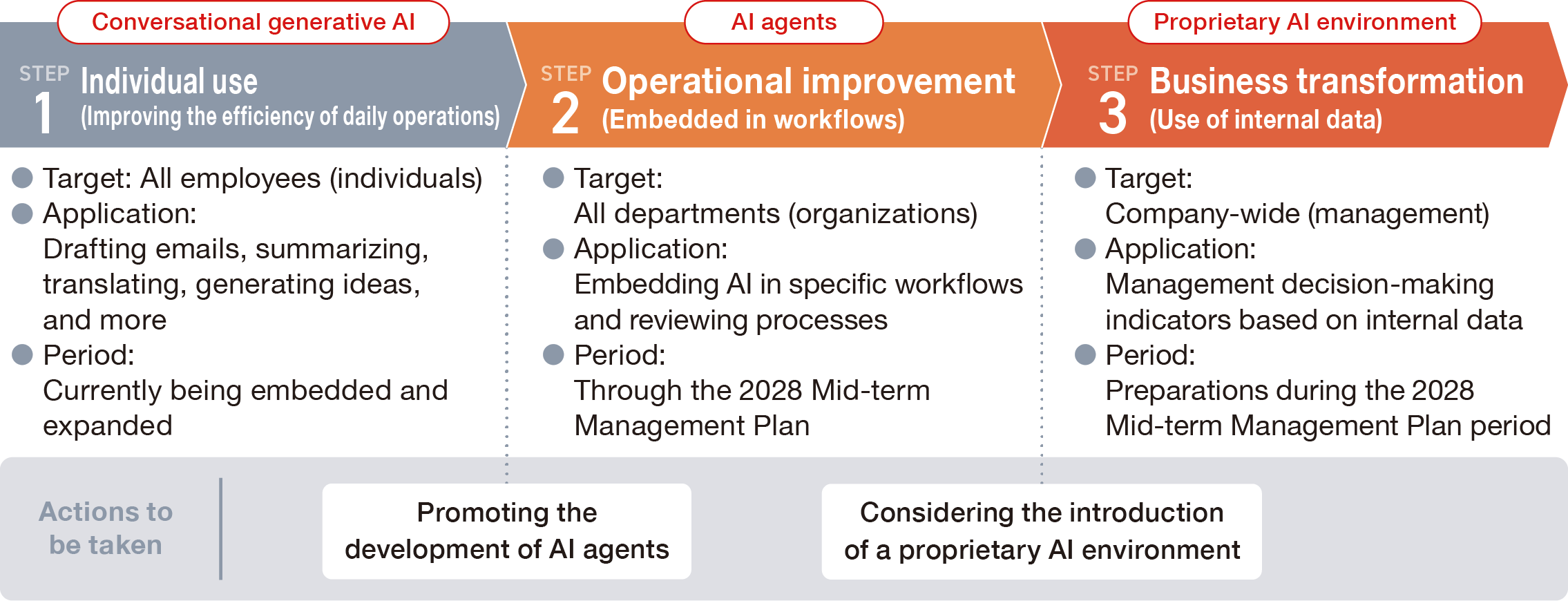
Future outlook for the use of generative AI