

Society
Occupational Safety and Health

Policy
Promote occupational safety and health
The NOF Group works to promote occupational safety and health by sharing activity targets as activities related to “occupational safety” among RC activities classified into “five components of safety,” and is developing Group-wide activities, including those of affiliated companies at all works and plants, based on the RC management system.
Occupational Safety and Health Policy
With the aim of eliminating occupational accidents, the NOF Group has clearly expressed its determination to make its workplaces secure and safe for all workers involved in Group activities, including external contractors, and to realize this ideal, set forth its Occupational Safety and Health Policy in April 2006. Based on the unwavering belief that “business cannot exist without safety,” this policy explicitly states our commitment to protecting diverse personnel “regardless of age or work experience,” including consideration for preventing occupational accidents among older employees and support for inexperienced younger employees. Beyond mere compliance with rules, we emphasize a proactive process in which all employees autonomously create safety through their daily activities. We seek to develop both a “comfortable workplace environment” in terms of facilities and an “open organizational culture” that promotes organizational learning from incidents.
Under this policy, we conduct occupational safety activities at each business site, plant, and Group company, including establishing occupational safety and health management systems, to enhance each onsite employee’s autonomous ability to protect safety and embed a robust safety culture.
Occupational Safety and Health Policy
Basic philosophy
We, as a group of chemical companies, shall endeavor to secure the safety and health of our employees and local communities in the belief that “no business can be viable without safety.” Regardless of age or work experience, all officers and employees shall build “workplaces where people can work safely and securely” through Responsible Care activities and close operational cooperation, and proactively promote occupational safety and health activities.
Fundamental principles
(1) We will operate a self-management system for occupational safety and health, and promote continuous management and improvement.
(2) We will reduce risks according to the work environment, work methods, and employees’ age, work experience, and skills, and thoroughly prevent occupational accidents.
(3) We will comply with laws and regulations concerning occupational safety and health and with the rules and standards established by our Company and Group companies.
(4) We will strive to create comfortable workplaces and an open organizational culture and maintain and improve employee health.
(5) We will ensure that all employees are fully aware of the principles.
The principles will be made widely available to the general public.
(Revised July 2026)
Occupational safety activities (RC activities)
The status of occupational safety activities at NOF’s works, plants, and Group companies is confirmed through regular RC audits. Along with audits, we are working to revitalize RC activities throughout the Group, with members of labor unions and Group companies also participating in RC audits as auditors. The results are reported to the RC Committee, as well as being shared with labor unions to develop joint labor–management activities.
Moreover, recognizing the importance of safety education, the NOF Group strives to further enhance its occupational safety and health management system and reinforce its safety activities, including promoting safety education, in an effort to ensure the safety and health of its employees.
RC Activity Targets
FY2025 safety activity results and FY2026 RC activity targets
Since fiscal 2015, we have promoted initiatives toward achieving our target of “absolutely zero accidents.”* In fiscal 2025, there were no fatalities, but 15 occupational accidents, including four lost-time accidents, occurred, and we did not achieve our target. In particular, there were three accidents involving “caught in/between” incidents, which are likely to lead to serious accidents, making it urgent to strengthen inherently safer measures.
In addition, in fiscal 2025, we worked on the elimination of unsafe behavior and unsafe conditions as a key issue under our RC activity goals, but the occurrence of nine accidents involving young and inexperienced employees with less than one year of experience (approximately 60% of the total) shows that further strengthening and review of safety education are necessary.
Based on sincere reflection on these incidents and the issues identified, in FY2026 we will prioritize the following initiatives to “build a culture of safety and security.”
- Building the Foundation of a Safety Culture (Understanding and passing on lessons from accidents)
We will enhance level-based and hands-on training so that employees can internalize past accident cases as their own and develop into personnel capable of preventing accidents autonomously. - Adoption of Basic Safety Actions
We will prevent rules from becoming mere formalities and evolve them into “practice” in which individuals can act proactively, through measures such as thorough pointing-and-calling and compliance with guidelines. - Prevention of Accidents Caused by Entrapment/Entanglement or Heatstroke
Based on the principle of the three actuals, we will identify risks by looking squarely at the actual workplace, actual items, and actual situation, and promote the inherent safety of equipment.
FY2026 RC Activity Targets and Occupational Safety Initiatives at NOF Group
[RC Activity Targets]
Occupational accidents:absolutely zero accidents
Traffic accidents:zero accidents causing injury to others or resulting in self-injury
[Key issues]
Through the participation of all employees and proactive risk anticipation, we aim for the following:
- Elimination of unsafe behavior and unsafe conditions
- Elimination of traffic accidents
①Building the foundation of a safety culture
②Adoption of basic safety actions
③Reduction of disaster risks
- Understanding and passing on lessons from accidents and countermeasures
- Providing and attending educational opportunities related to safety knowledge and skills
- Practicing confirmation actions (pointing and calling)
- Compliance with safety standards and guidelines
[Occupational safety]
- Strengthening measures against entrapment, entanglement, and heatstroke risks based on the three-actuals principle
- Ensuring compliance with amendments to the Ordinance on Industrial Safety and Health*
[Traffic safety]
- In-depth investigation of the causes of accidents causing harm to others and self-caused accidents
- Strengthening of education to promote awareness
Elimination of traffic accidents
In fiscal 2025, we introduced traffic safety activities unique to each works and affiliated company with the aim of reducing the number of accidents during commutes and work-related traffic accidents. Specifically, we continued to distribute pamphlets during the traffic safety week, arrange safety lectures by police stations, put up banners with road safety slogans, and prepare and disseminate maps showing near-miss traffic accidents. In FY2025, there were 31 at-fault and single-party accidents, an increase of 19 compared to the previous fiscal year, while commuting and work-related traffic accidents totaled 47, an increase of 21 compared to the previous fiscal year, requiring further initiatives.
In fiscal 2026, we will aim for zero traffic accidents through traffic safety activities involving all employees.
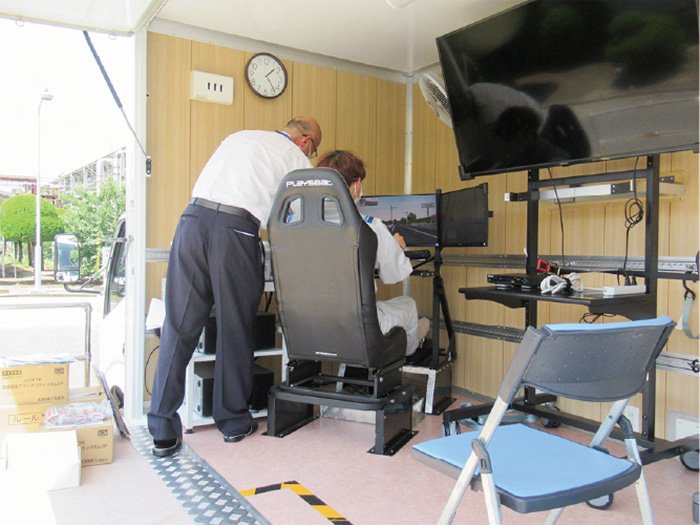
Traffic safety education (Amagasaki Plant)
Risks and Opportunities
Risks and opportunities in occupational safety and health
| Category | Major risks and opportunities | Overview |
Countermeasures |
|---|---|---|---|
| Risks | Occupational accidents |
|
①Enhancement of sensitivity toward danger and enforcement of basic
②Reduction of accident risks
|
| Mishandling of chemical substances |
|
①Enhancement of sensitivity toward danger and enforcement of basic
②Reduction of accident risks
|
|
| Traffic accidents (On-the-job accidents resulting in injury or death) |
|
①Enhancement of sensitivity toward danger and enforcement of basic
②Reduction of accident risks
|
|
| Traffic accidents |
|
||
| Transportation-related incidents |
|
①Safety instructions given to transportation companies
|
|
| Damage accident at storage |
|
||
| Fires/explosions |
|
①Strengthening of disaster prevention and security measures
②Execution of safety assessments during new construction or
|
|
| Damage or breakdown of equipment and machinery due to inappropriate maintenance and inspection |
|
||
| Opportu- nities | Growing needs for products that contribute to occupational safety and health | 【Prevention of heat stroke】Temperature indicators 【Prevention of chemical injuries】 Products free of hazardous substances (nonylphenol substitute products) |
|
Prevention and Reduction
Safety and disaster prevention capital expenditure
As part of our safety and disaster-prevention initiatives, the NOF Group has been systematically implementing facility improvement projects, including accident-prevention measures against explosions, fires, and leaks, as well as measures to enhance occupational safety and improve working environments. Further, to prepare for anticipated large-scale earthquakes, we are also systematically implementing projects to reinforce buildings against such quakes.
Major safety and disaster prevention capital expenditure (FY2025)
| Works / Plants | Purpose | Details |
|---|---|---|
| Amagasaki Plant | Safety work | Equipment for work at heights, lifting equipment for heavy objects and material storage equipment, jigs for specialized work, and emergency showers |
| Chidori Plant | Disaster prevention | Spare parts for critical equipment, disaster-prevention radios, and emergency generators |
| Oita Plant | Measures against typhoon and torrential rains | Waterproofing measures for building roofs |
| Taketoyo Plant | Safety | Entry and exit management systems and physical security equipment |
| Kinuura Plant | Working environment improvement |
Air conditioning, ventilation, and sanitary equipment |
Occurrence of occupational accidents in FY2025
Record of occupational accidents (FY2025)
| Metrics | Targets | Unit | FY2023 | FY2024 | FY2025 | |
|---|---|---|---|---|---|---|
| Accidents resulting in deaths or loss of functions*1 |
Main body of NOF (Japan) | persons | 0 | 0 | 0 | |
| Affiliate companies | persons | 0 | 0 | 0 | ||
| (Breakdown) | Japan | persons | 0 | 0 | 0 | |
| Asia | persons | 0 | 0 | 0 | ||
| Americas | persons | 0 | 0 | 0 | ||
| Europe | persons | 0 | 0 | 0 | ||
| Cooperating companies | persons | 0 | 0 | 0 | ||
| Frequency rate of accidents resulting in deaths or loss of functions*4 | ー | 0.00 | 0.00 | 0.00 | ||
| Severity rate*5 | ー | 0.00 | 0.00 | 0.00 | ||
| Lost-time injuries *2 |
Main body of NOF (Japan) | persons | 1 | 1 | 2 | |
| Affiliate companies | persons | 1 | 2 | 2 | ||
| (Breakdown) | Japan | persons | 1 | 2 | 2 | |
| Asia | persons | 0 | 0 | 0 | ||
| Americas | persons | 0 | 0 | 0 | ||
| Europe | persons | 0 | 0 | 0 | ||
| Cooperating companies | persons | 1 | 2 | 0 | ||
| Number of accidents with lost workdays | cases | 3 | 5 | 4 | ||
| Lost-time injury frequency rate*4 | ー | 0.50 | 0.80 | 0.77 | ||
| Severity rate*5 | ー | 0.012 | 0.012 | 0.027 | ||
| All accidents *3 | Main body of NOF (Japan) | persons | 3 | 9 | 7 | |
| Affiliate companies | persons | 3 | 8 | 5 | ||
| (Breakdown) | Japan | persons | 3 | 7 | 5 | |
| Asia | persons | 0 | 1 | 0 | ||
| Americas | persons | 0 | 0 | 0 | ||
| Europe | persons | 0 | 0 | 0 | ||
| Cooperating companies | persons | 2 | 2 | 3 | ||
| Overall accident frequency rate*4 | ー | 1.35 | 3.06 | 2.78 | ||
- Accidents resulting in loss of functions: Accidents causing permanent disability (disability level 5 or higher) to people who have recovered
- Lost-time injury: an accident resulting in at least one day away from work
- Including accidents without lost workdays
- Frequency rate = total number of lost-workday cases / total actual hours worked × 1,000,000
- Severity rate = total number of lost workdays / total actual hours worked × 1,000
Occupational safety and health management system
NOF Metal Coatings Europe N.V. has obtained ISO 45001 certification and provides a safe and healthy workplace environment while preventing occupational accidents.
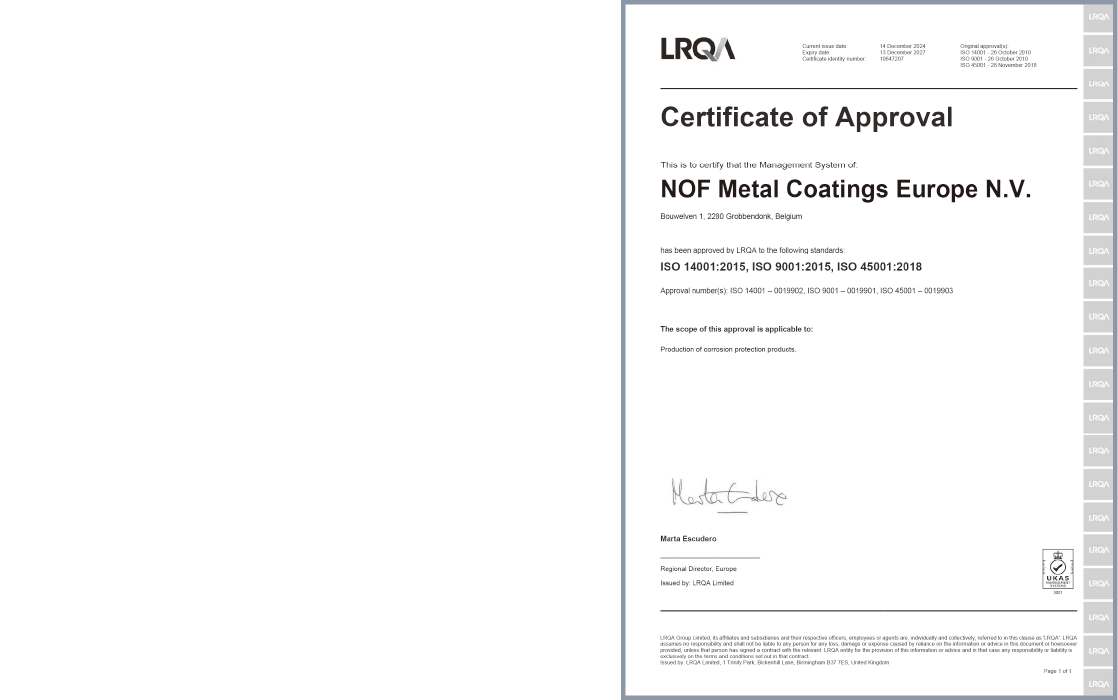
Implementation of alerts
As part of our occupational safety activities, the Responsible Care & Plant Investment Department, Corporate Technical Division, which oversees RC activities, sends out periodic and ad-hoc alerts on occupational safety, notifications on instructions or surveys regarding safety activities, etc., and disseminates them across all Group companies. We periodically implement safety and security measures for long holidays, ensure through implementation of heat stroke prevention measures during the summer, etc. On an ad-hoc basis, we issue additional alerts and instructions on measures when a disaster occurs or a typhoon approaches or whenever necessary. The Responsible Care & Plant Investment Department collects information on the status of these alerts, and provides feedback at RC audits and other forums to strengthen safety measures and raise employee awareness.
Investigation of causes of disasters, implementation of measures to prevent recurrence, and horizontal deployment of information
In the event of an occupational accident, it is important to quickly investigate the causes and plan and implement emergency and permanent measures. Such information is disseminated to each Group company for horizontal deployment in an effort to prevent similar disasters. In FY2025, we prioritized the “elimination of unsafe behaviors and conditions” and promoted safety activities involving all employees. However, occupational accidents occurred primarily among inexperienced employees, causing us to fail to achieve our target. As a result, the occupational accident frequency rate for the entire NOF Group was 2.78, indicating that further improvement is required compared with the chemical sector average of 1.19. We will strengthen our accident prevention measures
in FY2026.
In light of accidents among inexperienced employees with less than one year of service and the growing number of older workers, we will focus in FY2026 on “building the foundation of a safety culture,” including among managers. By reliably passing on lessons learned from past accidents and continuing hands-on education based on training curricula for each organizational level, we will enhance sensitivity to hazards and practical on-site capabilities. Through this, we aim to achieve “absolutely zero accidents.”
Furthermore, in FY2026 we will ensure full compliance with “NOF Group Adoption of Basic Safety Actions” and thoroughly practice “pointing and calling” in daily operations to establish “basic safe behaviors” and “reduce accident risks,” fostering a workplace culture where employees call attention to one another’s unsafe behavior rather than overlooking it. We will also strengthen risk countermeasures for accidents caused by entrapment/entanglement or heatstroke based on Sangen Shugi (the “three actuals” principle).
Through these initiatives, we aim to thoroughly mitigate the risk of disasters and prevent a recurrence while further deepening a truly autonomous safety culture throughout the entire Group.