

Environment
Chemical Safety

Policy
Policy (our fundamental view)
The NOF Group regards chemical safety as an important responsibility and prioritizes the following measures to improve chemical safety and realize a sustainable society:
- Assessment of product hazards and environmental impact
- Identification of potential hazards and implementation of countermeasures
- Updating product information and verifying legal compliance
- Ensuring safety during transportation
- Establishing emergency response systems
Specific actions for each measure under the policy are described below:
1.Assessment of product hazards and environmental impact
We collect and organize information on environmental impacts and hazards from the product development stage. This enables us to classify and grade hazards, clarify applicable regulatory requirements, and ensure safety throughout all processes, from manufacturing, handling, storage, and distribution to disposal. Our main initiatives are presented below:
Domestic chemical substance management
Response to relevant laws and regulations
In Japan, prior notification of new chemical substances is mandatory, pursuant to the Act on the Evaluation of Chemical Substances and Regulation of Their Manufacture, etc. (Chemical Substance Control Law) and the Industrial Safety and Health Act. To comply with the aforementioned laws and other regulations related to new chemical substances, NOF has established the Standards for the Management of New Chemical Substances and manages and operates the handling of new chemical substances accordingly. Figure 1 on the following page shows the system diagram, Figure 2 shows the inspection flow, and Figure 3 shows the management flow.
When beginning the manufacture of a new chemical substance, the Corporate Technical Division verifies that the notification draft prepared by the relevant business division meets legal requirements, ensuring that appropriate notification is submitted. In addition, to prevent manufactured or imported quantities from exceeding the approved amounts, the relevant business division manages the total quantity, while the Corporate Technical Division thoroughly oversees this management through internal audits. Furthermore, the Corporate Technical Division provides comprehensive training to all personnel involved in new chemical substance applications and management, as well as relevant legal training for those responsible for chemical substance applications and management. This training is conducted annually at each site to ensure the latest information is consistently shared.
When reporting actual manufacturing and import volumes of general chemical substances, priority assessment chemical substances, and other substances under the Chemical Substances Control Law, we provide appropriate reports together with end-use information from customers.
Engagement with industry associations
NOF also positively discloses information on the risks and other negative aspects of chemical substances through the Japan Initiative of Product Stewardship, which is the chemical industry’s institution for voluntary activities for the control of chemicals.
In addition, we participate in the Long-Range Research Initiative (LRI) implemented through the Japan Chemical Industry Association (JCIA), support research that leads to safety and security from a viewpoint that a company should “meet the needs of society,” and work together to solve social issues. Furthermore, as a member of the CMP Consortium (Chemical & Circular Management Platform Consortium), which was reorganized from the Joint Article Management Promotion-consortium* (JAMP), we use chemSHERPA, a tool operated by the CMP Consortium for communicating chemical substance information, to provide information to downstream users handling articles such as parts and molded products.
Proper management of polychlorinated biphenyl (PCB)
The NOF Domestic Group properly stores and manages polychlorinated biphenyl waste in accordance with the Law Concerning Special Measures Against PCB Waste, and disposes of such waste by commissioning disposal operators as prescribed by laws and regulations.
All treatment of high-concentration PCB has been completed as of the end of March 2023, the final deadline for treatment. For low-concentration PCBs, we are systematically replacing equipment in advance of the treatment deadline at the end of March 2027.
Promotion of lead-free products
In Japan, we promote initiatives to remove lead from pyrotechnic products such as detonators containing lead, which may cause water pollution, and we provide them as sustainability-contributing products. (For details, see this page.)
System diagram and Flow
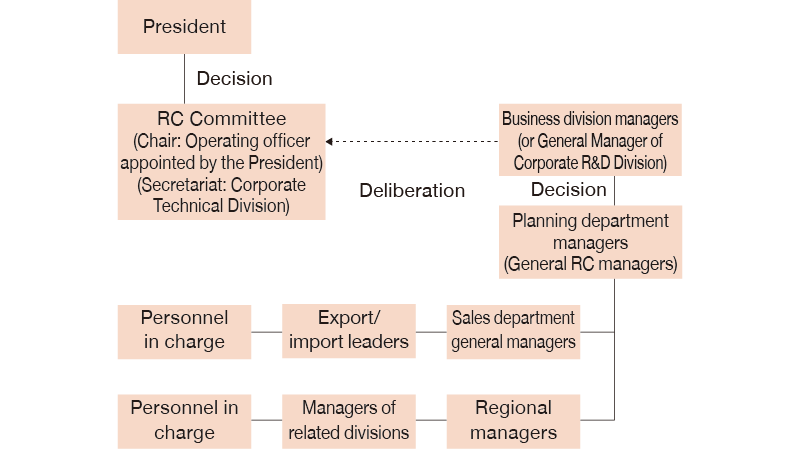
System Diagram of Production, Sales, Export, and Import of New Chemical Substances, Etc.
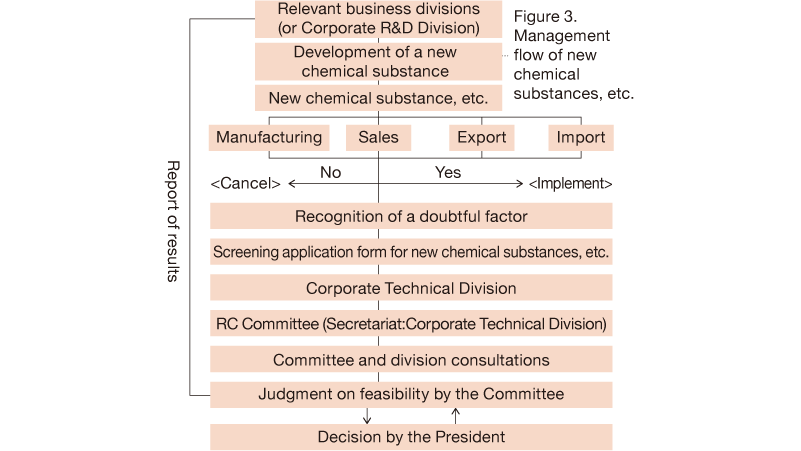
Inspection Flow of New Chemical Substances, Etc.
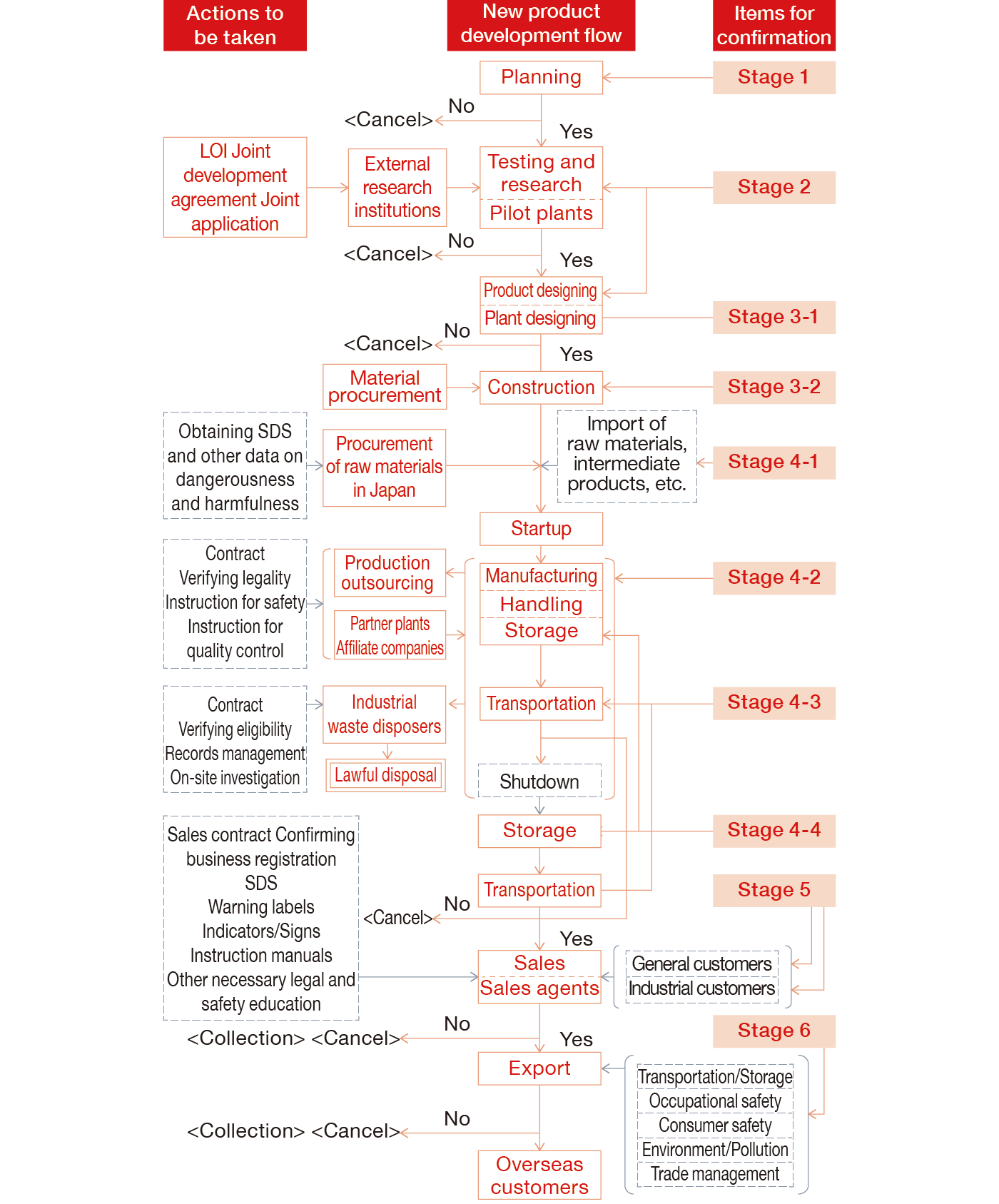
Management Flow of New Chemical Substances, Etc.
Items for Confirmation in Management Flow of New Chemical Substances, Etc.
| Stage | Principal items for confirmation |
|---|---|
| 1 | ①Quality planning (terms of use and impact on the environment, quality of competitors’ products, performance demanded by customers, selling points), ②Trademark/Patent, Response plan to laws and regulations in Japan and overseas, ③Development plan (system, schedule, R&D expenses, safety test expenses, etc.), ④Production plan (production processes, facilities for research and trial experiments), ⑤Sales and export plan, ⑥Profit and loss plan |
| 2 | ①Confirmation of the details of marketability and salability (functions, safety, container/package, transportation method, measures against industrial wastes, expenses for production and selling, sales prices, energy saving issues, etc.), ②Establishment of production processes and analysis/inspection method, ③Research for the necessity of GLP and GMP ④Research for specific value, reactivity, and explosiveness, ⑤Confirmation of safety test expenses, etc., ⑥Application of new chemical substances (Chemical Substances Control Law and Industrial Safety and Health Act), ⑦Research for CAS, TSCA, HCS, CEPA, WHMIS, EINECS, REACH Regulation, FD&C Act, etc., ⑧Confirmation of SDS, warning labels, indications and signs, instruction manual, information on each type of toxicity, ⑨Sales manual, ⑩Contract details, ⑪Application for patent and trademark, ⑫Retention of documents and records |
| 3-1 | ①Evaluation of cleaner production (reduction of wastes and prevention of generation), ②SA on safety and disaster prevention for equipment, processes, and operations (including health problems), ③Judgment on the effectiveness of the investment |
| 3-2 | ①Industrial Safety and Health Act, ②High Pressure Gas Safety Act, ③Fire Service Act, ④Explosives Control Act, ⑤Act on the Prevention of Disaster in Petroleum Industrial Complexes and Other Petroleum Facilities, ⑥Air Pollution Control Act, ⑦Ozone Layer Protection Law, ⑧Energy Saving related Laws, ⑨Water Pollution Prevention Act, ⑩Noise Regulation Law and Vibration Regulation Law, ⑪Offensive Odor Control Law, ⑫Waste Management and Public Cleansing Act, ⑬Act on Prevention of Marine Pollution and Maritime Disaster, ⑭Building Standards Act, ⑮Poisonous and Deleterious Substances Control Act, ⑯Act on Securing Quality, Efficacy and Safety of Products Including Pharmaceuticals and Medical Devices, ⑰Food Sanitation Act, ⑱Chemical Substances Control Law, ⑲Agricultural Chemicals Regulation Act, ⑳Act on the Regulation of Radioisotopes, etc. ㉑Port Regulations Law, ㉒Civil Aeronautics Act, ㉓Road Transportation Act, ㉔Factory Location Act, ㉕Municipal ordinances on prevention of fire, pollution, etc. |
| 4-1 | ①Prior confirmation of the presence of dangerous and harmful substances, ②Examination of laws and regulations for the relevant substance, ③Securing sufficient labor for SDS, warning labels, indications and signs, instruction manual, and others |
| 4-2 | ①Building Standards Act, ②Fire Service Act, ③Explosives Control Act, ④High Pressure Gas Safety Act, ⑤Act on the Prevention of Disaster in Petroleum Industrial Complexes and Other Petroleum Facilities, ⑥Act on Rationalizing Energy Use, ⑦Electricity Business Act and Gas Business Act, ⑧JIS, ⑨Law for Promotion of Effective Utilization of Resources, ⑩Waste Management and Public Cleansing Act, ⑪Chemical Substances Control Law, ⑫Industrial Safety and Health Act (Article 57-4 Ordinance on Prevention of Organic Solvent Poisoning, Ordinance on Prevention of Dangers Due to Specified Chemical Substances, Ordinance on Prevention of Tetraalkyl Lead Poisoning, Ordinance on Prevention of Lead Poisoning, Ordinance on Prevention of Dangers Due to Dust, Ordinance of Prevention of Ionizing Radiation Dangers), ⑬Act on Securing Quality, Efficacy and Safety of Products Including Pharmaceuticals and Medical Devices, ⑭Poisonous and Deleterious Substances Control Act, ⑮Food Sanitation Act, ⑯Agricultural Chemicals Regulation Act, ⑰Act on the Regulation of Radioisotopes, etc., ⑱Implementation of SA, SOP, and measures for health problems, ⑲PM system, ⑳QA (ISO 9000 series and JIS Z9900 series), ㉑The completion of SDS, warning labels, indications and signs, instruction manual, etc. |
| 4-3 | ①Explosives Control Act, ②High Pressure Gas Safety Act, ③Poisonous and Deleterious Substances Control Act, ④Fire Service Act, ⑤Act on the Regulation of Radioisotopes, etc., ⑥Railway Operation Act, ⑦Road Transport Vehicle Act, ⑧Road Act (underwater tunnel), ⑨Ship Safety Act, ⑩Port Regulations Law, ⑪Act on Prevention of Marine Pollution and Maritime Disaster, ⑫Maritime Traffic Safety Law, ⑬Civil Aeronautics Act, ⑭Postal Act, ⑮Others (carrying documents, qualification, vehicle, container, loading standards, and indications and signs) |
| 4-4 | ①Confirmation of precautions for indication/sign, ②Confirmation of precautions for storage |
| 5 | ①General and industrial customers: distribution of warning labels, indications and signs, and instruction manual, ②Industrial customers: SDS, quality warranty card, contract, confirmation of business registration, etc. |
| 6 | ◎Transportation/Storage ①UN, IMO (each code of IMDG, IBC, BC), ICAO, IATA, ②Europe: ADR, RID, REACH Regulation/CLP Directives, EC Directive ③US: 49CFR, CHEMTREC, NFPA, HCS, etc. ◎Occupational safety ④HCS, SDS, warning labels, indications and signs, instruction manuals, etc. ◎Consumer safety ⑤In addition to items presented in ④ above, product liability insurance and warranty card (limitation of warranty) ◎Environment/Pollution ⑥US: CAA, CWA, RCRA, CERCLA, SARA, TSCA, HCS, ⑦Canada: CEPA, WHMIS, ⑧Europe: REACH Regulation, RoHS Directive, etc. ◎Trade management ⑨Materials for chemical weapons, ⑩Materials for narcotic drugs, ⑪Harmful chemical substances, ⑫Strategic materials (management and operation standards for strategic materials) |
International chemical substance management
Chemical substances are being subject to stricter control on a global basis. At the World Summit on Sustainable Development (WSSD) held in 2002, a target was set as part of the international agenda to “use and produce chemicals in ways that minimize significant adverse effects on human health and the environment by 2020,” in an effort to realize sustainable development. Based on this agenda, countries around the world, including emerging countries, are being encouraged to adopt and firmly establish risk-based management of chemicals and implement GHS*1. In terms of chemical substances, there is a rising trend requiring control of relevant risks from the standpoint of the entire value chain, i.e. from manufacture to disposal, while also being required to disclose information on the risks caused by chemical substances and their control to the general public, including customers and consumers.
Amid the trend toward stronger chemical substance management, the NOF Group responds in compliance with the laws and regulations established in each country and region. To this end, NOF introduced and developed a company-wide SDS (safety data sheet) information management system in FY2020 and centrally manages SDSs throughout the Company. (For details, See this page)
NOF also compiles a list of chemical substances requiring management under the POPs Convention, RoHS Directive, and other frameworks, classifies them into three ranks, and promotes thorough management and volume reductions:
①Prohibited Substances: Chemical substances whose handling is entirely prohibited
②Reduced/Restricted Substances: Chemical substances for which alternatives are considered and handling volumes are reduced
③Managed Substances: Chemical substances handled under appropriate management
We are eliminating substances in category (1) and progressively reducing the procurement, use, and sale of substances in category (2). As a specific example, following the implementation of the EU REACH Regulation*2, one NOF product was designated a substance of very high concern (SVHC*3) in 2024 and is managed as a category (3) managed substance. We will continue complying with the REACH Regulation, sharing information with customers, and taking appropriate measures.
Compliance with chemical substance laws in each country
REACH Regulation is a comprehensive system of registration, evaluation, authorization, and restriction of chemical substances within the EU. Its objectives include “protecting human health and the environment” and “maintaining and enhancing the competitiveness of the EU chemicals industry,” and it applies to almost all chemical substances exported to the EU.
In addition, we comply with chemical substance regulations in relevant countries and regions, including the U.S. TSCA (Toxic Substances Control Act), the UK’s UK-REACH, South Korea’s K REACH, and chemical substance laws in China and Taiwan. The number of registrations under these regulations is shown in the table below. The NOF Group actively engages in exporting to overseas countries, including those in the EU region, and complies with the regulations of each country and region in accordance with the export volume of the chemical substance involved. We practice appropriate compliance by obtaining the latest information from industrial associations and related authorities.
Number of Registrations Under Laws and Regulations Outside Japan (As of the end of March 2026)
| Country / Region | Chemical substance management law / system | Number*4 |
|---|---|---|
| Europe | EU-REACH (Registration, Evaluation, Authorisation and Restriction of Chemicals) | 47 |
| UK | UK-REACH (UK Registration, Evaluation, Authorisation and Restriction of Chemicals) | 11 |
| US | TSCA (Toxic Substances Control Act) | 5 |
| Canada | NSNR (New Substances Notification Regulations) | 3 |
| China | MEE Order No.7 No.12 (Provision on the Environmental Administration of New Chemical Substances, Order No.7, No. 12) | 129 |
| South Korea | K-REACH (Act on the Registration and Evaluation of Chemicals) | 91 |
| Taiwan | TCCSCA (Toxic and Concerned Chemical Substances Control Act) | 134 |
| Philippines | RA6969 (Toxic Substances and Hazardous and Nuclear Wastes Control Act of 1990) | 5 |
- Abbreviation for Globally Harmonized System of Classification and Labelling of Chemicals, which classifies the hazardous properties of chemicals according to certain globally standardized criteria and displays them in an easy-to- understand manner using pictorial labels and other means.
- Abbreviation of Registration, Evaluation, Authorisation, and Restriction of Chemicals. REACH represents the EU’s quality control regulations on chemicals and is applied to the registration, evaluation, authorization, and restriction of chemicals.
- Abbreviation for “Substances of Very High Concern.” Substances requiring particular caution because they are highly likely to adversely affect the environment or human health and may eventually be prohibited from being brought into the EU.
- Refers to Functional Materials, Life Sciences, and Metal Coatings Businesses, excluding R&D applications.
Initiatives for the Global Framework on Chemicals (GFC*)
NOF Group deeply recognizes the importance of the Global Framework on Chemicals (GFC) and is proactively advancing initiatives based on it. The GFC provides international cooperation and guidelines for the management and regulation of chemicals, with the aim of protecting both the environment and human health. The following shows the specific GFC targets that the NOF Group will tackle.
Going forward, the NOF Group will continue initiatives aligned with the GFC, striving for environmental protection and the realization of a sustainable society.
GFC Strategic Objectives—Targets *2—NOF Group Initiatives
| Target | Target description | Initiative | Initiative indicators |
|---|---|---|---|
|
Strategic Objective A: Implementation of legal frameworks, institutional mechanisms, and capabilities |
|||
|
A3 |
By 2030, companies implement measures to identify, prevent, and minimize the adverse impacts of chemicals |
①Achieve harmony with nature and society through RC activities and dialogue with society ②Reduce emissions of environmentally hazardous substances ③Implement appropriate chemical substance management |
②Curb emissions of environmentally hazardous substances: zero emissions of environmentally hazardous substances ③List and classify chemical substances requiring management under the Stockholm Convention on POPs, the RoHS Directive, and other regulations, ensure thorough management, and reduce quantities |
| A4 | By 2030, relevant stakeholders effectively prevent illegal trade and trafficking in chemicals and waste |
②Recycle waste as resources |
①Promote zero emissions: 0.10% or less each year ②Recycle waste as resources: annual waste plastic recycling rate of 99% or higher |
|
Strategic Objective B: Generation, disclosure, and accessibility of knowledge, data, and information |
|||
|
B1 |
By 2035, comprehensive data and information on chemical properties are generated and made available and accessible |
|
ー |
| B2 | By 2030, relevant stakeholders make information on chemicals in materials and products available throughout the value chain to the greatest extent possible |
|
ー |
| B3 | By 2035, relevant stakeholders generate and disclose data on chemical production and chemical and waste emissions and releases |
|
|
| B4 | By 2035, relevant stakeholders apply guidelines, best practices, and standardized tools for hazard and risk assessment and waste management |
|
ー |
| B5 | Develop and implement education, training, and awareness programs on chemical safety, sustainability, safe alternatives, and benefits by 2030 |
|
ー |
| B7 | By 2030, relevant stakeholders generate and disclose, to the greatest extent possible, data and information on concentrations in the human body, exposure sources, biota, and environmental monitoring |
|
ー |
|
Strategic Objective D: Implementation of safer alternatives and innovative, sustainable solutions in product value chains |
|||
|
D1 |
By 2030, companies consistently invest and innovate to advance sustainable chemistry and resource efficiency |
|
|
| D4 | By 2030, relevant stakeholders prioritize sustainable solutions and safe alternatives in research and innovation programs |
|
ー |
| D7 | By 2030, relevant stakeholders implement effective occupational safety and health practices and environmental protection measures throughout the supply chain |
|
|
|
Strategic Objective E: Resource mobilization, partnerships, cooperation, capcity-building and integration |
|||
|
E2 |
Strengthen partnerships and networks among relevant sectors and stakeholders by 2030 |
|
|
- Abbreviation for Global Framework on Chemicals. The framework was adopted at the fifth International Conference on Chemicals Management (ICCM5) in September 2023. It is a voluntary framework for chemicals management throughout their life cycle, carried out by diverse stakeholders across multiple sectors, with the goal of preventing or minimizing the harmful effects of chemicals and waste on the environment and human health.
- Each “strategic objective” and “target description” refers to the “GFC National Implementation Plan” on the Ministry of the Environment website. (https://www.env.go.jp/content/000311365.pdf)
Status of compliance with chemical safety-related laws and regulations
Number of Violations (Number) [Covered organizations:NOF Group]
| FY2023 | FY2024 | FY2025 |
|---|---|---|
| 0 | 0 | 0 |
2. Identification of potential hazards and implementation of countermeasures
At each stage, such as planning and pilot production, we carry out chemical substances risk assessments and organize quantified information on potential hazards in products. In particular, for ingredients with significant potential risks, we implement effective measures such as requiring appropriate protective equipment and monitoring workplace environments, based on the results of risk assessments. Our main initiatives are presented below:
Chemical substances risk assessment
The NOF Group aims to achieve “zero accidents with lost workdays” through efforts to reduce all risks of occupational accidents and prevent their occurrence.
As part of these efforts, in order to prevent occupational accidents caused by chemical substances, the implementation of chemical substance risk assessments based on the Ordinance on Industrial Safety and Health is set as one of the annual RC activity targets related to occupational safety and health, and is carried out across the NOF Group’s domestic R&D, production, and quality control divisions. During the RC Committee’s regularly held RC audits at each production site, the status of implementation (target implementation rate: 100%) is verified, ensuring a system to reliably and thoroughly address the growing number of chemical substances subject to risk assessments each year.
Handling hazardous materials
Use of protective equipment and appointment of managers
With the entry into force of the revised Industrial Safety and Health Act in April 2024, it became mandatory not only to appoint a chemical substance manager responsible for the autonomous management of chemical substances, but also to require employees handling chemical substances to wear protective equipment and to have a protective equipment manager appropriately select and manage the use of such equipment. The NOF Group is once again working to ensure the wearing of protective equipment, which it required from before, and has established a management system in line with the revised law.
3. Updating product information and verifying legal compliance
To ensure product safety, we confirm legal compliance through testing and evaluation before sales begin. Furthermore, after products are launched, we continue to collect and update hazard information and reflect the latest findings. Our main initiatives are presented below:
Disclosure regarding product safety
NOF actively discloses product safety information through a chemical risk assessment support portal (JCIA*1 BIGDr*2 *3) as part of its commitment to the safe management of chemical substances. This is an initiative to promote appropriate chemical substance management and information sharing throughout the supply chain. Since FY2012, we have published safety summaries for the following two products to improve transparency:
- Ethylenebisstearamide (Product name: ALFLOW H-50S)
- Behenic acid
These safety summaries provide detailed information on products' chemical properties, hazards, use and exposure, and recommendations for appropriate handling, helping customers and relevant stakeholders safely use and manage the products. We will continue disclosing information through the chemical risk assessment portal and thoroughly manage risks throughout product life cycles.
NOF’s website also provides product catalogs under “NOF Product Introduction,” disclosing the chemical substances and products handled and their applications.
- JCIA: Japan Chemical Industry Association
- BIGDr: The Base of Information Gathering, sharing & Dissemination for risk management of chemical products
- JCIA BIGDr: “Chemical Substance Risk Assessment Support Portal” provided by the Japan Chemical Industry Association
Initiatives to improve information accuracy in chemical substance management
The NOF Group focuses on sustainable chemical substance management and is working to improve information accuracy.
Chemical substance management system
For chemical hazards, the latest information must always be reflected in SDSs (safety data sheets) and GHS labels in accordance with GHS criteria. Appropriate disclosure provides the foundation for all relevant parties, including users, distributors, and transportation operators, to handle chemicals safely.
NOF has introduced a comprehensive chemical substance management system and works to ensure the reliable operation of a system for appropriately providing SDSs so that customers and employees can readily obtain hazard information about our products. Under a global business structure offering more than 5,000 products in 82 countries and regions, promptly responding to each country’s laws and regulations is an extremely important responsibility. The comprehensive chemical substance management system centrally manages SDSs throughout the Company, responds promptly to revisions of laws and regulations in major countries, and reflects them in a timely manner in SDSs and GHS labels issued by each business division, ensuring that customers always receive the latest chemical substance information.
To further improve the transparency of chemical substance information internally, we have also built a database within the comprehensive chemical substance management system that can track and manage information such as chemical usage and handling histories, thereby promoting the digitalization of chemical substance information. This enables us to more accurately assess risks and environmental impacts for all chemical substances handled, including raw materials as well as our own products, and use the results to formulate sustainable management strategies.
Strengthening partnerships
The NOF Group maintains dialogue with customers to continue improving products from the perspective of chemical substance management. We also collaborate and share information with industry associations and regulatory authorities to help improve chemical substance management standards across the industry.
Development of environmentally conscious products
As part of our sustainability initiatives, we use data obtained through the comprehensive chemical substance management system to promote R&D of more environmentally friendly products. We will realize a sustainable business model while meeting customer needs.
The NOF Group aims to maintain the trust of its customers and provide valuable returns to all stakeholders while pursuing sustainable management.
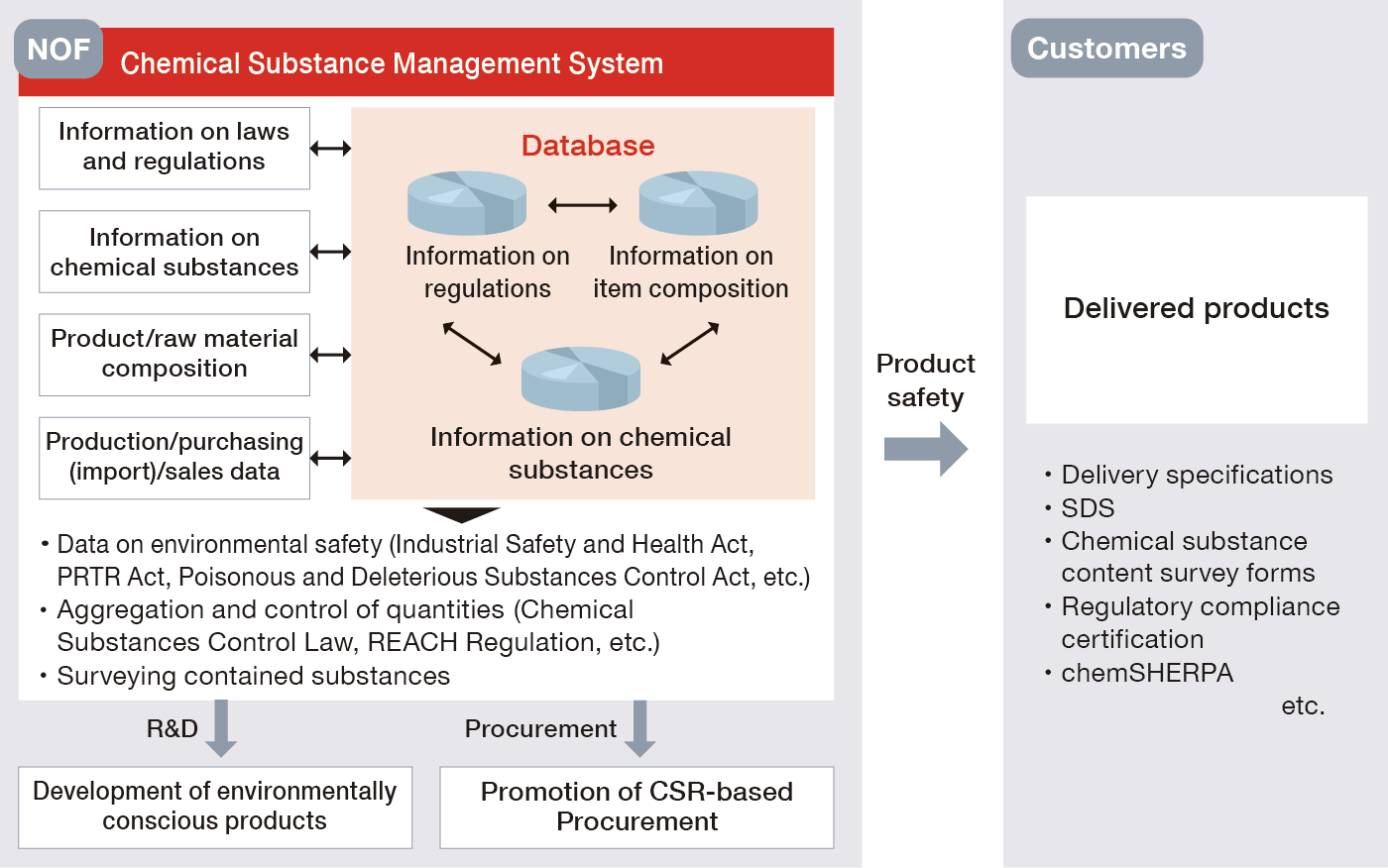
Overview of Chemical Substance Management System
4. Ensuring safety during transportation
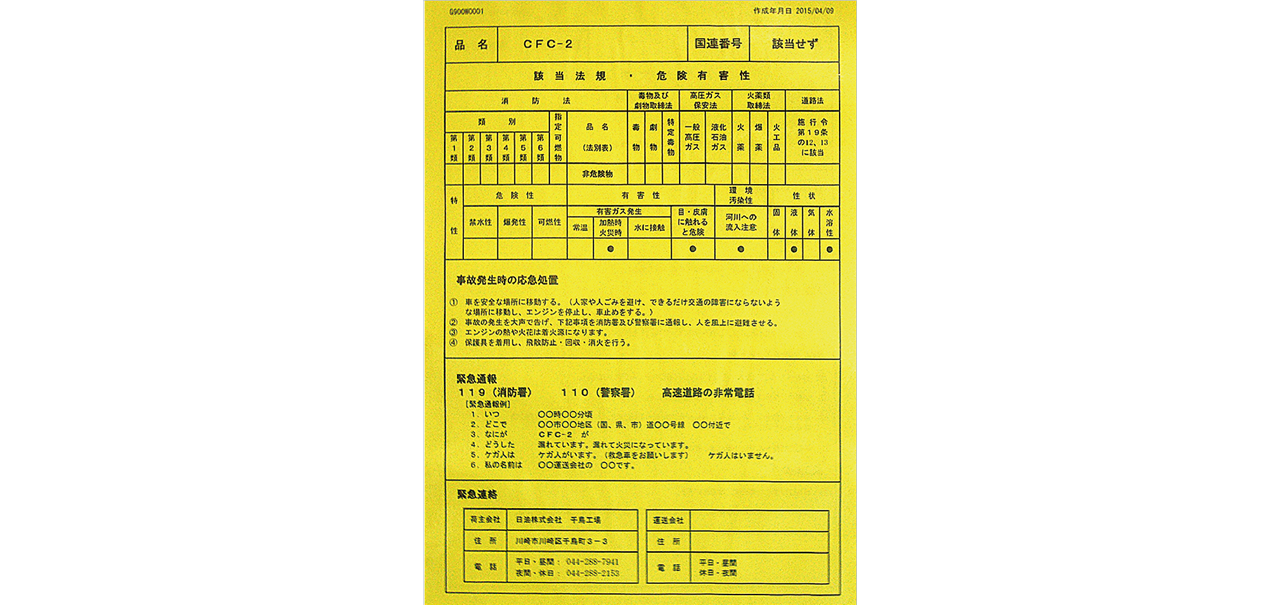
During transport, we strictly enforce the carrying of “Yellow Cards” containing chemical hazard information to ensure safety in transit. We have also established a management system for hazardous materials requiring low-temperature control. Our main initiatives are presented below:
Yellow cards
Should an accident occur during the transportation of chemical substances, it could have dire consequences on human life, the neighboring area, the cargo, and the road. The Yellow Card states the measures transport operators, the fire brigade, the police, and others should take, as well as contact and notification information, in the event of such an accident. The NOF Group strictly requires that such cards should be provided to transport operators involved, who are also required to carry the card with the corresponding product while in transportation.
Handling hazardous materials
Cold storage warehouses
For hazardous materials requiring low-temperature control, management temperatures are set for each product, and storage warehouses are monitored 24 hours a day. We also maintain private generators in preparation for power outages caused by disasters and other events.
Refrigerated trucks and reefer containers
For refrigerated trucks and reefer containers used to transport hazardous materials requiring low-temperature control, temperature and location information is monitored in real time using smartphone/GPS functions. Reefer containers are also equipped with two refrigeration units, including a backup, and a generator in preparation for interruptions of the ship’s power supply.
5. Establishing emergency response systems
We have built systems that enable prompt response in the event of unforeseen product accidents or situations requiring re-assessment.
To minimize the spread of damage inside and outside the Company, each production site has established and implemented the following measures according to the raw materials used and products manufactured:
- Disaster prevention rules, regulations, manuals, etc.
- Necessary disaster prevention equipment and materials
- Establishment of standards of conduct for all personnel
- Training disaster prevention personnel through planned drills
- Close communication systems with relevant authorities
- Procedures for preparing in advance the information that must be provided in emergencies
- Maintaining a strong safety foundation through continuous verification and improvement of the effectiveness of the immediate response system
Initiatives across the NOF Group’s Value Chain
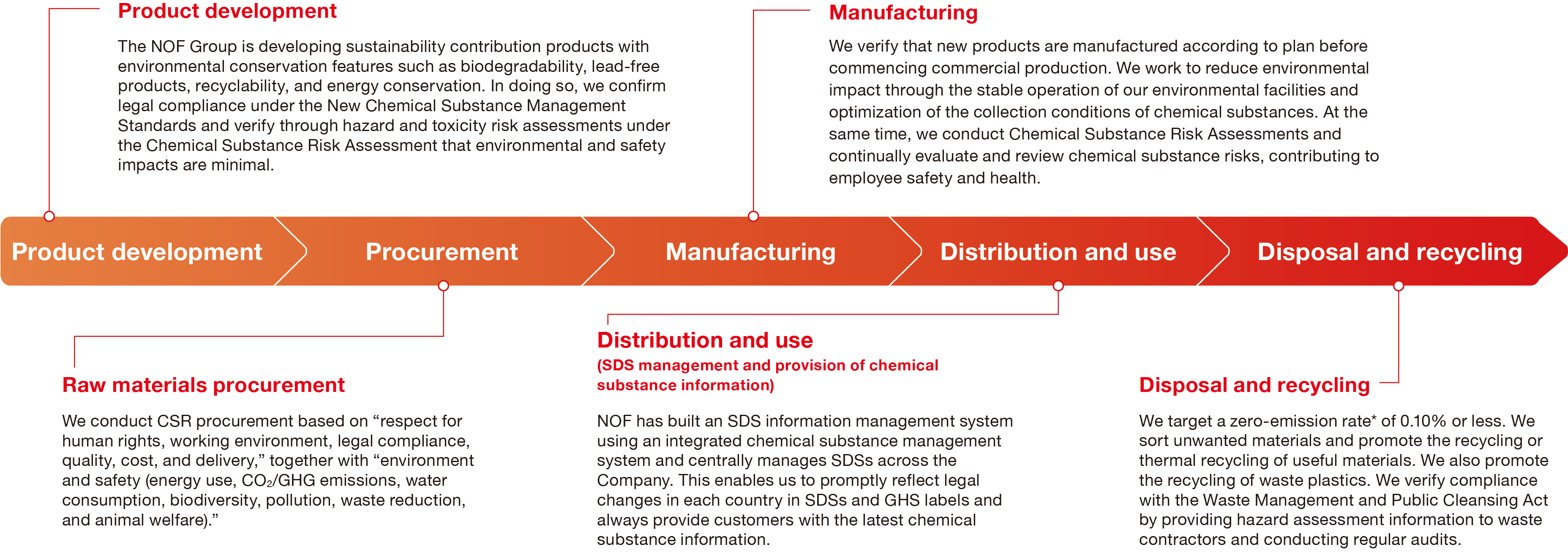
The NOF Group believes that a sound understanding of its products’ chemical properties, hazards, and impacts on people and the environment, as well as the management of risks associated with the handling of products, are fundamental to providing the market with a safe and competitive product portfolio in the future.
- Throughout the value chain, we comprehensively assess the hazards, risks, and impacts associated with each stage of the product life cycle and each product application.
- While ensuring compliance with domestic and overseas laws and regulations, we update the quality and quantity of information as needed to meet regional product information requirements, retain that information, and assure product safety.
Initiatives in the Supply Chain