Philosophy / Values
Sustainability Approach and Initiatives

Basic CSR Policy
Basic CSR Policy
We will fulfill our corporate social responsibility and conduct sustainable business activities.
1. We will, each and all, act in accordance with the highest standards of corporate ethics.
2. We will respect human rights, and enable a diversity of personnel to demonstrate their abilities.
3. We will promote Responsible Care activities, based on the five components of safety.
4. We will consider the interests of all our stakeholders.
5. We will contribute to society in cooperation with local communities.
Governance and Risk Management
Policies related to all aspects of sustainability (approach) and initiatives (highest governance body’s role)
Governance
The NOF Group recognizes sustainability matters as a corporate social responsibility and has established a system in which all Directors participate in deliberations at the Sustainability Committee chaired by the President, with Directors who are not committee members participating as observers. The Sustainability Committee meets regularly once a year and additionally as necessary.
In addition to the annual regular meeting, deliberations and decisions from meetings held as necessary are reported to the Board of Directors together with explanatory materials and minutes. The Board reconfirms the Committee’s deliberation results to provide appropriate oversight and approval. As the secretariat of the Committee, the Corporate Planning & Strategy Department, Corporate Technical Division, Human Resources & General Affairs Department, Legal Department, Purchasing Department, and Corporate Communications Department promote the formulation and specific development of sustainability strategies for the entire Group.
Strategy
The NOF Group identifies important risks and opportunities upon clarifying materiality (important issues) that could impact long-term management direction and corporate value. We have broadly classified these into three categories: “Provide new values to realize a prosperous and sustainable society” (business growth strategy from a sustainability perspective), “Strengthen the business foundation” (human capital strategy, etc.), and “Promote Responsible Care activities” (climate change response strategy, etc.). Based on key risks and opportunities, we have established long-term management strategies, individual business strategies, and sustainability-related materiality, indicators (KPIs), and targets.
Sustainability risks and opportunities
| Materiality | Risks | Opportunities | Countermeasures | |
|---|---|---|---|---|
| Strengthen the business foundation |
Create a comfortable workplace |
|
|
|
| Human capital enhancement |
|
|
|
|
|
|
|
||
| Promotion of CSR-based Procurement |
|
|
|
|
| Promote Responsible Care activities |
Response to climate change |
|
|
|
| Chemical Safety |
(Tighter domestic and international regulations)
|
|
|
|
We believe advancing strategies based on materiality creates the following financial impacts from the perspectives of (1) revenue growth, (2) cost reduction, and (3) risk management.
- Revenue growth
・Increased sales from expanding demand for sustainability contribution products
・Increased sales through improved recognition and reputation for proactive environmental conservation measures and other initiatives
・Creation of new business opportunities driven by growing interest in preventing climate change, air pollution, deforestation, and other issues - Cost reduction
・Cost reduction through resource efficiency, including reductions in water, energy, and waste
・Reduction in costs associated with taxes and other regulatory requirements by improving environmental regulatory compliance capabilities
・Lower financing costs and improved financing advantages through higher ESG evaluations - Risk management
・Minimizing environmental regulatory compliance costs
・Reducing reputational risk
・Ensuring stable raw material procurement through multiple sourcing and long-term contracts
Specific financial benefits (examples)
Advancing strategies based on materiality creates financial impacts that also provide value to stakeholders and lead to long-term returns.
Case 1: Investment in the supply chain
[Initiative]
Continued purchase of certified sustainable palm oil
[Effect]
Avoiding palm oil procurement and reputational risks while ensuring stable procurement
Case 2: Investment in local tree planting and forest maintenance
[Initiative]
Investment in tree planting and forest maintenance around plants and sales offices
[Effect]
Contributing to biodiversity conservation through maintaining and expanding forests and to the response to climate change by increasing CO₂ absorption
Case 3: Use of waste heat
[Initiative]
Use of low-pressure waste steam, high-temperature water from vessel cleaning, and heat generated when cooling exhaust gas from waste incineration equipment
[Effect]
Reducing energy costs
Case 4: Upgrading to high-efficiency equipment
[Initiative]
Upgrading compressors, pump motors, receiving, transforming and distribution equipment, boilers, refrigeration equipment, refrigerated warehouses, blowers, and other equipment to high-efficiency models
[Effect]
Reducing energy use
Risk Management
For business risks, including climate change-related and human capital-related risks, the Risk Management Committee conducts comprehensive risk assessments. The Committee meets as necessary and met four times in FY2025. The chairperson is appointed by the President from among the Operating Officers and in FY2025 was a Director concurrently serving as Executive Operating Officer. This assessment is conducted once every two years, and risk items and worst-case scenarios are reviewed each time to ensure assessments reflect the latest business environment. Each business risk is assigned to a supervising specialist committee. Climate change-related risks are handled by the Responsible Care (RC) Committee and Risk Management Committee. The RC Committee meets twice a year in principle and as necessary and met twice in FY2025. The chairperson is appointed by the President from among the Operating Officers and in FY2025 was a Director concurrently serving as Executive Operating Officer. Human capital-related risks are handled by the Risk Management Committee. Each committee monitors, analyzes, assesses, and addresses risks. Opportunities are discussed by the Executive Management Committee, Priority Business Review Committee, and other bodies, while important matters are deliberated by the Executive Committee. A system has been put in place in which the deliberation results of these specialist committees and meetings are reported to the Board of Directors
for supervision.
Metrics and Targets
The NOF Group has established sustainability-related KPIs and monitors the progress of specific measures to achieve its corporate vision set forth in NOF VISION 2030. We have established CO₂ emissions targets for responding to climate change, a key business issue, and various goals related to employee success to measure the advancement of human capital management.
In addition, we have established metrics for net sales of strategic products in the three prioritized business fields of the NOF Group, as well as for R&D investment, as KPIs for measuring business growth from the perspective of sustainability, and are monitoring these metrics.
Promotion of Sustainability
We will promote sustainability activities by increasing the frequency of activities by the Sustainability Committee, an umbrella organization chaired by the President, and the specialist committees.
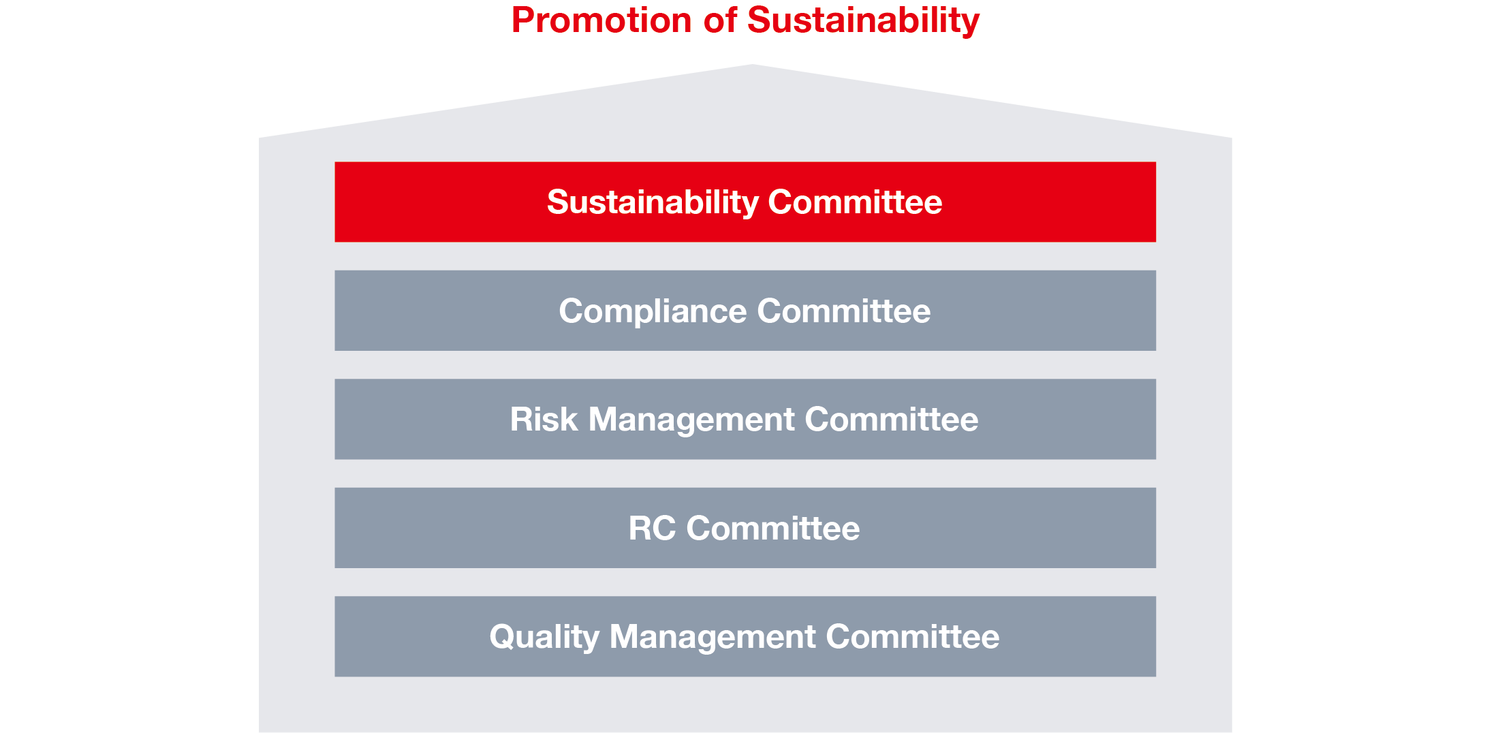
Sustainability promotion system
Sustainability of the NOF Group
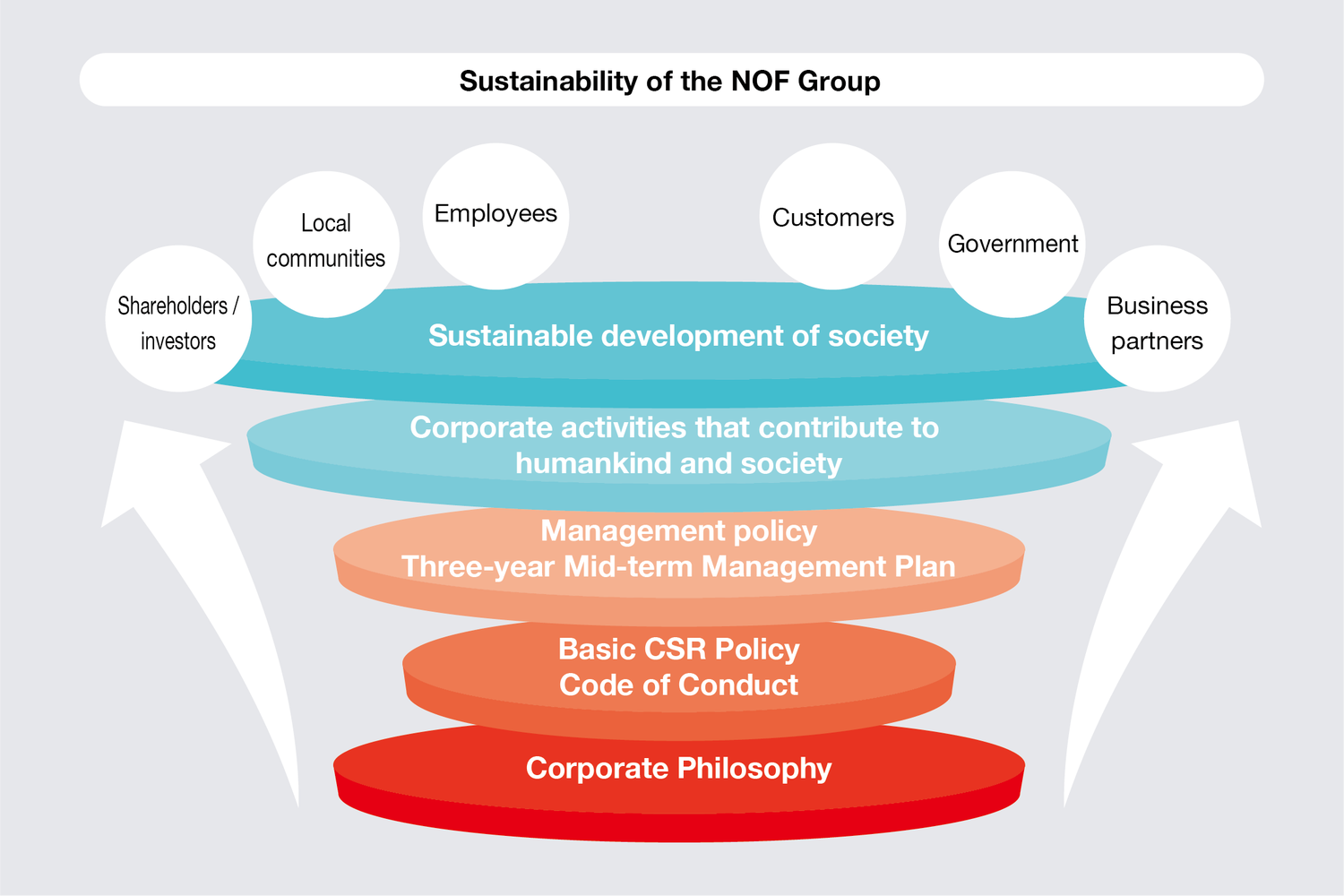
The NOF Group considers sustainability in our business activities to be encompassed by our Corporate Philosophy: “Contributing to humanity and society as a corporate group that creates new value through the power of chemistry, from the biosphere to outer space.” We will strive to maximize the values that we share with every stakeholder and with society.